
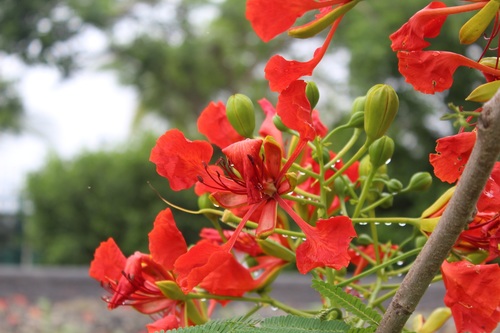


Delonix
delonix
Die Gattung Delonix umfasst prächtige, laubabwerfende Blütenbäume, die auf Madagaskar und Teilen Ostafrikas beheimatet sind und weltweit für ihre spektakulären Blütenprachten bekannt sind. Oft als Flamboyants oder Poincianas bezeichnet, werden diese Bäume für ihre weit ausladenden, schirmartigen Kronen gefeiert, die während der warmen Jahreszeit vollständig mit brillanten scharlachroten, orangefarbenen oder gelben Blüten bedeckt sind. Über ihren ästhetischen Reiz hinaus spielen Delonix-Arten eine wichtige ökologische Rolle, indem sie Schatten spenden, Böden stabilisieren und eine vielfältige Reihe von Bestäubern beherbergen. Sie haben sich bemerkenswert gut an tropische und subtropische Klimazonen angepasst, was sie zu einem der beliebtesten Zierbäume macht, die weltweit kultiviert werden.
Lebensraum: Typischerweise in tropischen Trockenwäldern, felsigen Hängen und Küstenmacchia Madagaskars zu finden, aber weltweit weit verbreitet in städtischen Gärten und Parks kultiviert.
Diese Bäume sind leicht an ihrer massiven, ausladenden Krone zu erkennen, die eine elegante, flache Schirmform bildet und typischerweise Höhen von 5 bis 15 Metern erreicht. Der Stamm ist graubraun und glatt, oft mit Brettwurzeln an der Basis. Die Blätter sind hellgrün, doppelt gefiedert und haben ein weiches, farnartiges Aussehen. In voller Blüte ist der Baum ein Farbenrausch, gekennzeichnet durch große Blüten mit vier ausgebreiteten scharlachroten oder orange-roten Blütenblättern und einem fünften aufrechten Blütenblatt, der sogenannten Fahne, das etwas größer ist und mit gelben und weißen Flecken versehen ist.
Kategorie
PflanzenSeltenheit
Gewöhnlich
Gefahr
1/5 · Sehr gering
Snaps
Mach den ersten Snap!
In Vietnam, wo der Baum um das Ende des Schuljahres blüht, wird er als 'Schülerblume' bezeichnet und hat einen nostalgischen Platz in der studentischen Kultur.
In vielen karibischen Nationen werden die trockenen, holzigen Samenschoten von Delonix als Schlaginstrument, bekannt als Shak-Shaks oder Maracas, verwendet.
Der gebräuchliche Name 'Poinciana' ehrt Phillippe de Longvilliers de Poincy, einen Gouverneur von Saint Kitts aus dem 17. Jahrhundert, der ein begeisterter Förderer des Baumes war.
Der Baum ist aufgrund seines flexiblen Holzes und seiner niedrigen, ausladenden Krone außergewöhnlich windbeständig, was ihn zu einem wertvollen Windschutz in sturmgefährdeten tropischen Küstengebieten macht.
Als photoautotrophe Pflanze erzeugt Delonix ihre eigenen organischen Verbindungen und Energie durch Photosynthese, unter Nutzung von Sonnenlicht, Wasser, Kohlendioxid und Bodenmineralien.
Altersunterschiede: Sämlinge verlassen sich auf Nährstoffreserven, die in den Samenkeimblättern gespeichert sind, bevor sie funktionelle Blätter für die Photosynthese entwickeln.
Für dieses Objekt sind noch keine Merkmal-Badges vergeben.
Sammlungen für dieses Objekt erscheinen hier, wenn weitere Themen hinzugefügt werden.
Gefahr
1/5 · Sehr gering
Noch keine besonderen Sicherheitshinweise.
Beginne mit der ganzen Pflanze und vergleiche dann Blattstellung, Blattränder, Stängel und eventuelle Blüten oder Früchte. Gegenständige Blätter wachsen paarweise, wechselständige einzeln am Stängel. Zusammen verraten diese Details weit mehr als ein einzelnes grünes Blatt. Pflanzen bestimmen: Lade ein Foto hoch und vergleiche die sichtbaren Merkmale.
500-1500 cm
2000-15000 kg
30-80 Jahre
Als photoautotrophe Pflanze erzeugt Delonix ihre eigenen organischen Verbindungen und Energie durch Photosynthese, unter Nutzung von Sonnenlicht, Wasser, Kohlendioxid und Bodenmineralien.
Typischerweise in tropischen Trockenwäldern, felsigen Hängen und Küstenmacchia Madagaskars zu finden, aber weltweit weit verbreitet in städtischen Gärten und Parks kultiviert.
12-30 Tage
Zoome hinein, um Cluster aufzulösen und zu sehen, wo dieses Objekt fotografiert wurde.
Neueste Snaps erscheinen hier, wenn neue Beobachtungen hinzukommen.

Texas, US
Hier kann man sehen Giraffen, Afrikanischer Löwe und östliches Spitzmaulnashorn.
Führer anzeigen →

Nouvelle-Aquitaine, FR
Hier kann man sehen Rosaflamingo, Giraffen und Roter Panda.
Führer anzeigen →

Kansas, US
Hier kann man sehen Lisztäffchen, Amerikanischer Bison und Puma.
Führer anzeigen →

Nevada, US
Hier kann man sehen Afrikanischer Löwe, Tiger und Zebra.
Führer anzeigen →

Andalusia, ES
Hier kann man sehen Tiger, Afrikanischer Löwe und Delonix.
Führer anzeigen →

Indiana, US
Hier kann man sehen Giraffen, Afrikanischer Löwe und Tiger.
Führer anzeigen →
Nimm die Entdeckung mit
Fotografiere deinen Fund mit Snappit, bestimme die Art und füge die Entdeckung deiner Sammlung hinzu.


















