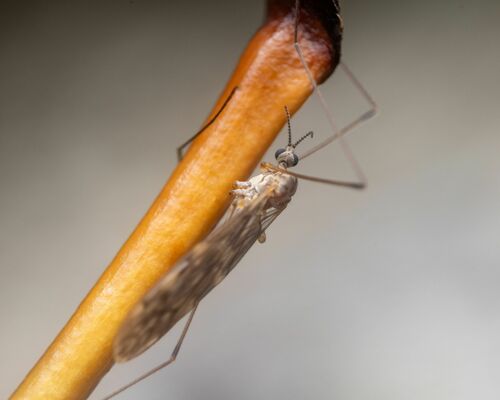





Dicranomyia marmorata
Dicranomyia marmorata
Dicranomyia marmorata ist eine spezielle Fliegenart, die schöne Muster auf ihren Flügeln hat. Diese winzigen Insekten leben gerne an feuchten Orten und sind oft in Wassernähe zu sehen, was sie zu einem lustigen Fund macht!
Lebensraum: Feuchtgebiete
Die Dicranomyia marmorata ist eine kleine, schlanke Schnake, die sich durch ihre wunderschön gesprenkelten, marmorähnlichen Flügel auszeichnet, die ihr ihren Namen geben. Sie hat einen bräunlichen oder gräulichen Körper und auffallend lange, zarte Beine, die leicht abbrechen. Dieser Fliege fehlen die stechenden Mundwerkzeuge von Stechmücken.
Kategorie
InsektenSeltenheit
Gewöhnlich
Gefahr
1/5 · Sehr gering
Snaps
Mach den ersten Snap!
Obwohl sie sehr lange, dünne Beine haben, sind diese Fliegen ziemlich langsame und ungeschickte Flieger!
Viele Schnakenlarven können tatsächlich monatelang unter Wasser leben und durch spezielle Röhren atmen!
Das 'marmorata' in ihrem Namen bedeutet 'marmoriert' und beschreibt ihre einzigartigen, gemusterten Flügel perfekt!
Sie werden manchmal mit riesigen Stechmücken verwechselt, aber diese harmlosen Insekten stechen niemals Menschen!
Larven sind die Recycler der Natur, die an verrottenden Pflanzen knabbern; Erwachsene können Nektar oder nur Wasser nippen.
Altersunterschiede: Larven sind Detritusfresser, Erwachsene ernähren sich möglicherweise von Nektar oder nur von Wasser.

Erithacus rubecula
Häufiger Gartenvogel, der verschiedene Insekten jagt.

Araneus diadematus
Fängt Fliegen oft in ihren komplexen Radnetzen.

Quercus robur
Larven gedeihen auf verrottenden Eichenblättern und Holz als Nahrung.
Mit Flecken oder farblich abgesetzten Bereichen gezeichnet.
Einzelgänger leben den größten Teil ihres Lebens allein und interagieren mit Artgenossen nur zur Paarung oder zur Aufzucht der Jungen.
Dieses Merkmal kennzeichnet Organismen, deren Ernährung sowohl pflanzliche als auch tierische Bestandteile umfasst.
Luftbewohnende Tiere verbringen einen erheblichen Teil ihres Lebens in der Luft und nutzen den Flug für verschiedene Aktivitäten wie Jagd, Wanderungen oder Nestbau.
Farbenfroh beschreibt Organismen oder Objekte, die eine große Vielfalt an leuchtenden und deutlich erkennbaren Farben aufweisen.
Dieses Lebensraummerkmal kennzeichnet Arten, die in Feuchtgebieten vorkommen. Dies sind Landflächen, die dauerhaft oder saisonal mit Wasser gesättigt sind, darunter Marschland, Sümpfe und Moore.
Beschreibt eine Art, deren Anwesenheit und Rolle einen unverhältnismäßig großen Einfluss auf ihre Umwelt haben.
Süßwasserlebensräume umfassen nicht-salzige Gewässer wie Flüsse, Seen, Teiche und Feuchtgebiete, die für zahlreiche Arten lebenswichtig sind.
Tagaktive Tiere sind hauptsächlich bei Tageslicht aktiv und ruhen oder schlafen in der Regel nachts.
Beschreibt Organismen, die Pollen übertragen und so die Befruchtung und Fortpflanzung von Pflanzen ermöglichen.
Noch keine Alternativnamen vorhanden.
Gefahr
1/5 · Sehr gering
Diese Fliegen sind harmlos, aber es ist immer gut, Insekten aus der Ferne zu beobachten.
Achte auf sechs Beine, Fühler, drei Körperabschnitte und die Form der Flügel. Käfer haben gehärtete Vorderflügel, Fliegen nur ein funktionierendes Flügelpaar. Winzige Insekten müssen oft aus der Nähe betrachtet werden, bevor ihre Gruppe klar wird. Insekten bestimmen: Lade ein Foto hoch und vergleiche die sichtbaren Merkmale.
8-15 mm
4-7 mm
7-14 Tage
5 km/h
Larven sind die Recycler der Natur, die an verrottenden Pflanzen knabbern; Erwachsene können Nektar oder nur Wasser nippen.
Feuchtgebiete
Futtersuche
Zoome hinein, um Cluster aufzulösen und zu sehen, wo dieses Objekt fotografiert wurde.
Neueste Snaps erscheinen hier, wenn neue Beobachtungen hinzukommen.
Nimm die Entdeckung mit
Fotografiere deinen Fund mit Snappit, bestimme die Art und füge die Entdeckung deiner Sammlung hinzu.