




Disholcaspis mellifica
Disholcaspis mellifica
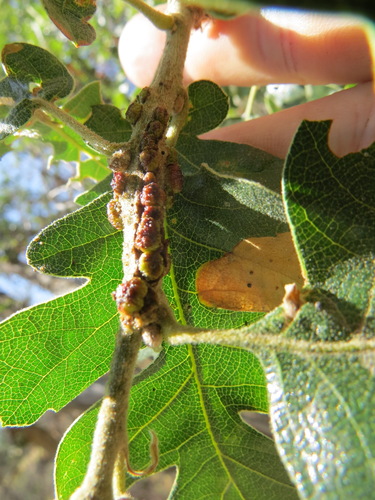
Disholcaspis mellifica ist ein winziges Insekt, das auf Eichen lebt. Es bildet Gallen, die wie kleine Behausungen für sich selbst sind, auf den Blättern. Diese Gallen können wie kleine Beulen oder Kugeln auf den Blättern aussehen.
Lebensraum: Wälder
Die Disholcaspis mellifica ist eine winzige, dunkel gefärbte Wespe, typischerweise schwarz oder dunkelbraun, mit zarten, transparenten Flügeln. Ihre kleine, kompakte Form und relativ kurzen Fühler unterscheiden sie von größeren, bunteren Wespen.
Kategorie
InsektenSeltenheit
Gewöhnlich
Gefahr
1/5 · Sehr gering
Snaps
Mach den ersten Snap!
Von dieser Wespe gebildete Gallen können manchmal für Beeren gehalten werden!
Manche Gallen enthalten viele Wespen, wie kleine Mehrfamilienhäuser!
Die Wespenlarven leben sicher in ihren selbstgebauten Pflanzenbehausungen.
Diese winzigen Wespen sind unglaubliche Meistermanipulatoren von Pflanzen.
Erwachsene ernähren sich von Pflanzenzucker, während Larven nährstoffreiches Eichengallengewebe fressen.
Altersunterschiede: Erwachsene konsumieren Nektar und Honigtau; Larven ernähren sich ausschließlich von den inneren Geweben der Eichengalle.

Quercus agrifolia
für die Induktion von Gallen, die den Larven Nahrung und Schutz bieten.
Torymus californicus
ihre Larven werden von dieser Wespe in den Gallen parasitiert.
Dryobates nuttallii
Spechte können an Gallen fressen und Larven konsumieren.
Einzelgänger leben den größten Teil ihres Lebens allein und interagieren mit Artgenossen nur zur Paarung oder zur Aufzucht der Jungen.
Baumbewohnende Tiere leben hauptsächlich in Bäumen und nutzen diese als Unterschlupf, Nahrungsquelle und zum Schutz vor Raubtieren.
Dieses Merkmal kennzeichnet Lebewesen, deren Ernährung vollständig oder hauptsächlich aus pflanzlichem Material besteht.
Beschreibt eine Beziehung zwischen zwei verschiedenen Arten, die eng zusammenleben, was oft einer oder beiden zugutekommt.
Waldlebensräume sind terrestrische Lebensräume, die von dichtem Baumbestand dominiert werden und eine große Vielfalt an Pflanzen- und Tierarten beherbergen.
Bezieht sich auf Arten, die deutlich kleiner sind als der Durchschnitt oder das Typische ihrer Art.
Beschreibt eine Art, deren Anwesenheit und Rolle einen unverhältnismäßig großen Einfluss auf ihre Umwelt haben.
Noch keine Alternativnamen vorhanden.
Gefahr
1/5 · Sehr gering
Es ist am besten, Insekten aus der Ferne zu betrachten und sie nicht zu berühren.
Achte auf sechs Beine, Fühler, drei Körperabschnitte und die Form der Flügel. Käfer haben gehärtete Vorderflügel, Fliegen nur ein funktionierendes Flügelpaar. Winzige Insekten müssen oft aus der Nähe betrachtet werden, bevor ihre Gruppe klar wird. Insekten bestimmen: Lade ein Foto hoch und vergleiche die sichtbaren Merkmale.
3-8 mm
2-5 mm
14-30 Tage
3 km/h
Erwachsene ernähren sich von Pflanzenzucker, während Larven nährstoffreiches Eichengallengewebe fressen.
Wälder
Futtersuche
Zoome hinein, um Cluster aufzulösen und zu sehen, wo dieses Objekt fotografiert wurde.
Neueste Snaps erscheinen hier, wenn neue Beobachtungen hinzukommen.
Nimm die Entdeckung mit
Fotografiere deinen Fund mit Snappit, bestimme die Art und füge die Entdeckung deiner Sammlung hinzu.