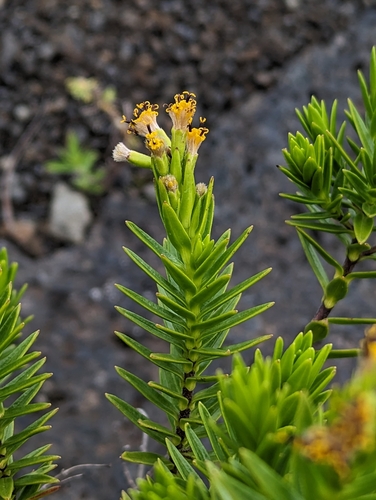


Dubautia Ciliolata
dubautia ciliolata
Dubautia ciliolata, gemeinhin als na'ena'e bekannt, ist ein bemerkenswerter immergrüner Strauch, der endemisch auf der Insel Hawaii vorkommt. Direkt aus harten, kargen basaltischen Lavafeldern wachsend, ist diese widerstandsfähige Pflanze ein Mitglied der berühmten hawaiianischen Silberschwert-Allianz. Sie repräsentiert eines der beeindruckendsten Beispiele adaptiver Radiation in der Pflanzenwelt, bei der sich ein einziger ursprünglicher Kolonist aus Nordamerika zu Dutzenden hochdiverser Arten entwickelte, die von alpinen Höhen bis zu feuchten Regenwäldern reichen. Mit ihrem kompakten, kuppelförmigen Wuchs und lebhaften Büscheln gelber Blüten bringt Dubautia ciliolata Leben in einige der jüngsten und sterilsten Landschaften der Erde. Sie dient als essentielle Pionierart, die Staub, organische Substanz und Feuchtigkeit einschließt, um die Bodenbildung auf frischen Lavafeldern anzustoßen.
Lebensraum: Gefunden in hochgelegenen subalpinen Strauchheiden und als Pionier auf kargen basaltischen Lavafeldern auf der Insel Hawaii.
Diese Pflanze ist ein kleiner, dicht verzweigter Strauch, der bis zu 150 Zentimeter hoch wird und oft eine abgerundete, kompakte Form annimmt. Ihre Blätter sind klein, steif und lanzettlich, etwa 1 bis 2 Zentimeter lang, und dicht an den Zweigen gedrängt. Ein wichtiges Erkennungsmerkmal ist das Vorhandensein feiner, wimpernähnlicher Haare an den Blatträndern. Während ihrer Blütezeit produziert sie auffällige, dichte Blütenstände an den Zweigspitzen, die kleine, röhrenförmige, leuchtend gelbe Blüten enthalten.
Kategorie
PflanzenSeltenheit
Common
Gefahr
1/5 · Sehr gering
Snaps
2
Obwohl sie wie ein kleiner Holzstrauch aussieht, ist sie eng mit dem berühmten hawaiianischen Silberschwert verwandt und teilt einen gemeinsamen Vorfahren, der vor Millionen von Jahren auf Hawaii ankam.
Ihr Holz und ihre Blätter enthalten klebrige Harze, die die Pflanze vor extremem Wasserverlust schützen und opportunistische Insektenschädlinge abwehren.
Der Artname 'ciliolata' stammt vom lateinischen Wort für Wimpern ab und bezieht sich auf den dichten Saum feiner Haare an ihren Blatträndern.
Als Fotoautotroph synthetisiert diese Art ihre eigenen Zucker unter Nutzung von Sonnenlicht, Kohlendioxid und Wasser, während sie wichtige mineralische Nährstoffe aus verwitterten vulkanischen Böden aufnimmt.
Hylaeus anthracinus
Wird von endemischen Bienen bestäubt, die sich von ihrem reichlich vorhandenen Nektar ernähren.
Capra hircus
Laub und Rinde werden stark von zerstörerischen eingeführten verwilderten Tieren abgeweidet.
Thyrocopa apatela
Bietet essenziellen Mikrohabitat und Nektar für einheimische hawaiianische Motten.
Für dieses Objekt sind noch keine Merkmal-Badges vergeben.
Noch keine Alternativnamen vorhanden.
Sammlungen für dieses Objekt erscheinen hier, wenn weitere Themen hinzugefügt werden.
Gefahr
1/5 · Sehr gering
Noch keine besonderen Sicherheitshinweise.
Der einfachste Weg, Dubautia Ciliolata zu bestimmen, ist die Verwendung der Naturführer-App Snappit.
30-150 cm
10-50 Jahre
Als Fotoautotroph synthetisiert diese Art ihre eigenen Zucker unter Nutzung von Sonnenlicht, Kohlendioxid und Wasser, während sie wichtige mineralische Nährstoffe aus verwitterten vulkanischen Böden aufnimmt.
Gefunden in hochgelegenen subalpinen Strauchheiden und als Pionier auf kargen basaltischen Lavafeldern auf der Insel Hawaii.
Zoome hinein, um Cluster aufzulösen und zu sehen, wo dieses Objekt fotografiert wurde.
Nimm die Entdeckung mit
Fotografiere deinen Fund mit Snappit, bestimme die Art und füge die Entdeckung deiner Sammlung hinzu.












.jpg&width=800)



_001.jpg&width=800)




