
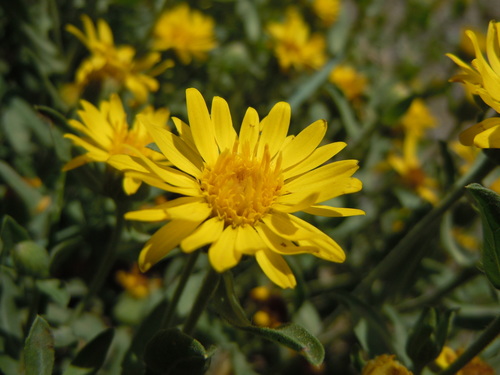


Heterotheca villosa
heterotheca villosa
Heterotheca villosa, gemeinhin bekannt als Behaarte Goldaster, ist eine widerstandsfähige, mehrjährige Wildblume, die in West- und Zentral-Nordamerika beheimatet ist. Diese zähe Aster gedeiht in rauen, trockenen Umgebungen, wo andere Pflanzen Schwierigkeiten haben, und zeigt ihre fröhlichen, gänseblümchenartigen gelben Blüten von Mittsommer bis zu den ersten Frösten. Sie wird hoch geschätzt für ihre extreme Dürretoleranz und ihre Fähigkeit, sandige oder gestörte Böden zu stabilisieren. Historisch nutzten indigene Völker die Behaarte Goldaster für verschiedene medizinische Zwecke, darunter das Brauen beruhigender Tees zur Behandlung von Atemwegsproblemen und Hautreizungen. Heute ist sie weiterhin ein wesentlicher Bestandteil einheimischer Grasländer und dient als wichtige Nektarquelle im Spätsommer für Bienen, Schmetterlinge und andere Bestäuber.
Lebensraum: Typischerweise in trockenen Grasländern, felsigen Hängen, sandigen Ebenen und offenen Kiefernwäldern zu finden.
Diese Pflanze, die zwischen 15 und 50 Zentimeter hoch wird, ist leicht an ihren graugrünen, dicht behaarten Blättern und Stängeln zu erkennen, die ihr ein weiches, staubiges Aussehen verleihen. Diese Haare schützen die Pflanze vor intensiver Sonneneinstrahlung und trockenen Winden. Ihre leuchtend gelben Blütenköpfe, etwa 2 bis 3 Zentimeter breit, bestehen aus zahlreichen Zungenblüten, die eine dunklere goldgelbe Mitte umgeben und an den Enden verzweigter Stängel sitzen.
Kategorie
PflanzenSeltenheit
Gewöhnlich
Gefahr
1/5 · Sehr gering
Snaps
Mach den ersten Snap!
In der traditionellen indigenen Medizin wurden Aufgüsse dieser Pflanze verwendet, um hyperaktive Kinder zu beruhigen und Erkältungssymptome zu lindern.
Der gebräuchliche Name 'Behaarte Goldaster' ist sehr wörtlich und beschreibt sowohl die pelzige Textur ihrer Blätter als auch den goldenen Farbton ihrer sternförmigen Blüten.
Die dichten Haare an ihren Blättern wirken wie ein natürlicher Sonnenschutz und schützen die empfindlichen Gewebe der Pflanze vor ultravioletter Strahlung in großer Höhe.
Die Pflanze ist mit dichten, feinen Haaren bedeckt, die intensive Sonneneinstrahlung reflektieren und den Feuchtigkeitsverlust reduzieren, indem sie eine Grenzschicht feuchter Luft einschließen.
Sie besitzt eine robuste, tiefe Pfahlwurzel, die es ihr ermöglicht, auf Wasserreserven tief unter der Erde zuzugreifen, was das Überleben während schwerer Dürren sichert.
Durch das Blühen im Spätsommer und Herbst vermeidet sie Hitzestress im Hochsommer und nutzt die Herbstfeuchtigkeit, während sie die Konkurrenz früher blühender Pflanzen umgeht.
Als photosynthetische Pflanze erzeugt sie ihre eigene Energie aus Sonnenlicht, Kohlendioxid und Wasser, während sie essentielle Mineralnährstoffe aus dem Boden aufnimmt.
Altersunterschiede: Sämlinge verlassen sich anfangs auf im Samencortax gespeicherte Nährstoffe, bevor sie Wurzeln und grüne Blätter entwickeln, um Photosynthese zu betreiben.
Apis mellifera
Erwachsene Honigbienen besuchen die gelben Blütenköpfe, um Pollen und Nektar zu sammeln, was die Bestäubung fördert.

Antilocapra americana
Gabelböcke fressen im Frühling das junge, zarte Laub der Pflanze, bevor die Stängel sehr faserig werden.
Junonia coenia
Erwachsene Schmetterlinge ernähren sich im Spätsommer vom reichlichen Nektar, wenn andere Blütenressourcen knapp sind.
Für dieses Objekt sind noch keine Merkmal-Badges vergeben.
Sammlungen für dieses Objekt erscheinen hier, wenn weitere Themen hinzugefügt werden.
Gefahr
1/5 · Sehr gering
Noch keine besonderen Sicherheitshinweise.
Beginne mit der ganzen Pflanze und vergleiche dann Blattstellung, Blattränder, Stängel und eventuelle Blüten oder Früchte. Gegenständige Blätter wachsen paarweise, wechselständige einzeln am Stängel. Zusammen verraten diese Details weit mehr als ein einzelnes grünes Blatt. Pflanzen bestimmen: Lade ein Foto hoch und vergleiche die sichtbaren Merkmale.
15-50 cm
3-10 Jahre
Als photosynthetische Pflanze erzeugt sie ihre eigene Energie aus Sonnenlicht, Kohlendioxid und Wasser, während sie essentielle Mineralnährstoffe aus dem Boden aufnimmt.
Typischerweise in trockenen Grasländern, felsigen Hängen, sandigen Ebenen und offenen Kiefernwäldern zu finden.
Zoome hinein, um Cluster aufzulösen und zu sehen, wo dieses Objekt fotografiert wurde.
Neueste Snaps erscheinen hier, wenn neue Beobachtungen hinzukommen.
Nimm die Entdeckung mit
Fotografiere deinen Fund mit Snappit, bestimme die Art und füge die Entdeckung deiner Sammlung hinzu.


















