

Homidia Socia
homidia socia
Homidia socia ist eine charmante Art von länglichem Springschwanz aus der Familie der Entomobryidae. Durch unbeabsichtigte menschliche Einführung weit verbreitet in gemäßigten Regionen, spielen diese winzigen, flügellosen Sechsfüßer eine entscheidende Rolle in Bodenökosystemen, indem sie den Abbau organischer Substanz beschleunigen. Sie sind sehr aktive Kreaturen, die häufig durch Laubstreu huschen oder beeindruckende Sprünge ausführen, wenn sie erschreckt werden. Als Detritivoren ernährt sich Homidia socia hauptsächlich von Pilzhyphen, Sporen und verrottendem Pflanzenmaterial. Indem sie Pilzpopulationen in Schach halten und organische Rückstände abbauen, helfen sie, essentielle Nährstoffe in den Boden zurückzuführen, was sie zum heimlichen besten Freund des Gärtners macht. Ihre Widerstandsfähigkeit und Anpassungsfähigkeit haben es ihnen ermöglicht, sowohl in wilden Wäldern als auch in stark urbanisierten Gärten zu gedeihen.
Lebensraum: Häufig in feuchten, organisch reichen Umgebungen wie feuchter Laubstreu, verrottenden Baumstämmen, Komposthaufen und Gartenmulch zu finden.
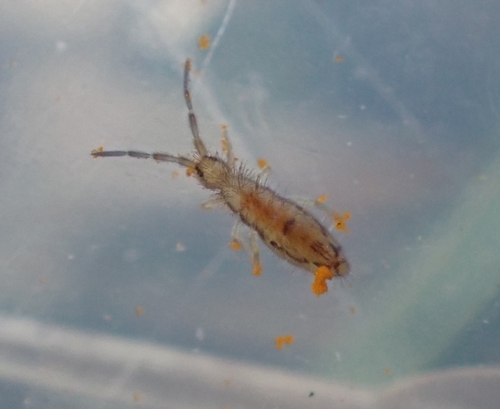
Dieser winzige Springschwanz ist extrem klein und länglich, gekennzeichnet durch einen Körper, der mit feinen, dichten Haaren bedeckt ist, die ihm unter Vergrößerung ein leicht flauschiges Aussehen verleihen. Homidia socia zeichnet sich durch seine blassgelbliche bis hellbraune Grundfärbung aus, akzentuiert durch dunkelviolettblaue oder schwarze Bänder, die quer über seine Abdominalsegmente verlaufen, besonders ausgeprägt am vierten Abdominalsegment, das auffallend länglich ist. Sie besitzen ein spezialisiertes, gabelartiges Sprungorgan, eine Furcula, das unter ihrem Abdomen verborgen ist und nur sichtbar wird, wenn es zur schnellen Flucht eingesetzt wird.
Kategorie
AnimalSeltenheit
Gewöhnlich
Gefahr
1/5 · Sehr gering
Snaps
Mach den ersten Snap!
Springschwänze wie Homidia socia sind keine echten Insekten; sie gehören zu einer alten Linie von Sechsfüßern, den Entognatha, die interne Mundwerkzeuge besitzen.
Der Gattungsname Homidia bezieht sich auf längliche Springschwänze, die von Terrarienbesitzern als Reinigungstrupps zur Kontrolle von Schimmel und Verfall sehr geschätzt werden.
Ihr Sprungmechanismus, die Furcula, wird wie eine Mausefalle unter Spannung gehalten und kann sie in Bruchteilen einer Sekunde bis zum 100-fachen ihrer Körperlänge katapultieren.
Ernährt sich hauptsächlich von mikroskopischen Pilzen, Sporen, Bakterien und verrottendem Pflanzenmaterial in feuchten Boden- und Streuschichten.
Für dieses Objekt sind noch keine Merkmal-Badges vergeben.
Noch keine Alternativnamen vorhanden.
Sammlungen für dieses Objekt erscheinen hier, wenn weitere Themen hinzugefügt werden.
Gefahr
1/5 · Sehr gering
Noch keine besonderen Sicherheitshinweise.
Beginne mit der Körperform, den Beinen oder Flossen, Fell, Federn oder Schuppen und auffälligen Zeichnungen. Berücksichtige dann Größe, Lebensraum und den Ort, an dem du das Tier gesehen hast. Jungtiere und saisonale Felle können ganz anders aussehen als die bekannten erwachsenen Tiere. Tiere bestimmen: Lade ein Foto hoch und vergleiche die sichtbaren Merkmale.
bis zu 1 Jahre
Ernährt sich hauptsächlich von mikroskopischen Pilzen, Sporen, Bakterien und verrottendem Pflanzenmaterial in feuchten Boden- und Streuschichten.
Häufig in feuchten, organisch reichen Umgebungen wie feuchter Laubstreu, verrottenden Baumstämmen, Komposthaufen und Gartenmulch zu finden.
Futtersuche
10-150
10-25 Tage
Zoome hinein, um Cluster aufzulösen und zu sehen, wo dieses Objekt fotografiert wurde.
Neueste Snaps erscheinen hier, wenn neue Beobachtungen hinzukommen.
Nimm die Entdeckung mit
Fotografiere deinen Fund mit Snappit, bestimme die Art und füge die Entdeckung deiner Sammlung hinzu.