
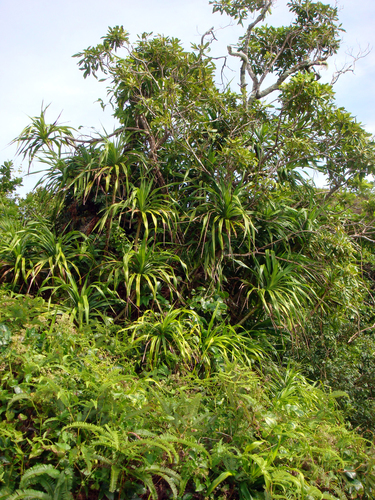


'Ie'Ie
freycinetia arborea
'Ie'Ie (Freycinetia arborea) ist eine ikonische einheimische hawaiianische Kletterpflanze, ein prominentes Mitglied des Unterwuchses und der mittleren Baumschicht hawaiianischer Regenwälder. Ihre auffälligen roten Blütenstände und ihre einzigartige Wuchsform machen sie leicht erkennbar. Als Mitglied der Familie der Pandanaceae zeigt sie faszinierende Anpassungen an ihre Inselumgebung und spielt eine entscheidende Rolle im Ökosystem, insbesondere durch ihre Interaktion mit einheimischen hawaiianischen Vögeln. Diese Art trägt wesentlich zur Biodiversität und zum kulturellen Erbe der Inseln bei, wobei ihre Früchte und Blätter historisch von den hawaiianischen Ureinwohnern genutzt wurden.
Lebensraum: Man findet sie in feuchten bis nassen Wäldern und oft auf älteren Lavafeldern, wo sie an Bäumen und Felsen klettert oder terrestrisch in schattigen, feuchten Umgebungen auf den hawaiianischen Inseln wächst.
Diese holzige Liane rankt oder klettert typischerweise mit zahlreichen kräftigen Luftwurzeln und erreicht oft beträchtliche Längen. Ihre Blätter sind spiralig entlang der Stängel angeordnet, linealisch bis lanzettlich mit fein gezähnten Rändern und werden bis zu 1 Meter lang. Das markanteste Merkmal ist ihr leuchtend roter Blütenstand, bestehend aus drei prominenten, blütenblattähnlichen Hochblättern (Spathen), die eine Ansammlung kleiner Blüten umschließen. Nach der Bestäubung entwickeln sich diese zu einer Sammelfrucht, die einer kleinen, rot-orangen Ananas ähnelt und etwa 5-10 cm lang ist.
Kategorie
PflanzenSeltenheit
Gewöhnlich
Gefahr
1/5 · Sehr gering
Snaps
Mach den ersten Snap!
Obwohl sie hauptsächlich eine Kletterpflanze ist, kann 'Ie'Ie auch terrestrisch (am Boden) oder als Epiphyt (auf anderen Pflanzen, ohne diese zu parasitieren) wachsen, was ihre bemerkenswerte Anpassungsfähigkeit an verschiedene Waldnischen zeigt.
Historisch wurden die langen, haltbaren Blätter und Luftwurzeln von 'Ie'Ie von den hawaiianischen Ureinwohnern kunstvoll zu komplizierten Körben, Matten und anderen nützlichen Gegenständen geflochten.
Die große, ananasähnliche Frucht von 'Ie'Ie ist essbar und wurde traditionell von den Hawaiianern verzehrt, obwohl sie einen ausgeprägten, etwas herben Geschmack hat.
Die leuchtend roten Hochblätter, die die 'Ie'Ie-Blüten umgeben, werden als evolutionäre Anpassung angesehen, um einheimische Vogelbestäuber anzulocken, insbesondere den 'I'iwi, dessen gekrümmter Schnabel perfekt für den Zugang zu seinem Nektar geeignet ist.
Als photosynthetische Pflanze produziert 'Ie'Ie ihre eigene Nahrung, indem sie Sonnenlicht, Kohlendioxid und Wasser in Zucker umwandelt und dabei Nährstoffe aus dem Boden oder dem Wirtssubstrat über ihr Wurzelsystem aufnimmt.
Für dieses Objekt sind noch keine Merkmal-Badges vergeben.
Noch keine Alternativnamen vorhanden.
Sammlungen für dieses Objekt erscheinen hier, wenn weitere Themen hinzugefügt werden.
Gefahr
1/5 · Sehr gering
Noch keine besonderen Sicherheitshinweise.
Beginne mit der ganzen Pflanze und vergleiche dann Blattstellung, Blattränder, Stängel und eventuelle Blüten oder Früchte. Gegenständige Blätter wachsen paarweise, wechselständige einzeln am Stängel. Zusammen verraten diese Details weit mehr als ein einzelnes grünes Blatt. Pflanzen bestimmen: Lade ein Foto hoch und vergleiche die sichtbaren Merkmale.
200-1500 cm
0.5-20 kg
20-100 Jahre
Als photosynthetische Pflanze produziert 'Ie'Ie ihre eigene Nahrung, indem sie Sonnenlicht, Kohlendioxid und Wasser in Zucker umwandelt und dabei Nährstoffe aus dem Boden oder dem Wirtssubstrat über ihr Wurzelsystem aufnimmt.
Man findet sie in feuchten bis nassen Wäldern und oft auf älteren Lavafeldern, wo sie an Bäumen und Felsen klettert oder terrestrisch in schattigen, feuchten Umgebungen auf den hawaiianischen Inseln wächst.
Zoome hinein, um Cluster aufzulösen und zu sehen, wo dieses Objekt fotografiert wurde.
Neueste Snaps erscheinen hier, wenn neue Beobachtungen hinzukommen.
Nimm die Entdeckung mit
Fotografiere deinen Fund mit Snappit, bestimme die Art und füge die Entdeckung deiner Sammlung hinzu.


















