

'Iliahi
santalum haleakalae
Die 'Iliahi, oder Haleakalā-Sandelholz (Santalum haleakalae), ist ein legendärer und kulturell bedeutender Baum, der auf den hochgelegenen vulkanischen Hängen Mauis, Hawaii, endemisch ist. Diese widerstandsfähige Pflanze, die in den rauen subalpinen Zonen beheimatet ist, hat sich an intensive Sonneneinstrahlung, extreme Temperaturschwankungen und trockene Bedingungen angepasst. Sie ist berühmt für ihr hocharomatisches Kernholz, das im frühen 19. Jahrhundert den lukrativen und verheerenden Sandelholzhandel befeuerte, der Hawaiis Sandelholzarten beinahe ausgerottet hätte. Heute ist die 'Iliahi ein geschützter Schatz des hawaiianischen Hochlandes. Was die 'Iliahi wirklich faszinierend macht, ist ihre Lebensweise als Hemiparasit. Während sie grüne Blätter zur Photosynthese besitzt, sucht und dringt ihr Wurzelsystem aktiv in die Wurzeln benachbarter Pflanzen ein, um Wasser und wichtige Nährstoffe abzuzapfen. Diese komplexe ökologische Beziehung macht den Baum außerhalb seines natürlichen Lebensraums unglaublich schwierig zu kultivieren, was die entscheidende Bedeutung des Schutzes seines ursprünglichen subalpinen Ökosystems unterstreicht.
Lebensraum: Findet sich in trockenen bis mesischen subalpinen Strauchheiden und Wäldern an den vulkanischen Hängen des Haleakalā, Maui, in Höhen zwischen 1.800 und 2.700 Metern.
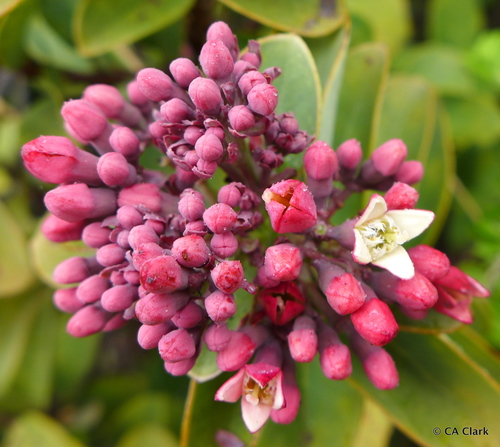
Ein mehrstämmiger, langsam wachsender immergrüner Strauch oder kleiner Baum, der Höhen von 200 bis 600 Zentimetern erreicht. Er weist dicke, ledrige und sukkulentenartige ovale Blätter auf, die olivgrün mit einem deutlichen hellen oder rötlichen Rand sind. Sein auffälligstes Merkmal sind die dichten Büschel kleiner, sternförmiger Blüten, die in leuchtenden Schattierungen von Hellrot, Orangerot oder Tiefrosa blühen. Nach der Befruchtung produziert er kleine, eiförmige Steinfrüchte, die im reifen Zustand dunkel purpurschwarz werden.
Kategorie
PflanzenSeltenheit
Common
Gefahr
1/5 · Sehr gering
Snaps
4
Im frühen 20. Jahrhundert führte das intensive königliche Monopol und der Handel mit hawaiianischem Sandelholz zur nahezu vollständigen Rodung dieser ausgewachsenen Bäume auf den Inseln.
Die Blüten der 'Iliahi durchlaufen eine dramatische Farbänderung, wenn sie reifen, von einem dezenten Grüngelb zu einem brillanten tiefen Karminrot.
Obwohl 'Iliahi selbst Photosynthese betreiben kann, würde sie ohne das Entziehen von Wasser und Mineralien aus den Wurzeln ihrer Nachbarn kaum überleben können.
Als Hemiparasit erzeugt 'Iliahi ihre eigene Energie durch Photosynthese, ist aber auf die Entnahme von Wasser, Stickstoff und anorganischen Nährstoffen aus den Wurzelsystemen von Wirtspflanzen angewiesen.
Altersunterschiede: Verlässt sich als Sämling zunächst auf Samenvorräte, bevor es die parasitischen Haustorien entwickelt, die zur Anheftung an eine Wirtspflanze erforderlich sind.
Für dieses Objekt sind noch keine Merkmal-Badges vergeben.
Noch keine Alternativnamen vorhanden.
Sammlungen für dieses Objekt erscheinen hier, wenn weitere Themen hinzugefügt werden.
Gefahr
1/5 · Sehr gering
Noch keine besonderen Sicherheitshinweise.
Der einfachste Weg, 'Iliahi zu bestimmen, ist die Verwendung der Naturführer-App Snappit.
200-600 cm
50-150 Jahre
Als Hemiparasit erzeugt 'Iliahi ihre eigene Energie durch Photosynthese, ist aber auf die Entnahme von Wasser, Stickstoff und anorganischen Nährstoffen aus den Wurzelsystemen von Wirtspflanzen angewiesen.
Findet sich in trockenen bis mesischen subalpinen Strauchheiden und Wäldern an den vulkanischen Hängen des Haleakalā, Maui, in Höhen zwischen 1.800 und 2.700 Metern.
Wurzelparasitismus
Zoome hinein, um Cluster aufzulösen und zu sehen, wo dieses Objekt fotografiert wurde.

Hawaii, US
Hier kann man sehen Goldstaub-Taggecko, Zitronendoktorfisch und Safranfink.
Führer anzeigen →

Hawaii, US
Hier kann man sehen ʻōhiʻa Lehua, Stinkende Passionsblume und Strandwinde.
Führer anzeigen →

Hawaii, US
Hier kann man sehen 'āhinahina, Jackson-Chamäleon und Hawaiʻi-ʻamakihi.
Führer anzeigen →
Nimm die Entdeckung mit
Fotografiere deinen Fund mit Snappit, bestimme die Art und füge die Entdeckung deiner Sammlung hinzu.











.jpg&width=800)



_001.jpg&width=800)




