
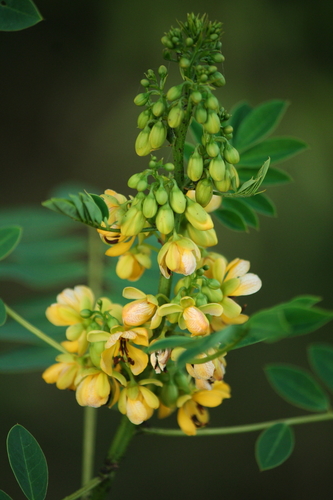


Maryland-Senna
senna marilandica
Die Maryland-Senna (Senna marilandica) ist eine charmante heimische Staude aus der Familie der Hülsenfrüchtler (Fabaceae), die Wiesen, offene Wälder und Straßenränder im östlichen und mittleren Teil der Vereinigten Staaten mit einem Spritzer fröhlichem Gelb bereichert. Diese robuste Pflanze wird nicht nur wegen ihrer attraktiven Spätsommerblüten geschätzt, sondern auch wegen ihrer bedeutenden ökologischen Beiträge. Sie dient mehreren Schmetterlingsarten, darunter dem Wandergelbling (Cloudless Sulphur), als wichtige Raupenfutterpflanze, und ihre Blüten bieten eine Fülle von Nektar für eine Vielzahl einheimischer Bienen. Über ihre Schönheit hinaus spielt die Maryland-Senna durch die Stickstofffixierung eine entscheidende Rolle für die Bodengesundheit, was sie zu einem hervorragenden Kandidaten für ökologische Restaurierungsprojekte und Gärten mit einheimischen Pflanzen macht. Ihre charakteristischen Samenhülsen, die nach der Blüte erscheinen, sorgen im Herbst und Winter für weiteres Interesse.
Lebensraum: Diese Art gedeiht in offenen, sonnigen bis halbschattigen Umgebungen und ist häufig in feuchten bis trocken-mesischen Böden von offenen Wäldern, Waldrändern, Wiesen, Feldern, Straßenrändern und gestörten Gebieten zu finden.
Die Maryland-Senna zeichnet sich durch ihre leuchtend sonnengelben Blüten aus, die typischerweise von Hochsommer bis Frühherbst blühen. Die Blüten sind in kurzen, achselständigen Trauben angeordnet und haben fünf deutlich voneinander abgegrenzte Blütenblätter, oft mit einer leicht unregelmäßigen Form. Ihr Laub besteht aus gefiederten Blättern, wobei jedes Blatt 6 bis 10 Paare länglicher bis lanzettförmiger Fiederblättchen aufweist, die glatt und dunkelgrün sind. Die Pflanze wächst als aufrechte, krautige Staude und erreicht Wuchshöhen von 90 bis 180 Zentimetern. Nach dem Verblühen entwickeln sich lange, flache, dunkelbraune bis schwarze Samenhülsen, die ihr visuelles Erscheinungsbild ergänzen und die Identifizierung erleichtern.
Kategorie
PflanzenSeltenheit
Gewöhnlich
Gefahr
1/5 · Sehr gering
Snaps
Mach den ersten Snap!
Ihre Samenhülsen, die abgeflachten grünen Bohnen ähneln, werden bei Reife dunkelbraun bis schwarz und bleiben im Winter an der Pflanze haften, was für einen optischen Reiz sorgt.
Die Maryland-Senna ist eine beliebte Wahl für Gärten mit einheimischen Pflanzen und Bestäuber-Gärten, da sie pflegeleicht, trockenheitstolerant und ökologisch vorteilhaft ist.
Der Gattungsname 'Senna' stammt vom arabischen Wort 'sana' ab und bezieht sich auf eine Pflanze, deren Blätter und Hülsen abführende Eigenschaften besitzen, obwohl diese spezifische Art nicht weit verbreitet medizinisch genutzt wird.
Im Gegensatz zu vielen Pflanzen benötigt die Maryland-Senna die sogenannte 'Buzz-Pollination' (Vibrationsbestäubung), bei der Bienen ihre Flugmuskeln vibrieren lassen, um Pollen aus spezialisierten Staubbeuteln freizusetzen.
Die Maryland-Senna bildet, wie viele Hülsenfrüchtler, eine symbiotische Beziehung mit Bodenbakterien (Rhizobien) in ihren Wurzelknöllchen. Diese Bakterien wandeln atmosphärischen Stickstoff in eine für die Pflanze nutzbare Form um und reichern so den Boden für sich selbst und die umgebende Vegetation an.
Ihre leuchtend gelben Blüten sind eine bedeutende Nektar- und Pollenquelle und ziehen eine Vielzahl einheimischer Bestäuber an, insbesondere langrüsselige Bienen wie Hummeln und Holzbienen. Sie besitzt auch 'porizide Staubbeutel', die eine Vibrationsbestäubung erfordern.
Das Laub der Maryland-Senna dient als kritische Nahrungsquelle für die Raupen mehrerer Schmetterlingsarten, insbesondere des Wandergelblings (Phoebis sennae) und des Schlafmützenfalters (Eurema nicippe), und unterstützt deren Lebenszyklen.
Als photosynthetischer Organismus produziert die Maryland-Senna ihre eigene Nahrung, indem sie Lichtenergie in chemische Energie umwandelt. Sie nimmt Wasser und essentielle Mineralstoffe aus dem Boden sowie Kohlendioxid aus der Luft auf, um ihr Wachstum und ihre Stoffwechselprozesse anzutreiben.
Phoebis sennae
Die Raupen ernähren sich von den Blättern der Maryland-Senna.
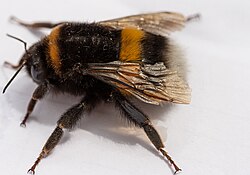
Bombus spp.
Sie sammeln Nektar und Pollen von den Blüten und erleichtern so die Kreuzbestäubung.

Odocoileus virginianus
Weidetiere können das Laub abfressen, insbesondere jüngere Pflanzen.
Rhizobium spp.
Diese Bakterien leben in Wurzelknöllchen und wandeln atmosphärischen Stickstoff in für die Pflanze nutzbare Formen um.
Für dieses Objekt sind noch keine Merkmal-Badges vergeben.
Noch keine Alternativnamen vorhanden.
Sammlungen für dieses Objekt erscheinen hier, wenn weitere Themen hinzugefügt werden.
Gefahr
1/5 · Sehr gering
Noch keine besonderen Sicherheitshinweise.
Beginne mit der ganzen Pflanze und vergleiche dann Blattstellung, Blattränder, Stängel und eventuelle Blüten oder Früchte. Gegenständige Blätter wachsen paarweise, wechselständige einzeln am Stängel. Zusammen verraten diese Details weit mehr als ein einzelnes grünes Blatt. Pflanzen bestimmen: Lade ein Foto hoch und vergleiche die sichtbaren Merkmale.
90-180 cm
0.5-2.5 kg
3-10 Jahre
Als photosynthetischer Organismus produziert die Maryland-Senna ihre eigene Nahrung, indem sie Lichtenergie in chemische Energie umwandelt. Sie nimmt Wasser und essentielle Mineralstoffe aus dem Boden sowie Kohlendioxid aus der Luft auf, um ihr Wachstum und ihre Stoffwechselprozesse anzutreiben.
Diese Art gedeiht in offenen, sonnigen bis halbschattigen Umgebungen und ist häufig in feuchten bis trocken-mesischen Böden von offenen Wäldern, Waldrändern, Wiesen, Feldern, Straßenrändern und gestörten Gebieten zu finden.
Zoome hinein, um Cluster aufzulösen und zu sehen, wo dieses Objekt fotografiert wurde.
Neueste Snaps erscheinen hier, wenn neue Beobachtungen hinzukommen.
Nimm die Entdeckung mit
Fotografiere deinen Fund mit Snappit, bestimme die Art und füge die Entdeckung deiner Sammlung hinzu.


















