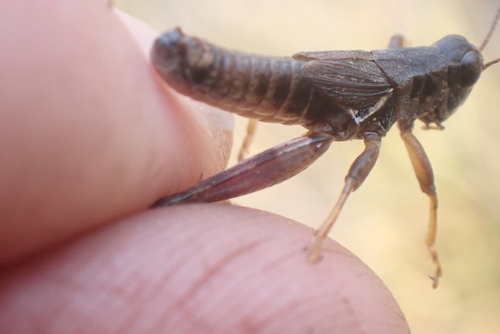





Melanoplus Molothrus
melanoplus molothrus
Die Melanoplus Molothrus ist eine lebhafte Heuschrecke, bekannt für ihre verspielten Sprünge! Kinder werden es lieben, diesen kleinen Kreaturen beim Herumhüpfen im Gras zuzusehen.
Lebensraum: Offene Felder, Grasland und Wiesen.
Die Melanoplus Molothrus ist eine robuste Heuschrecke, typischerweise 25-35 mm lang, die oft erdige Grün- und Brauntöne aufweist. Sie besitzt einen auffälligen stacheligen 'Sporn' zwischen ihren Vorderbeinen und subtile schwarze Bänder an ihren kräftigen Hinterbeinen, was sie visuell unterscheidet.
Kategorie
InsektenSeltenheit
Gewöhnlich
Gefahr
1/5 · Sehr gering
Snaps
Mach den ersten Snap!
Weibliche Heuschrecken legen ihre Eier unterirdisch in einer schaumigen Hülle ab, die sie den Winter über schützt.
Ihre langen Fühler sind wie Supersensoren, die ihnen helfen, sich zurechtzufinden und Veränderungen zu erkennen.
Sie hören Geräusche mit speziellen Organen, den Tympanalorganen, die sich an ihrem Bauch befinden, nicht am Kopf!
Anders als Schmetterlinge durchlaufen Heuschrecken eine unvollständige Metamorphose, was bedeutet, dass junge Nymphen wie winzige Erwachsene aussehen!
Die Melanoplus Molothrus kann sich dank ihrer kräftigen Hinterbeine hoch in die Luft katapultieren, was ihr hilft, Raubtieren schnell zu entkommen.
Die Melanoplus Molothrus hat eine Körperfärbung, die perfekt zu Gräsern und Blättern passt, was ihr hilft, sich vor hungrigen Vögeln zu verstecken.
Die Melanoplus Molothrus kann ihre Beine und Flügel aneinanderreiben, um Zirpgeräusche zu erzeugen, die ihnen bei der Partnersuche helfen.
Melanoplus Molothrus sind Pflanzenfresser, die Blätter und Gräser, die in ihrem Lebensraum vorkommen, knabbern.

Passer domesticus
Ein häufiger Vogel, der Heuschrecken häufig jagt.

Peromyscus maniculatus
Kleine Säugetiere wie Mäuse suchen Insekten als Teil ihrer Nahrung.

Dactylis glomerata
Ernährt sich von den Blättern dieser weit verbreiteten Grasart.

Trifolium pratense
Genießt das Knabbern an den Blättern dieser häufigen Blütenpflanze.
Einzelgänger leben den größten Teil ihres Lebens allein und interagieren mit Artgenossen nur zur Paarung oder zur Aufzucht der Jungen.
Farbenfroh beschreibt Organismen oder Objekte, die eine große Vielfalt an leuchtenden und deutlich erkennbaren Farben aufweisen.
Grasland-Lebensräume sind terrestrische Biome, die von Gräsern und krautigen Pflanzen dominiert werden und einer Vielzahl von Weidetieren als Lebensraum dienen.
Dieses Merkmal kennzeichnet Lebewesen, deren Ernährung vollständig oder hauptsächlich aus pflanzlichem Material besteht.
Tagaktive Tiere sind hauptsächlich bei Tageslicht aktiv und ruhen oder schlafen in der Regel nachts.
Gefahr
1/5 · Sehr gering
Noch keine besonderen Sicherheitshinweise.
Achte auf sechs Beine, Fühler, drei Körperabschnitte und die Form der Flügel. Käfer haben gehärtete Vorderflügel, Fliegen nur ein funktionierendes Flügelpaar. Winzige Insekten müssen oft aus der Nähe betrachtet werden, bevor ihre Gruppe klar wird. Insekten bestimmen: Lade ein Foto hoch und vergleiche die sichtbaren Merkmale.
40-60 mm
25-35 mm
60-120 Tage
5 km/h
Melanoplus Molothrus sind Pflanzenfresser, die Blätter und Gräser, die in ihrem Lebensraum vorkommen, knabbern.
Offene Felder, Grasland und Wiesen.
Nahrungssuche
Zoome hinein, um Cluster aufzulösen und zu sehen, wo dieses Objekt fotografiert wurde.
Neueste Snaps erscheinen hier, wenn neue Beobachtungen hinzukommen.
Nimm die Entdeckung mit
Fotografiere deinen Fund mit Snappit, bestimme die Art und füge die Entdeckung deiner Sammlung hinzu.