

Microcystis Smithii
microcystis smithii
Microcystis smithii ist eine faszinierende Art koloniebildender Cyanobakterien, die gemeinhin als Blaualgen bezeichnet werden, obwohl sie biologisch gesehen Bakterien sind. Dieser mikroskopische Organismus gedeiht in warmen, nährstoffreichen Süßwasserumgebungen und spielt eine entscheidende Rolle in aquatischen Ökosystemen. Einerseits ist er ein hocheffizienter photosynthetischer Produzent, der zum globalen Kohlenstoffkreislauf beiträgt und Sauerstoff ins Wasser abgibt. Andererseits kann er sich unter optimalen Bedingungen mit hohen Temperaturen und landwirtschaftlichem Abfluss schnell vermehren und dichte, auffällige Blüten bilden, die die Wasseroberfläche dominieren. Diese Kolonien werden durch eine schützende Schleimhülle zusammengehalten, die es ihnen ermöglicht, verschiedenen Umweltstressoren standzuhalten. Als wichtiger Vertreter des Süßwasserphytoplanktons ist Microcystis smithii von großem Interesse für Limnologen und Ökologen, die die Wasserqualität und die Auswirkungen der Eutrophierung weltweit untersuchen.
Lebensraum: Vorkommend in eutrophen Süßwasserumgebungen, insbesondere in warmen Seen, Stauseen, Teichen und langsam fließenden Flüssen, die reich an Stickstoff und Phosphor sind.
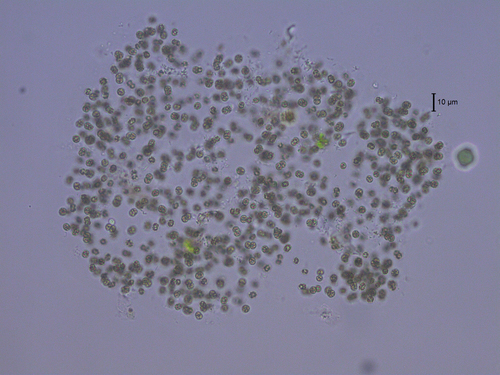
Auf mikroskopischer Ebene besteht Microcystis smithii aus kleinen, kugelförmigen oder halbkugelförmigen Zellen mit einem Durchmesser von etwa 3 bis 6 Mikrometern. Diese Zellen aggregieren zu größeren, sehr variablen Kolonien, die kugelförmig, länglich oder unregelmäßig gelappt erscheinen können und oft von einem klaren, strukturierten Schleim umgeben sind. Für das bloße Auge erscheint eine hohe Konzentration dieser Kolonien als eine lebhafte erbsen- bis blaugrüne Verfärbung im Wasser, die an verschüttete Farbe oder einen dicken, pudrigen Schaum auf der Oberfläche erinnert.
Kategorie
AnimalSeltenheit
Gewöhnlich
Gefahr
1/5 · Sehr gering
Snaps
Mach den ersten Snap!
Vorfahren von Cyanobakterien wie Microcystis waren vor 2,4 Milliarden Jahren für das Große Sauerstoffereignis verantwortlich, das die sauerstoffreiche Atmosphäre der Erde schuf.
Obwohl sie als 'Blaualgen' bezeichnet werden, ist Microcystis smithii eigentlich ein photosynthetisches Bakterium, was bedeutet, dass es keinen Zellkern besitzt.
Unter warmen, nährstoffreichen Bedingungen können sie massive Blüten bilden, die sogar aus dem Weltraum sichtbar sind und ganze Gewässer leuchtend grün färben.
Nutzt interne Gasvesikel, um seine Dichte anzupassen, wodurch die Zellen tagsüber zur Wasseroberfläche aufsteigen können, um Photosynthese zu betreiben, und nachts absinken, um Nährstoffe aufzunehmen.
Produziert eine dicke, gelatinöse Hülle, die die Kolonie umgibt und die Zellen vor dem Austrocknen schützt sowie mikroskopische Weidegänger abwehrt.
Nutzt Sonnenlicht und Chlorophyll, um Wassermoleküle zu spalten und dabei Sauerstoff als Nebenprodukt zu erzeugen, was historisch zur Gestaltung der Erdatmosphäre beigetragen hat.
Als photosynthetisches Cyanobakterium erzeugt es seine eigene Energie aus Sonnenlicht, Kohlendioxid und im Wasser gelösten anorganischen Nährstoffen.
Daphnia magna
Verzehrt Microcystis-Zellen, wobei die Beweidung oft durch die Koloniegröße und potenzielle Toxine begrenzt ist.
Hypophthalmichthys molitrix
Filtert große Mengen an Cyanobakterien und hilft so, Wasserblüten in bewirtschafteten Süßwasserökosystemen zu kontrollieren.
Microcystis virus Ma-LMM01
Infiziert und lysiert Microcystis-Zellen und wirkt als natürliches biologisches Kontrollmittel, um Blüten zum Kollaps zu bringen.
Für dieses Objekt sind noch keine Merkmal-Badges vergeben.
Noch keine Alternativnamen vorhanden.
Sammlungen für dieses Objekt erscheinen hier, wenn weitere Themen hinzugefügt werden.
Gefahr
1/5 · Sehr gering
Noch keine besonderen Sicherheitshinweise.
Der einfachste Weg, Microcystis Smithii zu bestimmen, ist die Verwendung der Naturführer-App Snappit.
0 cm
Als photosynthetisches Cyanobakterium erzeugt es seine eigene Energie aus Sonnenlicht, Kohlendioxid und im Wasser gelösten anorganischen Nährstoffen.
Vorkommend in eutrophen Süßwasserumgebungen, insbesondere in warmen Seen, Stauseen, Teichen und langsam fließenden Flüssen, die reich an Stickstoff und Phosphor sind.
Zoome hinein, um Cluster aufzulösen und zu sehen, wo dieses Objekt fotografiert wurde.
Neueste Snaps erscheinen hier, wenn neue Beobachtungen hinzukommen.
Nimm die Entdeckung mit
Fotografiere deinen Fund mit Snappit, bestimme die Art und füge die Entdeckung deiner Sammlung hinzu.