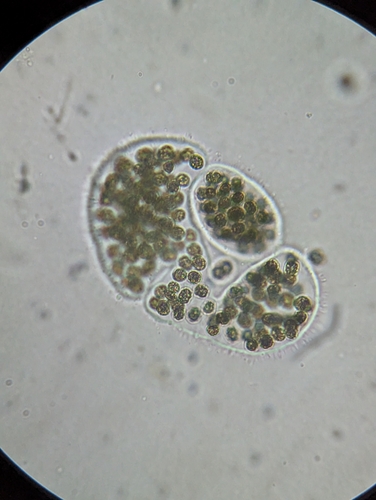


Microcystis wesenbergii
microcystis wesenbergii
Microcystis wesenbergii ist ein faszinierendes, koloniales einzelliges Cyanobakterium, das weltweit häufig in Süßwasserumgebungen vorkommt. Bekannt für die Bildung schwebender Kolonien, spielt dieses photosynthetische Bakterium eine komplexe Rolle in aquatischen Ökosystemen. Während es durch die Nutzung von Sonnenlicht zur Primärproduktion beiträgt, ist es auch bekannt für seine Beteiligung an schädlichen Algenblüten unter nährstoffreichen Bedingungen. Im Gegensatz zu einigen seiner berüchtigten Verwandten wird Microcystis wesenbergii oft als weniger toxisch oder ungiftig angesehen, obwohl es häufig zusammen mit toxinproduzierenden Arten vorkommt. Eingeschlossen in eine ausgeprägte, gut definierte gelatinöse Hülle, gruppieren sich diese mikroskopisch kleinen Organismen und nutzen Auftrieb regulierende Gasvesikel, um sich in der Wassersäule auf und ab zu bewegen und die Lichtabsorption zu optimieren.
Lebensraum: Weltweit schwebend in eutrophen Süßwasserseen, Stauseen, Teichen und langsam fließenden Flüssen zu finden.
Microcystis wesenbergii bildet kugelförmige, gelappte oder unregelmäßig geformte Kolonien, die farblich von hellgrün bis blaugrün reichen. Einzelne Zellen sind kugelförmig, messen etwa 4 bis 7 Mikrometer im Durchmesser und sind in einer gut sichtbaren, lichtbrechenden und strukturierten schleimigen Hülle eingeschlossen. Diese äußere gelatinöse Hülle hat eine scharfe, deutliche Grenze, die sie unter einem Lichtmikroskop klar von anderen Microcystis-Arten unterscheidet. Makroskopisch sehen dichte Ansammlungen aus wie grüne Erbsensuppe oder verschüttete Farbe auf der Wasseroberfläche.
Kategorie
AnimalSeltenheit
Gewöhnlich
Gefahr
1/5 · Sehr gering
Snaps
Mach den ersten Snap!
Sie nutzen spezialisierte Gasvesikel, um tagsüber zur Oberfläche aufzusteigen, um Photosynthese zu betreiben, und sinken nachts ab, um Nährstoffe aus kühleren, tieferen Gewässern aufzunehmen.
Unter dem Mikroskop ist das entscheidende Merkmal von Microcystis wesenbergii seine bemerkenswert klare, glasartige äußere gelatinöse Grenze, die wie ein klarer Heiligenschein aussieht.
Während einige Microcystis-Arten tödliche Microcystin-Toxine produzieren, wird M. wesenbergii im Allgemeinen als ungiftig angesehen, obwohl es oft neben hochtoxischen Verwandten lebt.
Nutzt gasgefüllte Vesikel innerhalb ihrer Zellen, um ihre vertikale Position in der Wassersäule anzupassen, aufsteigend, um Sonnenlicht zu ernten, oder absinkend, um auf tiefere Nährstoffe zuzugreifen.
Produziert eine dicke, widerstandsfähige äußere Schleimhülle, die Zellen vor mechanischen Schäden, Austrocknung und chemischen Schwankungen in der Umgebung schützt.
Nutzt Phycobiliproteine neben Chlorophyll, um Lichtwellenlängen zu erfassen, die andere photosynthetische Organismen nicht nutzen können, wodurch es in trüben Gewässern gedeihen kann.
Als photosynthetisches Cyanobakterium erzeugt es seine eigene Energie aus Sonnenlicht, Wasser und Kohlendioxid, während es gelöste Nährstoffe wie Phosphor und Stickstoff direkt aus dem umgebenden Wasser aufnimmt.
Daphnia magna
Zooplankton wie Daphnien weiden Cyanobakterien ab, obwohl sie Schwierigkeiten haben können, größere Kolonien zu verdauen.
Hypophthalmichthys molitrix
Silberkarpfen filtrieren Phytoplankton, einschließlich Microcystis-Kolonien, und helfen so, Algenblüten in Seen zu kontrollieren.
Für dieses Objekt sind noch keine Merkmal-Badges vergeben.
Noch keine Alternativnamen vorhanden.
Sammlungen für dieses Objekt erscheinen hier, wenn weitere Themen hinzugefügt werden.
Gefahr
1/5 · Sehr gering
Noch keine besonderen Sicherheitshinweise.
Der einfachste Weg, Microcystis wesenbergii zu bestimmen, ist die Verwendung der Naturführer-App Snappit.
Als photosynthetisches Cyanobakterium erzeugt es seine eigene Energie aus Sonnenlicht, Wasser und Kohlendioxid, während es gelöste Nährstoffe wie Phosphor und Stickstoff direkt aus dem umgebenden Wasser aufnimmt.
Weltweit schwebend in eutrophen Süßwasserseen, Stauseen, Teichen und langsam fließenden Flüssen zu finden.
Zoome hinein, um Cluster aufzulösen und zu sehen, wo dieses Objekt fotografiert wurde.
Neueste Snaps erscheinen hier, wenn neue Beobachtungen hinzukommen.
Nimm die Entdeckung mit
Fotografiere deinen Fund mit Snappit, bestimme die Art und füge die Entdeckung deiner Sammlung hinzu.