
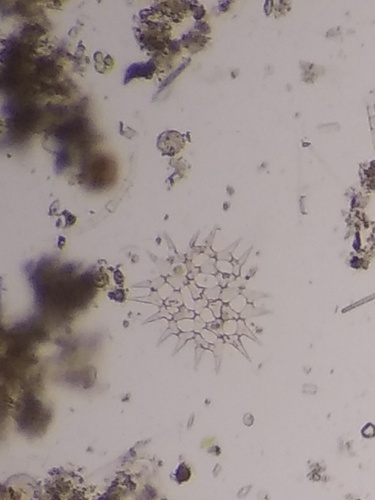


Monactinus Biwae
monactinus biwae
Monactinus Biwae ist eine wunderschöne, mikroskopisch kleine Grünalge, bekannt für ihre auffällige sternförmige geometrische Symmetrie. Als freischwimmender Kolonieorganismus besteht sie aus einer einschichtigen Zellscheibe, die präzise in konzentrischen Ringen angeordnet ist. Diese Mikroalge spielt eine entscheidende Rolle in Süßwasser-Nahrungsnetzen, indem sie als Primärproduzent Sonnenenergie in organische Substanz umwandelt und gleichzeitig ihre aquatische Umgebung mit Sauerstoff anreichert.
Lebensraum: Bewohnt die offenen Gewässer von Süßwasserseen, Stauseen und langsam fließenden Flüssen, wo sie als Bestandteil des schwimmenden Phytoplanktons gedeiht.
Unter dem Mikroskop ähnelt Monactinus Biwae einer grünen, radähnlichen Struktur oder einem Zahnrad. Sie bildet flache, scheibenförmige Kolonien (Coenobien), die typischerweise aus 8, 16, 32 oder 64 Zellen bestehen. Die inneren Zellen sind polygonal und passen eng zusammen, während jede äußere Zelle durch ein einzelnes, markantes, nach außen gerichtetes Horn oder einen Stachel gekennzeichnet ist, was der gesamten Kolonie ein sternförmiges Aussehen verleiht. Die Zellen sind reich an grünem Chlorophyll, was ihnen eine lebendige, grasgrüne Farbe verleiht.
Kategorie
PflanzenSeltenheit
Gewöhnlich
Gefahr
1/5 · Sehr gering
Snaps
Mach den ersten Snap!
Sie ist nach dem Biwa-See in Japan benannt, dem größten Süßwassersee des Landes, wo sie historisch detailliert untersucht wurde.
Ihre äußeren Zellen weisen einen einzelnen hornähnlichen Vorsprung auf, der die Gattung Monactinus von ihrer nahen Verwandten Pediastrum unterscheidet, die typischerweise zwei besitzt.
Die Anzahl der Zellen in einer Kolonie wird bei der Geburt festgelegt und erhöht sich nicht; einzelne Zellen werden einfach größer, wenn die Kolonie reift.
Die flache, einschichtige Scheibenstruktur maximiert die Oberfläche für die Sonneneinstrahlung und optimiert so die Effizienz ihres photosynthetischen Prozesses.
Während der Fortpflanzung versammeln sich bewegliche Zoosporen in einem temporären Vesikel und ordnen sich spontan zu einer perfekten geometrischen Kolonie an, bevor sie Zellwände entwickeln.
Die Zellwand enthält robuste, verrottungsbeständige Biopolymere, die die Kolonie vor plötzlichen osmotischen Verschiebungen und physischen Schäden schützen.
Als photosynthetischer Organismus stellt sie ihre eigene Nahrung mithilfe von Sonnenlicht, Kohlendioxid und gelösten anorganischen Nährstoffen aus dem Wasser her.
Daphnia pulex
Dient als wichtige Nahrungsquelle für filtrierende Zooplankton.
Microcystis aeruginosa
Konkurriert um gelösten Phosphor und Stickstoff in Süßwasserseen.
Für dieses Objekt sind noch keine Merkmal-Badges vergeben.
Noch keine Alternativnamen vorhanden.
Sammlungen für dieses Objekt erscheinen hier, wenn weitere Themen hinzugefügt werden.
Gefahr
1/5 · Sehr gering
Noch keine besonderen Sicherheitshinweise.
Beginne mit der ganzen Pflanze und vergleiche dann Blattstellung, Blattränder, Stängel und eventuelle Blüten oder Früchte. Gegenständige Blätter wachsen paarweise, wechselständige einzeln am Stängel. Zusammen verraten diese Details weit mehr als ein einzelnes grünes Blatt. Pflanzen bestimmen: Lade ein Foto hoch und vergleiche die sichtbaren Merkmale.
0 cm
Als photosynthetischer Organismus stellt sie ihre eigene Nahrung mithilfe von Sonnenlicht, Kohlendioxid und gelösten anorganischen Nährstoffen aus dem Wasser her.
Bewohnt die offenen Gewässer von Süßwasserseen, Stauseen und langsam fließenden Flüssen, wo sie als Bestandteil des schwimmenden Phytoplanktons gedeiht.
Photosynthese
8-64
Zoome hinein, um Cluster aufzulösen und zu sehen, wo dieses Objekt fotografiert wurde.
Neueste Snaps erscheinen hier, wenn neue Beobachtungen hinzukommen.
Nimm die Entdeckung mit
Fotografiere deinen Fund mit Snappit, bestimme die Art und füge die Entdeckung deiner Sammlung hinzu.

















