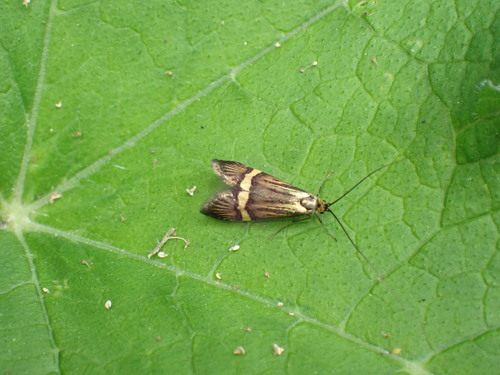


Nemophora Degeerella
nemophora degeerella
Die Nemophora degeerella, gemeinhin bekannt als Langhornfalter, ist ein faszinierendes und leicht erkennbares Insekt, bekannt für die außergewöhnliche Länge seiner Antennen, insbesondere bei Männchen. Diese kleinen, tagaktiven Falter sind im Spätfrühling und Frühsommer ein entzückender Anblick in Wäldern und Lichtungen. Sie werden für ihre unverwechselbaren Balzflüge gefeiert, bei denen Männchen in Schwärmen zusammenkommen, um ein Luftballett aufzuführen und ihre verlängerten Antennen zu präsentieren, um Weibchen anzulocken. Dieses Verhalten, kombiniert mit ihren auffälligen metallischen Flügeln, macht sie zu einem faszinierenden Objekt für Naturbegeisterte und einem wichtigen Bestandteil ihrer Ökosysteme als Bestäuber und Detritusfresser in ihrem Larvenstadium.
Lebensraum: Findet sich in Laub- und Mischwäldern, an Waldrändern, auf Lichtungen und Wiesen, wo Laubbäume und verschiedene Blütenpflanzen vorkommen.
Nemophora degeerella ist ein kleiner Falter, typischerweise mit einer Flügelspannweite von 1,6 bis 2,4 cm. Seine Vorderflügel sind schimmernd metallisch goldbronzen, oft mit einem schwachen purpurfarbenen Glanz, während die Hinterflügel dunkler und eher purpurbraun sind. Das auffälligste Merkmal sind die Antennen: Bei den Männchen sind sie bemerkenswert lang, oft zwei- bis dreimal so lang wie ihr Körper, schlank und weiß gespitzt. Weibchen haben kürzere, wenn auch proportional lange Antennen, die dunkler gefärbt sind. Ihre schlanken Körper sind dunkel und bilden einen Kontrast zu ihren irisierenden Flügeln.
Kategorie
InsektenSeltenheit
Gewöhnlich
Gefahr
1/5 · Sehr gering
Snaps
Mach den ersten Snap!
Die Antennen der Männchen können bis zu dreimal so lang wie ihr Körper sein, was sie zu den längsten im Verhältnis zur Körpergröße unter allen Insekten macht.
Ihre Larven bauen ein einzigartiges tragbares Gehäuse aus Seide und Detritus, das sie zum Schutz tragen, während sie sich von verrottendem Material ernähren.
Sie führen aufwendige Luft-'Leks' auf, bei denen Dutzende von Männchen schwärmen und in der Luft auf- und abtanzen, um Weibchen anzulocken, ein Verhalten, das eher bei Vögeln als bei Motten üblich ist.
Im Gegensatz zu den meisten Motten ist Nemophora degeerella streng tagaktiv und fliegt aktiv am Tag, besonders bei Sonnenschein.
Männliche Nemophora degeerella besitzen Antennen, die zwei- bis dreimal so lang wie ihr Körper sein können, eine bemerkenswerte Anpassung, die hauptsächlich bei aufwendigen Balzflügen zur Anziehung von Partnerinnen genutzt wird.
Männchen versammeln sich in Schwärmen, oft als Leks bezeichnet, und fliegen in einer charakteristischen Auf- und Abbewegung, während sie ihre langen Antennen präsentieren, um Weibchen anzulocken und um sie zu konkurrieren.
Die Larven leben in einem tragbaren, seidenen Gehäuse, das mit Detritus bedeckt ist und Tarnung sowie Schutz bietet, während sie sich von verrottendem Pflanzenmaterial auf dem Waldboden ernähren.
Die Ernährung von Nemophora degeerella variiert erheblich zwischen den Lebensstadien. Larven sind Detritusfresser und ernähren sich von verrottendem Pflanzenmaterial und Pilzhyphen, die auf dem Waldboden gefunden werden. Adulte Falter sind nektarfressend und konsumieren hauptsächlich Nektar von verschiedenen Blütenpflanzen.
Altersunterschiede: Ja, die Ernährung ändert sich signifikant von detritusfressenden Larven zu nektarfressenden Adulten.
Crataegus monogyna
Adulte ernähren sich von Nektar und tragen so zur Bestäubung dieser Pflanzen bei.

Quercus robur
Larven verzehren verrottendes Pflanzenmaterial und tragen zum Nährstoffkreislauf bei.

Erithacus rubecula
Adulte Falter dienen verschiedenen insektenfressenden Vögeln als Nahrungsquelle.
Ichneumonidae
Mottenlarven können von verschiedenen Wespen parasitiert werden.
Für dieses Objekt sind noch keine Merkmal-Badges vergeben.
Noch keine Alternativnamen vorhanden.
Sammlungen für dieses Objekt erscheinen hier, wenn weitere Themen hinzugefügt werden.
Gefahr
1/5 · Sehr gering
Noch keine besonderen Sicherheitshinweise.
Vergleiche die Flügelform in Ruhe, die Zeichnung der Vorderflügel, die Fühler und den Körperbau. Bei kleinen braunen Faltern kommt es oft auf feine Details an, die ein Handyfoto nicht immer einfängt. Nachtfalter bestimmen: Lade ein Foto hoch und vergleiche die sichtbaren Merkmale.
0-1 cm
1-2 cm
0.0001-0.0002 kg
0 Jahre
8 km/h
Die Ernährung von Nemophora degeerella variiert erheblich zwischen den Lebensstadien. Larven sind Detritusfresser und ernähren sich von verrottendem Pflanzenmaterial und Pilzhyphen, die auf dem Waldboden gefunden werden. Adulte Falter sind nektarfressend und konsumieren hauptsächlich Nektar von verschiedenen Blütenpflanzen.
Findet sich in Laub- und Mischwäldern, an Waldrändern, auf Lichtungen und Wiesen, wo Laubbäume und verschiedene Blütenpflanzen vorkommen.
Zoome hinein, um Cluster aufzulösen und zu sehen, wo dieses Objekt fotografiert wurde.
Neueste Snaps erscheinen hier, wenn neue Beobachtungen hinzukommen.
Nimm die Entdeckung mit
Fotografiere deinen Fund mit Snappit, bestimme die Art und füge die Entdeckung deiner Sammlung hinzu.