




Opisthius Richardsoni
opisthius richardsoni
Opisthius richardsoni ist ein faszinierender Laufkäfer, der im westlichen Nordamerika beheimatet ist und Uferregionen besiedelt. Dieser kleine, aber sehr aktive Käfer lebt an den kiesigen und schlammigen Ufern schnell fließender, kalter Bäche und spielt als winziger Prädator eine wesentliche Rolle in den Uferökosystemen. Man sieht ihn häufig an warmen, sonnigen Tagen schnell über offene Sandbänke huschen. Besonders faszinierend an diesem Käfer ist seine frappierende Ähnlichkeit mit Sandlaufkäfern, was auf eine konvergente Evolution zurückzuführen ist, die durch ihre gemeinsamen tagaktiven Jagdgewohnheiten bedingt ist. Bekannt für seine unglaubliche Geschwindigkeit und seinen scharfen Sehsinn, ist dieser Käfer ein Liebling unter Entomologen, die unberührte Gebirgsbäche erforschen, und er dient als hervorragender Indikator für gesunde, ungestörte Uferlebensräume.
Lebensraum: Zu finden an kiesigen, sandigen oder schlammigen Ufern sauberer, schnell fließender Gebirgsbäche und -flüsse.
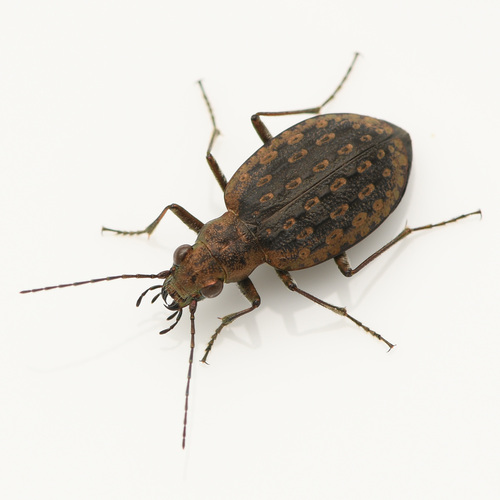
Dieser Käfer ist typischerweise 8,5 bis 11 Millimeter lang und hat einen leicht abgeflachten, ovalen Körper mit einem matt-metallischen bronzegrünen oder gräulich-schwarzen Glanz. Seine auffälligsten Merkmale sind seine außergewöhnlich großen, hervorstehenden Facettenaugen und die charakteristischen Reihen großer, flacher, kreisförmiger Vertiefungen auf seinen Flügeldecken, die ihm eine raue, genarbte Textur verleihen. Er besitzt lange, schlanke Beine, die an schnelles Sprinten angepasst sind, und kurze, fadenförmige Antennen.
Kategorie
InsektenSeltenheit
Gewöhnlich
Gefahr
1/5 · Sehr gering
Snaps
Mach den ersten Snap!
Obwohl er als Laufkäfer klassifiziert ist, wird er aufgrund seiner großen Augen und seines Sprintverhaltens häufig mit einem Sandlaufkäfer verwechselt.
Die Gattung Opisthius enthält in Nordamerika nur diese eine Art, was sie zu einer sehr einzigartigen evolutionären Linie innerhalb ihrer Unterfamilie macht.
Diese Art ist hoch spezialisiert auf das Leben am Wasserrand und taucht sofort ins Wasser oder versteckt sich unter Kies, wenn sie von Landräubern bedroht wird.
Als gefräßiger Prädator jagt er aktiv kleine Wirbellose auf den feuchten Böden der Flussufer.
Pelzig beschreibt Tiere, die eine dichte Schicht aus weichen Haaren oder Fell besitzen.
Soziale Tiere leben in organisierten Gruppen und kooperieren, um ihr Überleben zu sichern, beispielsweise bei der Nahrungssuche, Verteidigung und Aufzucht der Jungen.
Dieses Merkmal kennzeichnet Organismen, deren Ernährung sowohl pflanzliche als auch tierische Bestandteile umfasst.
Baumbewohnende Tiere leben hauptsächlich in Bäumen und nutzen diese als Unterschlupf, Nahrungsquelle und zum Schutz vor Raubtieren.
Tagaktive Tiere sind hauptsächlich bei Tageslicht aktiv und ruhen oder schlafen in der Regel nachts.
Noch keine Alternativnamen vorhanden.
Sammlungen für dieses Objekt erscheinen hier, wenn weitere Themen hinzugefügt werden.
Gefahr
1/5 · Sehr gering
Noch keine besonderen Sicherheitshinweise.
Achte auf die harten Flügeldecken, die in einer Linie auf dem Rücken zusammenstoßen, und vergleiche dann Fühler, Körperform, Beine und Zeichnung. Metallische Farben verändern sich je nach Licht stark. Käfer bestimmen: Lade ein Foto hoch und vergleiche die sichtbaren Merkmale.
1 cm
0.00005-0.00015 kg
1-2 Jahre
3 km/h
Als gefräßiger Prädator jagt er aktiv kleine Wirbellose auf den feuchten Böden der Flussufer.
Zu finden an kiesigen, sandigen oder schlammigen Ufern sauberer, schnell fließender Gebirgsbäche und -flüsse.
Verfolgungsjagd
Zoome hinein, um Cluster aufzulösen und zu sehen, wo dieses Objekt fotografiert wurde.
Neueste Snaps erscheinen hier, wenn neue Beobachtungen hinzukommen.
Nimm die Entdeckung mit
Fotografiere deinen Fund mit Snappit, bestimme die Art und füge die Entdeckung deiner Sammlung hinzu.