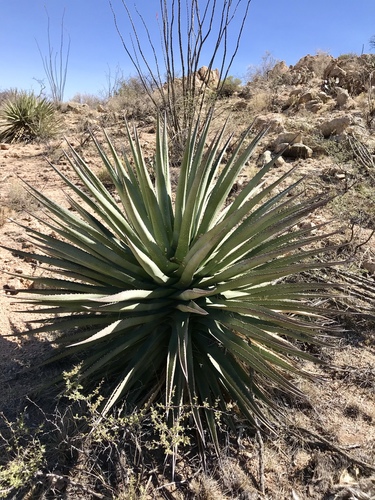


Palmers Agave
agave palmeri
Palmers Agave ist eine markante, mehrjährige Sukkulente, die in den trockenen Grasländern und Eichenwäldern der südwestlichen Vereinigten Staaten und Nordmexikos beheimatet ist. Sie ist bekannt für ihre langsam wachsende, symmetrische Rosette aus zähen, blaugrünen Blättern, die Wasser speichern, um strenge Wüstendürren zu überstehen. Diese widerstandsfähige Pflanze verbringt bis zu dreißig Jahre damit, Ressourcen anzusammeln, bevor sie ein einzigartiges, dramatisches Fortpflanzungsereignis in Gang setzt. Sie bildet einen imposanten Blütenstiel, der eine Höhe von bis zu fünf Metern erreichen kann und in leuchtenden Büscheln nektarreicher Blüten explodiert, bevor die Mutterpflanze schließlich eingeht.
Lebensraum: Gefunden in trockenen, felsigen Böden von Halbwüstengrasländern, Eichenwäldern und Wüstengebüsch, typischerweise in Höhenlagen zwischen 900 und 2.400 Metern.
Diese Art bildet eine große, dichte Rosette aus dicken, lanzettförmigen Blättern, die blaugrün bis graugrün gefärbt sind und Durchmesser von 50 bis 120 Zentimetern erreichen. Die Ränder jedes Blattes sind mit scharfen, dunkelbraunen Zähnen bewehrt, und die Blattspitze mündet in einen kräftigen, imposanten Dorn. Ihr dramatischstes Merkmal ist der massive, verzweigte Blütenstiel, der drei bis fünf Meter hoch aufragt und Büschel röhrenförmiger, hellgelber Blüten trägt, die oft mit rosa oder roten Spitzen überhaucht sind.
Kategorie
PflanzenSeltenheit
Gewöhnlich
Gefahr
1/5 · Sehr gering
Snaps
Mach den ersten Snap!
Da die Pflanze nach der Blüte abstirbt, verlässt sie sich auf die Produktion Tausender geflügelter Samen, die vom Wüstenwind verbreitet werden.
Indigene Völker ernteten traditionell das zentrale 'Herz' oder die Cabeza der Agave und rösteten es mehrere Tage lang in steinausgekleideten Gruben, um eine süße, nahrhafte Nahrungsquelle zu schaffen.
Die Blüten der Palmers Agave produzieren nachts reichlich Nektar und haben sich speziell entwickelt, um nachtaktive, wandernde Fledermäuse anzuziehen.
Sie nutzt die CAM-Photosynthese zur Wassereinsparung, indem sie ihre Spaltöffnungen nachts öffnet, um Kohlendioxid aufzunehmen, anstatt tagsüber in der heißen Wüste.
Sie kanalisiert all ihre Lebensenergie-Reserven in ein einziges, massives Blühereignis, um Bestäubung und Samenproduktion zu maximieren, und stirbt kurz darauf.
Die konkave Form ihrer starren, aufrechten Blätter fungiert als natürlicher Trichter, der spärliches Regenwasser direkt zu ihrem flachen Wurzelsystem leitet.
Als Pflanze ist Palmers Agave ein Fotoautotroph, die ihre eigene Energie mithilfe von Sonnenlicht, Kohlendioxid und Wasser durch Photosynthese erzeugt.
Leptonycteris yerbabuena
Die Kleine Langnasenfledermaus ist ein wichtiger Bestäuber der Palmers Agave und ernährt sich während nächtlicher Nahrungsflüge von ihrem energiereichen Nektar.
Choeronycteris mexicana
Die Mexikanische Langzungenfledermaus besucht nachts aktiv die imposanten Blüten, um Nektar zu trinken und unterstützt so den genetischen Austausch zwischen den Agavenpopulationen.
Scyphophorus acupunctatus
Der Agavenrüssler gräbt sich in den Kern der Pflanze, um seine Eier abzulegen, was die Agave schwer schädigen oder abtöten kann.
Für dieses Objekt sind noch keine Merkmal-Badges vergeben.
Noch keine Alternativnamen vorhanden.
Sammlungen für dieses Objekt erscheinen hier, wenn weitere Themen hinzugefügt werden.
Gefahr
1/5 · Sehr gering
Noch keine besonderen Sicherheitshinweise.
Vergleiche Blattstellung, Rosettenform, Rippen, Dornen und Blüten. Bedenke, dass Trockenheit und starke Sonne Farbe und Form einer Pflanze verändern können. Sukkulenten bestimmen: Lade ein Foto hoch und vergleiche die sichtbaren Merkmale.
50-120 cm
10-50 kg
10-30 Jahre
Als Pflanze ist Palmers Agave ein Fotoautotroph, die ihre eigene Energie mithilfe von Sonnenlicht, Kohlendioxid und Wasser durch Photosynthese erzeugt.
Gefunden in trockenen, felsigen Böden von Halbwüstengrasländern, Eichenwäldern und Wüstengebüsch, typischerweise in Höhenlagen zwischen 900 und 2.400 Metern.
Zoome hinein, um Cluster aufzulösen und zu sehen, wo dieses Objekt fotografiert wurde.
Neueste Snaps erscheinen hier, wenn neue Beobachtungen hinzukommen.

Arizona, US
Hier kann man sehen Mexikanischer Häher und Yarrows Stachelleguan.
Führer anzeigen →

Arizona, US
Hier kann man sehen Regenbogen-Igelkaktus und Rotschwanzbussard.
Führer anzeigen →
Nimm die Entdeckung mit
Fotografiere deinen Fund mit Snappit, bestimme die Art und füge die Entdeckung deiner Sammlung hinzu.