
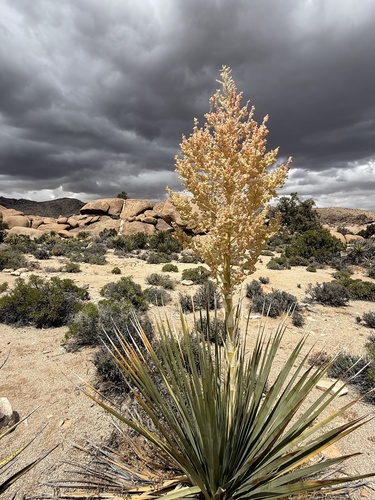


Parrys Nolina
nolina parryi
Parrys Nolina, auch bekannt als Parrys Bärengras, ist eine auffällige, immergrüne, sukkulentenähnliche Pflanze, die auf den trockenen Berghängen und in den Hochwüstenregionen des südwestlichen Teils der Vereinigten Staaten und des nördlichen Mexikos heimisch ist. Obwohl sie mit ihren dichten Rosetten aus langen, schwertartigen Blättern einer Yucca oder Agave ähnelt, gehört sie zur Familie der Spargelgewächse (Asparagaceae). Diese widerstandsfähige Pflanze ist bekannt für ihre Fähigkeit, in extrem rauen, steinigen Böden zu gedeihen, wo nur wenige andere große Pflanzen überleben können, und bildet dramatische Blickpunkte in der Wüstenlandschaft.
Lebensraum: Man findet sie an trockenen, felsigen Hängen, im Chaparral und in Pinyon-Wacholder-Wäldern in Wüstengebirgen.
Diese Art bildet einen großen, runden Horst aus steifen, faserigen, blaugrünen Blättern, die bis zu 1,5 Meter lang werden und fein gesägte Ränder aufweisen. Wenn sie ausgewachsen ist, treibt sie einen kolossalen, verholzten Blütenstiel aus, der 2 bis 4 Meter hoch wird und mit einer dichten, cremeweißen Rispe gekrönt ist, die Tausende winziger, sternförmiger Blüten enthält, die im Spätfrühling blühen.
Kategorie
PflanzenSeltenheit
Gewöhnlich
Gefahr
1/5 · Sehr gering
Snaps
Mach den ersten Snap!
Trotz ihres gebräuchlichen Namens 'Bärengras' und ihres grasähnlichen Aussehens ist sie eine entfernte Verwandte des Garten-Spargels.
Indigene Völker des amerikanischen Südwestens nutzten die starken, faserigen Blätter dieser Pflanze, um äußerst langlebige Körbe, Matten und Sandalen zu flechten.
Das spektakuläre Blütenereignis tötet die Pflanze nicht, anders als bei vielen Agavenarten, die nach einmaliger Blüte absterben.
Besitzt einen dicken, verholzten unterirdischen Caudex, der es der Pflanze ermöglicht, auch nach intensiven Wüstenbränden schnell wieder auszutreiben und sich zu regenerieren.
Die konkave, rinnenförmige Struktur ihrer steifen Blätter leitet minimale Niederschläge effizient direkt zu ihrem zentralisierten Wurzelsystem.
Die Blattränder sind mit mikroskopisch kleinen, rasiermesserscharfen Zähnen besetzt, die Pflanzenfresser davon abhalten, ihr zähes Laub zu fressen.
Als photosynthetische Pflanze stellt sie ihre eigene Nahrung aus Sonnenlicht, Wasser und Kohlendioxid her, während sie essentielle Wüstenmineralien über ihre Wurzeln aufnimmt.
Ovis canadensis nelsoni
Die jungen, zarten Blütenstiele bieten Wüsten-Dickhornschafen im Frühling hoch nahrhafte Nahrung.
Neotoma lepida
Wüsten-Waldratten sammeln die scharfen, faserigen Blätter, um schützende, raubtiersichere Mieten und Nester zu bauen.
Apis mellifera
Bietet einheimischen Wüstenbienen wichtigen Nektar und Pollen, die bei der Fremdbestäubung der Pflanzen helfen.
Für dieses Objekt sind noch keine Merkmal-Badges vergeben.
Noch keine Alternativnamen vorhanden.
Sammlungen für dieses Objekt erscheinen hier, wenn weitere Themen hinzugefügt werden.
Gefahr
1/5 · Sehr gering
Noch keine besonderen Sicherheitshinweise.
Beginne mit der ganzen Pflanze und vergleiche dann Blattstellung, Blattränder, Stängel und eventuelle Blüten oder Früchte. Gegenständige Blätter wachsen paarweise, wechselständige einzeln am Stängel. Zusammen verraten diese Details weit mehr als ein einzelnes grünes Blatt. Pflanzen bestimmen: Lade ein Foto hoch und vergleiche die sichtbaren Merkmale.
100-400 cm
50-100 Jahre
Als photosynthetische Pflanze stellt sie ihre eigene Nahrung aus Sonnenlicht, Wasser und Kohlendioxid her, während sie essentielle Wüstenmineralien über ihre Wurzeln aufnimmt.
Man findet sie an trockenen, felsigen Hängen, im Chaparral und in Pinyon-Wacholder-Wäldern in Wüstengebirgen.
Zoome hinein, um Cluster aufzulösen und zu sehen, wo dieses Objekt fotografiert wurde.
Neueste Snaps erscheinen hier, wenn neue Beobachtungen hinzukommen.
Nimm die Entdeckung mit
Fotografiere deinen Fund mit Snappit, bestimme die Art und füge die Entdeckung deiner Sammlung hinzu.


















