
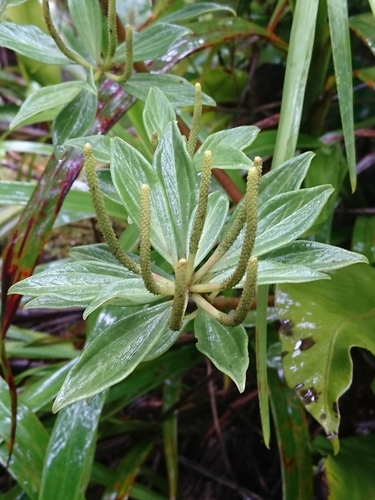


Peperomia Hesperomannii
peperomia hesperomannii
Die Peperomia hesperomannii ist eine seltene, bezaubernde sukkulente Krautpflanze, die endemisch in den feuchten, moosigen Wäldern von Kauai, Hawaii, vorkommt. Lokal als 'ala'ala wai nui bekannt, gedeiht diese schattenliebende Staude im feuchten Unterholz, wo sie sich an feuchte Felsen oder moosbedeckte Baumstämme klammert. Ihre fleischigen, dunkelgrünen Blätter und schlanken, hellgrünen Blütenähren sind klassische Merkmale der Familie der Pfeffergewächse (Piperaceae). Diese zarte Art spielt eine wichtige Rolle in ihrem fragilen Inselökosystem, indem sie Mikrohabitate für einheimische Wirbellose bietet und an komplexen Nahrungsnetzen des Waldes teilnimmt.
Lebensraum: Man findet sie in feuchten hawaiianischen Bergwäldern, wo sie typischerweise als Epiphyt auf moosigen Baumstämmen oder als Lithophyt auf feuchten Felsen wächst.
Dieses kompakte Kraut erreicht typischerweise eine Höhe von 10 bis 30 cm und besitzt aufrechte oder ausladende sukkulente Stängel. Seine Blätter sind gegenständig angeordnet oder in Quirlen gebündelt und zeigen eine längliche, elliptische bis lanzettliche Form mit einer glatten, glänzenden Oberfläche und einem satten waldgrünen Farbton. Die Pflanze produziert winzige, unauffällige grüne Blüten, die dicht entlang schmaler, ährenartiger Blütenstände (Spadices) angeordnet sind, welche über dem Laub aufsteigen und eine unverwechselbare, samtige Textur aufweisen.
Kategorie
PflanzenSeltenheit
Gewöhnlich
Gefahr
1/5 · Sehr gering
Snaps
Mach den ersten Snap!
Ihre Samen sind mit einer klebrigen Substanz bedeckt, die wie ein natürlicher Klettverschluss funktioniert und an einheimischen Waldvögeln haftet, um neue moosige Äste zu besiedeln.
Der hawaiianische Name für Peperomia ist 'ala'ala wai nui, was poetisch auf ihre sukkulente, wasserhaltende Natur verweist.
Im Gegensatz zu vielen gängigen Zimmerpflanzen der Gattung Peperomia ist Peperomia hesperomannii extrem empfindlich und kommt außerhalb ihres ursprünglichen, unberührten hawaiianischen Regenwaldlebensraums selten vor.
Produziert extrem klebrige Samen, die leicht an den Federn einheimischer Waldvögel haften und so eine effiziente Samenverbreitung ermöglichen.
Fleischige Blätter und Stängel speichern Wasser, wodurch die Pflanze vorübergehende Trockenperioden an ihren epiphytischen Standorten in höheren Lagen überleben kann.
Speziell angepasst, um im tief schattigen Waldunterholz zu gedeihen und die minimale Sonneneinstrahlung durch das Blätterdach optimal zu nutzen.
Als photosynthetische Pflanze synthetisiert sie ihre eigene Nahrung mithilfe von Sonnenlicht, Wasser und Kohlendioxid, ergänzt durch Nährstoffe, die aus umgebendem organischem Material aufgenommen werden.
Chlorodrepanis stejnegeri
Verbreitet die klebrigen Samen der Pflanze durch Epizoochorie, wenn der Vogel die reifen Samenstände streift.
Succinea caduca
Frisst gelegentlich die fleischigen Blätter und die damit verbundenen Mikropilze, die auf feuchten Peperomia-Stängeln wachsen.
Für dieses Objekt sind noch keine Merkmal-Badges vergeben.
Noch keine Alternativnamen vorhanden.
Sammlungen für dieses Objekt erscheinen hier, wenn weitere Themen hinzugefügt werden.
Gefahr
1/5 · Sehr gering
Noch keine besonderen Sicherheitshinweise.
Beginne mit der ganzen Pflanze und vergleiche dann Blattstellung, Blattränder, Stängel und eventuelle Blüten oder Früchte. Gegenständige Blätter wachsen paarweise, wechselständige einzeln am Stängel. Zusammen verraten diese Details weit mehr als ein einzelnes grünes Blatt. Pflanzen bestimmen: Lade ein Foto hoch und vergleiche die sichtbaren Merkmale.
10-30 cm
0.05-0.25 kg
3-10 Jahre
Als photosynthetische Pflanze synthetisiert sie ihre eigene Nahrung mithilfe von Sonnenlicht, Wasser und Kohlendioxid, ergänzt durch Nährstoffe, die aus umgebendem organischem Material aufgenommen werden.
Man findet sie in feuchten hawaiianischen Bergwäldern, wo sie typischerweise als Epiphyt auf moosigen Baumstämmen oder als Lithophyt auf feuchten Felsen wächst.
Zoome hinein, um Cluster aufzulösen und zu sehen, wo dieses Objekt fotografiert wurde.
Neueste Snaps erscheinen hier, wenn neue Beobachtungen hinzukommen.
Nimm die Entdeckung mit
Fotografiere deinen Fund mit Snappit, bestimme die Art und füge die Entdeckung deiner Sammlung hinzu.


















