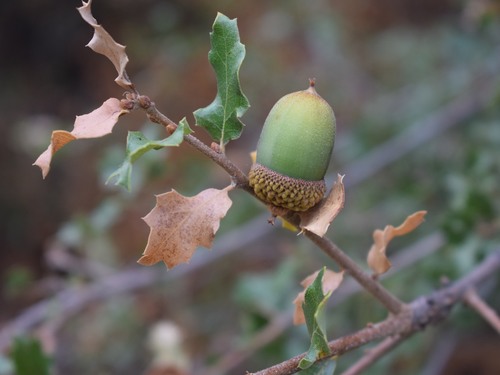


Quercus Berberidifolia
quercus berberidifolia
Quercus berberidifolia, gemeinhin bekannt als Kalifornische Busch-Eiche, ist ein äußerst widerstandsfähiger immergrüner Strauch oder kleiner Baum, der in den Chaparral-Ökosystemen Kaliforniens beheimatet ist. Diese robuste Holzpflanze ist ein Eckpfeiler ihres Lebensraums, sie bietet entscheidenden Erosionsschutz an trockenen Berghängen und dient als unschätzbare Nahrungs- und Schutzquelle für eine vielfältige lokale Tierwelt. Sie ist in der Lage, intensive Sommerdürren und wiederkehrende Waldbrände zu überleben, und verkörpert die robuste Ausdauer der heimischen Flora Kaliforniens.
Lebensraum: Primär in trockenen Chaparral-, Küsten-Salbei-Busch- und offenen Eichenwald-Ökosystemen in ganz Kalifornien zu finden.
Dieser immergrüne Strauch wächst typischerweise zwischen 100 und 400 Zentimeter hoch und bildet dichte, verzweigte Dickichte. Seine Blätter sind klein, ledrig und ovalförmig, gekennzeichnet durch scharfe, dornige Ränder, die Stechpalmen ähneln. Die obere Blattoberfläche ist ein mattes, staubiges Grün, während die Unterseite ein blasseres Graugrün ist und mit winzigen, feinen Haaren bedeckt ist. Im Herbst produziert sie unverwechselbare eiförmige Eicheln, die in flachen, schuppigen Kappen sitzen.
Kategorie
PflanzenSeltenheit
Gewöhnlich
Gefahr
1/5 · Sehr gering
Snaps
1
Trotz ihres kleinen, buschigen, strauchartigen Aussehens ist sie ein echtes Mitglied der Eichenfamilie und gehört zur selben Gattung wie riesige Wald-Eichen.
Ihr Artname 'berberidifolia' bedeutet 'berberitzenblättrig' und bezieht sich auf die Ähnlichkeit ihrer stacheligen Blätter mit denen von Berberitzensträuchern.
Die Eicheln dieser Pflanze wurden historisch von indigenen kalifornischen Stämmen geerntet, von Gerbstoffen befreit und zu Mehl gemahlen.
Als autotrophe Pflanze erzeugt sie ihre eigene Energie mittels Photosynthese, indem sie Sonnenlicht, Wasser und Kohlendioxid in Zucker umwandelt.
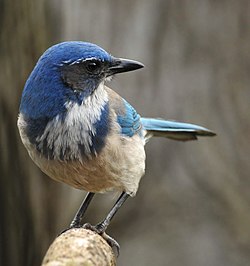
Aphelocoma californica
Der Buschhäher versteckt und vergräbt die Eicheln und pflanzt so unwissentlich neue Eichenbäume, wenn er vergessen hat, wo er sie versteckt hat.

Odocoileus hemionus
Ernährt sich von den Blättern, jungen Trieben und nährstoffreichen Eicheln der Busch-Eiche.
Andricus quercuscalifornicus
Legt Eier in die Zweige der Eiche, wodurch die Pflanze helle, stachelige Gallen bildet, die die Wespenlarven schützen.
Für dieses Objekt sind noch keine Merkmal-Badges vergeben.
Sammlungen für dieses Objekt erscheinen hier, wenn weitere Themen hinzugefügt werden.
Gefahr
1/5 · Sehr gering
Noch keine besonderen Sicherheitshinweise.
Beginne mit der ganzen Pflanze und vergleiche dann Blattstellung, Blattränder, Stängel und eventuelle Blüten oder Früchte. Gegenständige Blätter wachsen paarweise, wechselständige einzeln am Stängel. Zusammen verraten diese Details weit mehr als ein einzelnes grünes Blatt. Pflanzen bestimmen: Lade ein Foto hoch und vergleiche die sichtbaren Merkmale.
100-400 cm
50-150 Jahre
Als autotrophe Pflanze erzeugt sie ihre eigene Energie mittels Photosynthese, indem sie Sonnenlicht, Wasser und Kohlendioxid in Zucker umwandelt.
Primär in trockenen Chaparral-, Küsten-Salbei-Busch- und offenen Eichenwald-Ökosystemen in ganz Kalifornien zu finden.
Zoome hinein, um Cluster aufzulösen und zu sehen, wo dieses Objekt fotografiert wurde.

California, US
Hier kann man sehen Westlicher Zaunleguan und Kalifornischer Mohn.
Führer anzeigen →

California, US
Hier kann man sehen Graublättrige Zistrose und Sprödblatt-Manzanita.
Führer anzeigen →
Nimm die Entdeckung mit
Fotografiere deinen Fund mit Snappit, bestimme die Art und füge die Entdeckung deiner Sammlung hinzu.