
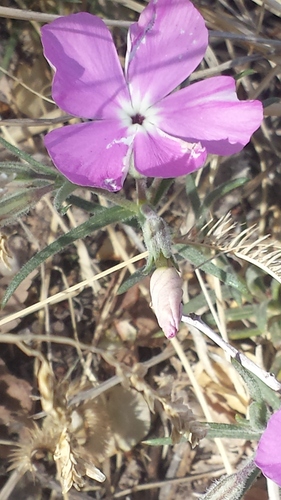


Santa Fe Phlox
phlox nana
Der Santa Fe Phlox, wissenschaftlich bekannt als Phlox nana, ist eine charmante und widerstandsfähige ausdauernde krautige Pflanze, die in den ariden und semi-ariden Regionen der südwestlichen Vereinigten Staaten beheimatet ist. Diese Art ist bekannt für ihren kompakten Wuchs und ihre üppige Blütenpracht, die sie in ihrer oft rauen Umgebung hervorstechen lässt. Sie spielt eine entscheidende Rolle in ihrem Ökosystem, indem sie früh in der Saison Nektar für verschiedene Bestäuber liefert und zur Bodenstabilisierung in trockenen, felsigen Böden beiträgt. Ihre Fähigkeit, unter herausfordernden Bedingungen zu gedeihen, zeigt die Anpassungsfähigkeit und Schönheit der Natur.
Lebensraum: Der Santa Fe Phlox ist typischerweise in trockenen, felsigen oder sandigen Böden zu finden, oft in offenen Graslandschaften, Pinyon-Wacholder-Wäldern oder Wüstenstrauchhabitaten.
Der Santa Fe Phlox bildet typischerweise eine niedrig wachsende, mattenartige Pflanze, die gewöhnlich eine Höhe von 5 bis 20 Zentimetern erreicht. Ihre schmalen, linearen Blätter sind oft mit feinen Haaren bedeckt, was ihnen ein leicht graugrünes Aussehen verleiht. Die Hauptattraktion sind ihre fünfblättrigen, trichterförmigen Blüten, die farblich von leuchtendem Rosa bis Lavendel reichen, manchmal reinweiß erscheinen und oft ein deutliches dunkleres Auge oder einen Streifen in der Mitte haben. Diese Blüten messen typischerweise 1,5 bis 2,5 cm im Durchmesser und sind an den Stielspitzen gebündelt.
Kategorie
PflanzenSeltenheit
Gewöhnlich
Gefahr
1/5 · Sehr gering
Snaps
Mach den ersten Snap!
Trotz ihres zarten Aussehens ist Phlox nana unglaublich robust und gedeiht oft in extremer Hitze und Trockenheit, wo viele andere Pflanzen Schwierigkeiten haben.
Ihre kompakte Größe und lebhaften Blüten machen sie zu einer beliebten Wahl für Liebhaber heimischer Pflanzen, die wasser sparende Xeriscape-Gärten anlegen möchten.
Der Gattungsname 'Phlox' stammt vom griechischen Wort für 'Flamme', was wahrscheinlich auf die intensiven, feurigen Farben einiger Phlox-Arten hinweist.
Dieser Phlox besitzt ein gut entwickeltes Pfahlwurzelsystem, das ihm ermöglicht, tiefer gelegene Bodenfeuchtigkeit zu erreichen, was das Überleben in langen Dürreperioden, die in seinem natürlichen Lebensraum häufig sind, ermöglicht.
Ihre leuchtend gefärbten, duftenden Blüten wirken als starkes visuelles und olfaktorisches Signal und ziehen eine Vielzahl von Bestäubern wie Bienen und Schmetterlinge an, die für ihre Fortpflanzung unerlässlich sind.
Die Pflanze produziert zahlreiche kleine Samen, die effizient durch Wind oder kleine Tiere verbreitet werden, wodurch sie nach günstigen Bedingungen schnell neue geeignete Gebiete besiedeln kann.
Als autotrophe Pflanze produziert der Santa Fe Phlox seine eigene Nahrung durch Photosynthese, indem er Sonnenlicht, Kohlendioxid und Wasser in Zucker für Energie und Wachstum umwandelt.

Apis mellifera
Primärer Bestäuber, sammelt Nektar und Pollen.

Vanessa cardui
Primärer Bestäuber, sammelt Nektar und trägt zur Kreuzbestäubung bei.

Odocoileus hemionus
Frisst Blätter und Stängel, kann die Pflanzengesundheit beeinträchtigen.
Für dieses Objekt sind noch keine Merkmal-Badges vergeben.
Noch keine Alternativnamen vorhanden.
Sammlungen für dieses Objekt erscheinen hier, wenn weitere Themen hinzugefügt werden.
Gefahr
1/5 · Sehr gering
Noch keine besonderen Sicherheitshinweise.
Beginne mit der ganzen Pflanze und vergleiche dann Blattstellung, Blattränder, Stängel und eventuelle Blüten oder Früchte. Gegenständige Blätter wachsen paarweise, wechselständige einzeln am Stängel. Zusammen verraten diese Details weit mehr als ein einzelnes grünes Blatt. Pflanzen bestimmen: Lade ein Foto hoch und vergleiche die sichtbaren Merkmale.
5-20 cm
2-5 Jahre
Als autotrophe Pflanze produziert der Santa Fe Phlox seine eigene Nahrung durch Photosynthese, indem er Sonnenlicht, Kohlendioxid und Wasser in Zucker für Energie und Wachstum umwandelt.
Der Santa Fe Phlox ist typischerweise in trockenen, felsigen oder sandigen Böden zu finden, oft in offenen Graslandschaften, Pinyon-Wacholder-Wäldern oder Wüstenstrauchhabitaten.
Photosynthese
Zoome hinein, um Cluster aufzulösen und zu sehen, wo dieses Objekt fotografiert wurde.
Neueste Snaps erscheinen hier, wenn neue Beobachtungen hinzukommen.

New Mexico, US
Hier kann man sehen Baum-Cholla, Colorado-Pinyon-Kiefer und Hausgimpel.
Führer anzeigen →

Texas, US
Hier kann man sehen Texas-Igelkaktus und Geschmückte Baumleguan.
Führer anzeigen →

New Mexico, US
Hier kann man sehen Baum-Cholla, Colorado-Pinyon-Kiefer und Apachenfeder.
Führer anzeigen →
Nimm die Entdeckung mit
Fotografiere deinen Fund mit Snappit, bestimme die Art und füge die Entdeckung deiner Sammlung hinzu.

















