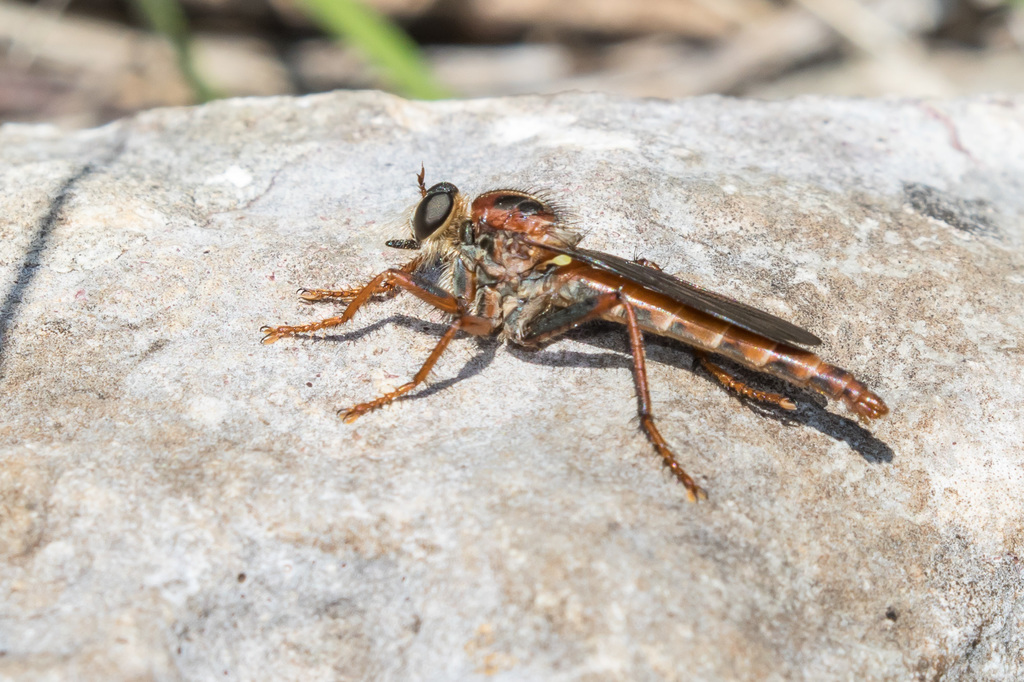





Stenopogon inquinatus
Stenopogon inquinatus
Die Stenopogon inquinatus ist eine lustige kleine Fliege, die gerne herumschwirrt! Man findet sie oft in Wassernähe und sie ist bekannt für ihren einzigartigen, farbenfrohen Körper.
Lebensraum: Feuchtgebiete
Die Stenopogon inquinatus ist eine mittelgroße Raubfliege, typischerweise graubraun mit borstigen Beinen und einem markanten 'Schnurrbart' aus Haaren um ihre Mundwerkzeuge. Sie hat große, prominente rötlich-braune Facettenaugen, die ihr eine ausgezeichnete Jagdvision verleihen.
Kategorie
InsektenSeltenheit
Gewöhnlich
Gefahr
1/5 · Sehr gering
Snaps
Mach den ersten Snap!
Raubfliegen hocken oft auf sonnigen Felsen oder Ästen und warten geduldig auf eine Mahlzeit, die vorbeifliegt!
Einige Raubfliegenarten imitieren geschickt Bienen oder Wespen, um Fressfeinde abzuschrecken!
Ihre Larven sind ebenfalls wilde Jäger, die im Boden leben und andere Insektenlarven fressen!
Sie trinken keinen Nektar; sie stechen ihre Beute und schlürfen deren verflüssigtes Inneres heraus!
Stenopogon inquinatus kann Beute mit unglaublicher Geschwindigkeit und Agilität auflauern, indem sie ihr scharfes Sehvermögen nutzt, um Ziele genau zu bestimmen.
Stenopogon inquinatus hat ein starkes Gift, das durch ihren Rüssel injiziert wird und ihre Insektenbeute schnell lähmt.
Stenopogon inquinatus hat starke, borstige Beine, die ihr helfen, kämpfende Beute im Flug sicher zu greifen.
Dieses Insekt ist ein geschickter Jäger und jagt andere Insekten, um seine Mahlzeiten zu erhalten.
Altersunterschiede: Larven sind räuberisch und ernähren sich von kleinen bodenbewohnenden Insekten und Engerlingen, während erwachsene Tiere fliegende Insekten jagen.
Apis mellifera
Ein häufiges fliegendes Insekt als Beute für erwachsene Raubfliegen.

Vespula vulgaris
Trotz ihres Stiches sind Wespen Beute für diese agilen Jäger.

Melanoplus sanguinipes
Größere Insekten wie Heuschrecken sind wichtige Nahrungsquellen.
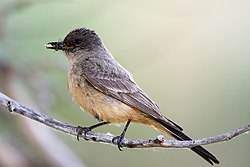
Sayornis saya
Dieser Vogel jagt verschiedene Insekten, einschließlich Raubfliegen.
Soziale Tiere leben in organisierten Gruppen und kooperieren, um ihr Überleben zu sichern, beispielsweise bei der Nahrungssuche, Verteidigung und Aufzucht der Jungen.
Dieses Merkmal kennzeichnet Organismen, deren Ernährung sowohl pflanzliche als auch tierische Bestandteile umfasst.
Luftbewohnende Tiere verbringen einen erheblichen Teil ihres Lebens in der Luft und nutzen den Flug für verschiedene Aktivitäten wie Jagd, Wanderungen oder Nestbau.
Farbenfroh beschreibt Organismen oder Objekte, die eine große Vielfalt an leuchtenden und deutlich erkennbaren Farben aufweisen.
Dieses Lebensraummerkmal kennzeichnet Arten, die in Feuchtgebieten vorkommen. Dies sind Landflächen, die dauerhaft oder saisonal mit Wasser gesättigt sind, darunter Marschland, Sümpfe und Moore.
Dieses Merkmal kennzeichnet Lebewesen, die bei der Jagd, Flucht oder Fortbewegung eine außergewöhnliche Schnelligkeit aufweisen.
Tagaktive Tiere sind hauptsächlich bei Tageslicht aktiv und ruhen oder schlafen in der Regel nachts.
Beschreibt Organismen, die Pollen übertragen und so die Befruchtung und Fortpflanzung von Pflanzen ermöglichen.
Noch keine Alternativnamen vorhanden.
Gefahr
1/5 · Sehr gering
Diese Fliegen sind harmlos, aber es ist am besten, sie aus der Ferne zu beobachten.
Achte auf sechs Beine, Fühler, drei Körperabschnitte und die Form der Flügel. Käfer haben gehärtete Vorderflügel, Fliegen nur ein funktionierendes Flügelpaar. Winzige Insekten müssen oft aus der Nähe betrachtet werden, bevor ihre Gruppe klar wird. Insekten bestimmen: Lade ein Foto hoch und vergleiche die sichtbaren Merkmale.
22-30 mm
15-20 mm
14-45 Tage
40 km/h
Dieses Insekt ist ein geschickter Jäger und jagt andere Insekten, um seine Mahlzeiten zu erhalten.
Feuchtgebiete
Lauerjagd
Zoome hinein, um Cluster aufzulösen und zu sehen, wo dieses Objekt fotografiert wurde.
Neueste Snaps erscheinen hier, wenn neue Beobachtungen hinzukommen.
Nimm die Entdeckung mit
Fotografiere deinen Fund mit Snappit, bestimme die Art und füge die Entdeckung deiner Sammlung hinzu.