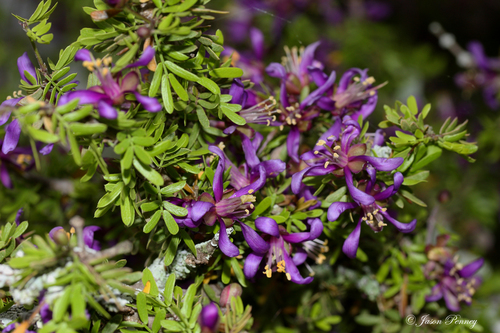


Texas Lignum Vitae
guaiacum angustifolium
Das Texas Lignum Vitae, lokal bekannt als Guayacan, ist ein bemerkenswert robuster, langsam wachsender immergrüner Strauch oder kleiner Baum, der in den ariden Buschlandschaften des südlichen Texas und nördlichen Mexikos beheimatet ist. Bekannt für sein unglaublich dichtes, schweres Holz und leuchtend lila Blüten, spielt diese widerstandsfähige Pflanze eine entscheidende ökologische Rolle in ihrem rauen Wüstenhabitat, indem sie ein wichtiges Schutz und Nahrung für die lokale Tierwelt bietet. Historisch wurde ihr zähes, harziges Holz für industrielle Anwendungen hoch geschätzt, und ihre medizinischen Eigenschaften brachten ihr den Namen 'Baum des Lebens' ein. Heute wird sie sowohl als einheimischer Überlebenskünstler als auch als Zierpflanze für wassersparende Gärten geschätzt.
Lebensraum: Findet sich in ariden Buschlandschaften, felsigen Hängen und der Tamaulipas-Dornenstrauchsavanne im südlichen Texas und nördlichen Mexiko.
Diese Art bildet einen knorrigen, mehrfach verzweigten Strauch oder kleinen Baum, der 1 bis 6 Meter hoch wird. Er besitzt kleine, dunkelgrüne gefiederte Blätter mit schmalen, gegenständigen Fiederblättchen, die sich zur Feuchtigkeitskonservierung zusammenfalten können. Im Frühling oder nach starken Regenfällen sind die Zweige mit Büscheln fünfblättriger, violett- bis blau-purpurfarbener Blüten mit leuchtend gelben Staubgefäßen geschmückt, die schließlich herzförmigen, orange-gelben Samenkapseln mit glänzenden, scharlachroten Samen weichen.
Kategorie
PflanzenSeltenheit
Common
Gefahr
1/5 · Sehr gering
Snaps
1
Aufgrund seines hohen Harzgehalts ist das Holz von Natur aus selbstschmierend und wurde historisch zur Herstellung von Lagern für Schiffspropellerwellen verwendet.
Sein Holz ist so dicht und schwer, dass es nicht schwimmen kann und sofort sinkt, wenn es ins Wasser gelegt wird.
Der gebräuchliche Name 'Lignum-Vitae' bedeutet im Lateinischen 'Holz des Lebens', was auf die historischen medizinischen Verwendungen seiner Rinde und Harzes zurückzuführen ist.
Produziert ihre eigenen organischen Verbindungen unter Nutzung von Sonnenlicht, Kohlendioxid, Wasser und essentiellen Bodenmineralien durch Photosynthese.
Für dieses Objekt sind noch keine Merkmal-Badges vergeben.
Noch keine Alternativnamen vorhanden.
Sammlungen für dieses Objekt erscheinen hier, wenn weitere Themen hinzugefügt werden.
Gefahr
1/5 · Sehr gering
Noch keine besonderen Sicherheitshinweise.
Der einfachste Weg, Texas Lignum Vitae zu bestimmen, ist die Verwendung der Naturführer-App Snappit.
100-600 cm
50-150 Jahre
Produziert ihre eigenen organischen Verbindungen unter Nutzung von Sonnenlicht, Kohlendioxid, Wasser und essentiellen Bodenmineralien durch Photosynthese.
Findet sich in ariden Buschlandschaften, felsigen Hängen und der Tamaulipas-Dornenstrauchsavanne im südlichen Texas und nördlichen Mexiko.
Photosynthese
Zoome hinein, um Cluster aufzulösen und zu sehen, wo dieses Objekt fotografiert wurde.
Nimm die Entdeckung mit
Fotografiere deinen Fund mit Snappit, bestimme die Art und füge die Entdeckung deiner Sammlung hinzu.












.jpg&width=800)



_001.jpg&width=800)




