
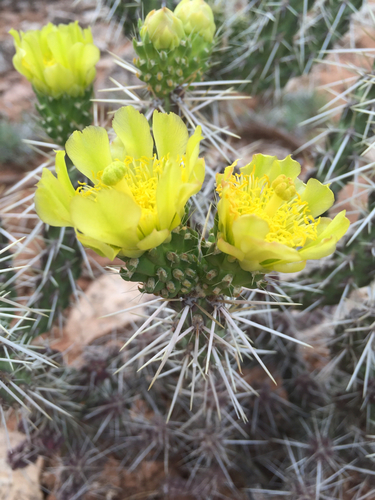


Whipple-Cholla
cylindropuntia whipplei
Die Whipple-Cholla, wissenschaftlich bekannt als Cylindropuntia whipplei, ist ein stark verzweigter, strauchartiger Kaktus, der in den Hochwüstenregionen der südwestlichen Vereinigten Staaten heimisch ist. Oft bildet sie dichte, niedrig wachsende Dickichte, und diese widerstandsfähige Art ist gut an die kalten Winter und trockenen, sengenden Sommer des Colorado-Plateaus angepasst. Sie sticht in ihrer ariden Landschaft hervor, indem sie eine leuchtende hellgrüne Färbung beibehält und kleine, hellgrüne Blüten produziert, die zu fleischigen, gelben, stachellosen Früchten heranreifen.
Lebensraum: Typischerweise auf sandigen Ebenen, felsigen Hängen und Lehmböden innerhalb von Wüstengrasland und Pinyon-Juniper-Wäldern zu finden.
Dieser Kaktus wächst typischerweise als niedriger, ausladender Strauch oder aufrechter Horst zwischen 30 und 150 Zentimetern Höhe. Er weist zylindrische, tief tuberose grüne Stängel auf, die dicht mit hellweißen oder gelben Stacheln bedeckt sind. Die Stacheln sind von durchscheinenden, papierartigen Scheiden umhüllt, die Licht reflektieren und der Pflanze ein schimmerndes, silbriges Aussehen verleihen. Im Spätfrühling produziert sie gelb-grüne Blüten von etwa 2 bis 3 Zentimetern Breite, gefolgt von persistenten, knorrigen, leuchtend gelben Früchten.
Kategorie
PflanzenSeltenheit
Gewöhnlich
Gefahr
1/5 · Sehr gering
Snaps
Mach den ersten Snap!
Da sich die Stängelsegmente so leicht lösen und an vorbeiziehenden Tieren festhaken, trägt diese Pflanze den Spitznamen 'Anhalter' als primäre Methode, neues Territorium zu besiedeln.
Indianische Stämme, einschließlich der Hopi, nutzten die gelben Früchte historisch als Nahrung und aßen sie roh, gedünstet oder getrocknet zur Winterlagerung.
Die papierartigen Scheiden, die die Stacheln umgeben, wirken wie Miniatur-Sonnenschirme und reduzieren die Umgebungstemperatur der Pflanzenhaut.
Ihre Stacheln sind von papierartigen, durchscheinenden Scheiden bedeckt, die intensive Sonneneinstrahlung reflektieren, den Stängel kühlen und den Wasserverlust reduzieren.
Die Stängelsegmente lösen sich leicht; wenn sie fallen oder von Tieren weggetragen werden, wurzeln sie leicht im Boden und bilden neue Klonpflanzen.
Sie nutzt die CAM-Photosynthese, öffnet ihre Spaltöffnungen nachts, um Kohlendioxid aufzunehmen, und minimiert die Wasserverdunstung während des heißen Tages.
Als photosynthetische Pflanze produziert sie ihre eigene Energie mithilfe von Sonnenlicht, Wasser und Kohlendioxid.

Campylorhynchus brunneicapillus
Bietet kritische Nistplätze, physischen Schutz vor Raubtieren und eine Nahrungsquelle für die Vögel.
Ovis canadensis nelsoni
Ernährt sich von den stachellosen gelben Früchten und gelegentlich von den fleischigen Stängeln während Dürreperioden.
Diadasia rinconis
Besucht die grünlich-gelben Blüten, um Pollen und Nektar zu sammeln, und fungiert als primärer Bestäuber.
Für dieses Objekt sind noch keine Merkmal-Badges vergeben.
Noch keine Alternativnamen vorhanden.
Sammlungen für dieses Objekt erscheinen hier, wenn weitere Themen hinzugefügt werden.
Gefahr
1/5 · Sehr gering
Noch keine besonderen Sicherheitshinweise.
Vergleiche Blattstellung, Rosettenform, Rippen, Dornen und Blüten. Bedenke, dass Trockenheit und starke Sonne Farbe und Form einer Pflanze verändern können. Sukkulenten bestimmen: Lade ein Foto hoch und vergleiche die sichtbaren Merkmale.
30-150 cm
1-25 kg
20-100 Jahre
Als photosynthetische Pflanze produziert sie ihre eigene Energie mithilfe von Sonnenlicht, Wasser und Kohlendioxid.
Typischerweise auf sandigen Ebenen, felsigen Hängen und Lehmböden innerhalb von Wüstengrasland und Pinyon-Juniper-Wäldern zu finden.
Futtersuche
Zoome hinein, um Cluster aufzulösen und zu sehen, wo dieses Objekt fotografiert wurde.
Neueste Snaps erscheinen hier, wenn neue Beobachtungen hinzukommen.

New Mexico, US
Hier kann man sehen Pinkblütiger Igelkaktus und Feuerkaktus.
Führer anzeigen →

New Mexico, US
Hier kann man sehen Kolkrabe, Haussperling und Vierflügelige Salzmeld.
Führer anzeigen →

Colorado, US
Hier kann man sehen Maultierhirsch und Gummi-Kaninchenbürste.
Führer anzeigen →
Nimm die Entdeckung mit
Fotografiere deinen Fund mit Snappit, bestimme die Art und füge die Entdeckung deiner Sammlung hinzu.

















