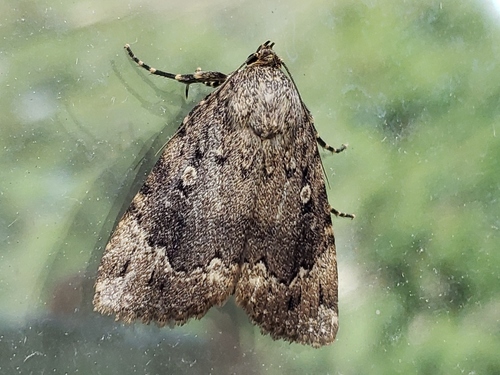


American Copper Underwing
amphipyra pyramidoides
The American Copper Underwing (Amphipyra pyramidoides) is a captivating nocturnal moth native to North America. Known for its clever concealment strategies, this moth features drab, bark-like forewings that blend seamlessly with tree trunks during the day, keeping it safe from hungry birds. However, when disturbed or in flight, it reveals a brilliant flash of coppery-orange on its hindwings—a defensive mechanism designed to startle potential predators. The caterpillars are equally distinctive, possessing a bright green body with a prominent yellow stripe along each side and a striking pyramid-shaped hump on the rear. This common but delightful species is a favorite among backyard entomologists and plays an important role in forest ecosystems as both a herbivore and a food source for nocturnal insectivores.
Hábitat: Found in deciduous forests, suburban gardens, orchards, and parks across North America where larval host plants are abundant.
The adult moth has a wingspan of 4 to 5 cm. Its forewings are mottled with dark brown, grey, and black, perfectly mimicking tree bark, complete with thin, scalloped lines. In contrast, the hindwings are a bright, shiny coppery-orange or copper-brown, with a dark brown border. The caterpillar is pale green, decorated with a yellow lateral line, a thin white dorsal line, and a characteristic pointed, pyramid-shaped horn on its eighth abdominal segment.
Categoría
InsectosRareza
Common
Peligro
1/5 · Muy bajo
Snaps
¡Sé la primera persona en hacer un snap!
The caterpillar has a distinct, bright yellow stripe and a pyramidal rear hump, which earned it the scientific species name pyramidoides.
The common name underwing refers to the contrast between the drab forewings and the brilliantly colored copper hindwings hiding underneath.
Unlike many moths that fly immediately when disturbed, the American Copper Underwing often prefers to run or scurry sideways along tree bark to escape danger.
Flashes bright copper hindwings when threatened to startle predators while keeping its cryptic forewings folded at rest.
Forewings mimic tree bark textures and shades, allowing the moth to remain completely hidden on trunks during daylight hours.
The caterpillar features a sharp rear hump that breaks up its caterpillar-like silhouette, helping it blend into leaf margins.
Caterpillars feed on the foliage of various deciduous trees and shrubs, while adults feed on sweet substances like rotting fruit, tree sap, and nectar.
Diferencias por edad: Larvae feed strictly on leafy foliage of woody plants, whereas adults transition to a liquid diet of nectar, sap, and fermenting fruit juices.
Quercus alba
Caterpillars feed heavily on the leaves of this tree species during spring.
Acer rubrum
Larvae use the foliage of this deciduous tree as a primary food source.
Megascops asio
This nocturnal bird hunts and feeds on adult moths during their late summer flight period.
Eptesicus fuscus
Uses echolocation to capture adult underwing moths mid-flight during the night.
Aún no hay insignias de rasgos asignadas a este objeto.
Todavía no hay alias listados.
Las colecciones para este objeto aparecerán aquí a medida que se añadan más temas.
Peligro
1/5 · Muy bajo
Todavía no hay notas especiales de seguridad.
La forma más fácil de identificar a American Copper Underwing es usar la aplicación de identificación de naturaleza Snappit.
2+ cm
4+ cm
0.0001+ kg
1+ años
15 km/h
Caterpillars feed on the foliage of various deciduous trees and shrubs, while adults feed on sweet substances like rotting fruit, tree sap, and nectar.
Found in deciduous forests, suburban gardens, orchards, and parks across North America where larval host plants are abundant.
Acércate para separar los grupos y explorar dónde se ha fotografiado este objeto.
Los snaps recientes aparecerán aquí a medida que se añadan nuevas observaciones.
















