Red Buckeye
Aesculus pavia
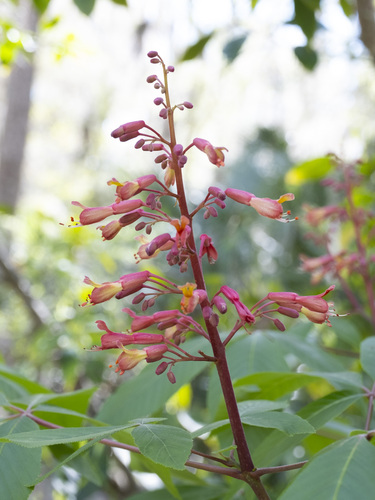
The Red Buckeye is a beautiful tree with bright red flowers that bloom in spring. It has large, shiny leaves and can grow up to 20 feet tall, making it a lovely sight in parks and gardens.
Hábitat: Forests
The Red Buckeye has striking clusters of bright red, tubular flowers in spring, making it easily identifiable. Its large, palmate leaves have five to seven leaflets. It produces shiny, dark brown seeds with a pale spot, truly resembling a deer's eye.
Categoría
PlantasRareza
Common
Peligro
2/5 · Bajo
Snaps
¡Sé la primera persona en hacer un snap!
Even though they look yummy, every single part of the Red Buckeye is toxic!
Its bright red flowers are like perfect straws for hummingbirds' long beaks!
Native Americans once used parts of the plant to make stunning red dyes!
The name 'buckeye' comes from its shiny, dark seeds, like a deer's eye!
Red Buckeye can attract hummingbirds with its bright red, tubular flowers, ensuring successful pollination.
Red Buckeye has toxic seeds, leaves, and bark that help it defend against hungry herbivores.
Red Buckeye can flower early in spring, getting a head start on resources and attracting pollinators.

Archilochus colubris
Its tubular red flowers provide nectar.

Bombus bimaculatus
Gathers nectar and pollen from the flowers.
Turdus migratorius
Uses branches for nesting and perching.
Las plantas aromáticas producen y emiten compuestos orgánicos volátiles fragantes, a menudo como defensa o para atraer a los polinizadores.
Las plantas caducifolias pierden periódicamente todas sus hojas, por lo general durante el otoño o las estaciones secas.
Las plantas con flores son cualquier planta que produce flores como parte de su ciclo reproductivo.
Las plantas de floración primaveral producen sus flores durante la temporada de primavera, lo que a menudo significa el final del invierno y el comienzo de un nuevo crecimiento.

Los árboles de hoja ancha son angiospermas caracterizadas por hojas planas y anchas que típicamente se caen anualmente en climas templados.

Colorido describe a organismos u objetos que exhiben una amplia variedad de colores brillantes y distintivos.

Describe plantas que son particularmente atractivas y beneficiosas para una amplia variedad de organismos polinizadores.

Los hábitats boscosos son entornos terrestres dominados por una densa cubierta arbórea, que sustentan una gran diversidad de vida animal y vegetal.
Todavía no hay alias listados.
Peligro
2/5 · Bajo
Do not eat the seeds from the Red Buckeye; they can make you feel sick.
300-600 cm
300-600 cm
2.5-4 cm
Primavera
No
Alta
Perenne
Aves
Acércate para separar los grupos y explorar dónde se ha fotografiado este objeto.
Los snaps recientes aparecerán aquí a medida que se añadan nuevas observaciones.

Tennessee, US
Puedes ver Red Buckeye, Prairie Trillium y Largeflower Bellwort.
Ver guía →

Georgia, US
Puedes ver Elf Orpine, Dimpled Trout Lily y Porter's Sunflower.
Ver guía →
Tennessee, US
Puedes ver Red Buckeye, Aniseroot y Christmas Fern.
Ver guía →
Texas, US
Puedes ver Red Buckeye, American Beautyberry y Pond Slider.
Ver guía →