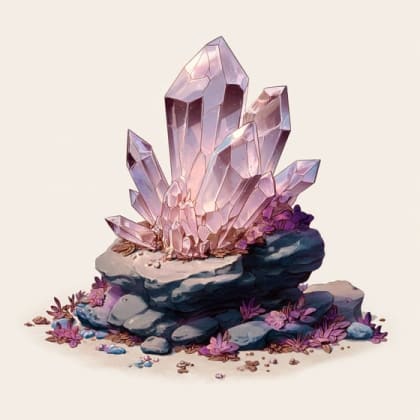



Agate
Agate is a colorful stone with beautiful patterns! Each piece is unique, just like a snowflake.
The Agate is a translucent, often vibrantly colored mineral known for its distinctive bands or stripes. These intricate patterns, resembling tiny landscapes or eyes, form within a typically rounded nodule. Its glassy luster makes its layered colors shine.
Category
MineralRarity
Common
Danger
1/5 · Very low
Snaps
Be the first to snap!
Ancient Egyptians used Agate for seals and carvings thousands of years ago.
Some Agate forms inside gas bubbles within ancient lava!
The famous 'Agate Beach' in Oregon is covered in colorful Agate pebbles!
You can find Agate nodules that look like tiny thunder eggs!
Agate's microscopic quartz crystals allow it to absorb different mineral impurities, creating its amazing spectrum of colors and distinct bands.
Because Agate is very hard (7 on Mohs scale), it resists erosion, preserving geological history for millions of years.
Agate can be translucent, allowing light to pass through its layers, highlighting its stunning internal patterns and colors.
Banded describes rocks or minerals characterized by distinct parallel layers or streaks of differing composition, color, or texture.
Colorful describes organisms or objects displaying a wide range of bright and distinct colors.
A geode is a hollow, spherical rock formation lined with inward-growing crystals or concentric banding, often found in volcanic or sedimentary rocks.
A gemstone is a piece of mineral crystal which, when cut and polished, is used to make jewelry or other adornments.

Crystalline describes a mineral or rock composed of crystals, often exhibiting a regular atomic structure and geometric external form.

Natural refers to organisms, materials, or phenomena existing or produced by nature, not artificially created.
Danger
1/5 · Very low
Handle gently and avoid sharp edges. Ask an adult before picking anything up.
The easiest way to identify Agate is to use the Snappit nature identifier app.
white, gray, blue, red, green, yellow, brown, black, pink, purple
7
vitreous
2.6
trigonal
Zoom in to split clusters and explore where this object has been snapped.
Recent snaps will appear here as new observations are added.
Take the discovery with you
Snap it with Snappit to identify it, learn what makes it special, and add the discovery to your collection.