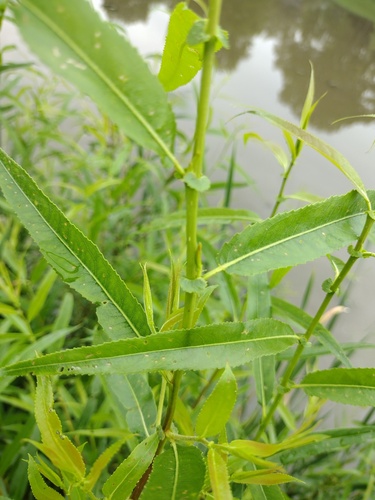
Black Willow
Quadrella cynophallophora (L.) Hutch.
The Black Willow has long, slender leaves and is often found near water. It’s a great tree for making shady spots!
Habitat: Wetlands and near rivers
The Black Willow has shaggy, deeply furrowed, dark brown to black bark, giving it its name. Its narrow, lance-shaped leaves are bright green above and paler below, often having finely toothed edges. It often grows with multiple trunks, creating a broad, irregular crown.
Category
TreesRarity
Common
Danger
1/5 · Very low
Snaps
8
Beavers absolutely love to munch on Black Willow bark and use its branches for their homes.
Its bark naturally contains a chemical similar to aspirin, used for centuries as medicine.
Its wood is so lightweight, it was once used to make artificial limbs and crates!
This tree is North America's largest native willow, towering over other willows!
Black Willow can stabilize riverbanks with its extensive, fibrous root system that holds soil firmly, preventing erosion during floods.
Black Willow has a super-fast growth rate that allows it to quickly colonize disturbed areas, especially along waterways.
Black Willow can sprout new trees from broken branches that fall into moist soil, a handy trick to spread rapidly.

Castor canadensis
eats bark and uses branches for dams.

Odocoileus virginianus
browses young twigs and foliage.
Plectrodera scalator
larvae tunnel into the tree's wood.
Aphis saliceti
sucks sap from leaves and young shoots.
Deciduous plants periodically shed all their leaves, typically during autumn or dry seasons.
Shade tolerant plants are adapted to grow and thrive in areas with low light levels, requiring less direct sunlight.
Broadleaf trees are angiosperms characterized by flat, wide leaves that are typically shed annually in temperate climates.
Rapid growing plants exhibit accelerated growth rates, quickly increasing in size and biomass within a short period.

This habitat trait identifies species found in wetlands, which are areas of land saturated with water, either permanently or seasonally, including marshes, swamps, and bogs.
Danger
1/5 · Very low
Do not pick or eat anything you find. Some plants and mushrooms can be harmful.
The easiest way to identify Black Willow is to use the Snappit nature identifier app.
10-30 m
10-15 m
Yes
50-150 cm
65-100 years
Wetlands and near rivers
Capsule
Zoom in to split clusters and explore where this object has been snapped.
May 27, 2026
Ridgewood Historic DistrictPhoto attribution
no rights reserved
License: CC0 1.0 ↗
Image may be shown cropped inside the card frame.

New Jersey, US
You might spot Garlic Mustard, Sensitive Fern, and Common Mugwort.
View guide →

New York, US
You might spot American White Waterlily, Buttonbush, and Common Milkweed.
View guide →

Texas, US
You might spot Texas Hedgehog Cactus, Ornate Tree Lizard, and Cactus Wren.
View guide →

District of Columbia, US
You might spot Spotted Lanternfly and Eastern Gray Squirrel.
View guide →

Ohio, US
You might spot Blue-Ringed Dancer, Bee, and American Rubyspot.
View guide →

Illinois, US
You might spot Cliff Swallow, Baldcypress, and Indian Heliotrope.
View guide →
Take the discovery with you
Snap it with Snappit to identify it, learn what makes it special, and add the discovery to your collection.