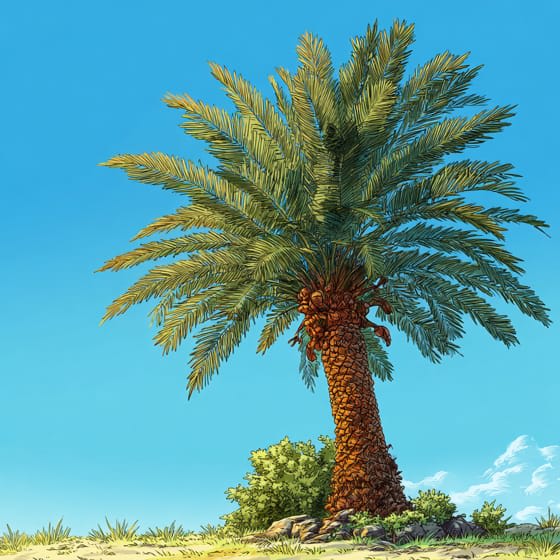





Canary Island Date Palm
Phoenix canariensis hort. ex Chabaud
The Canary Island Date Palm has tall, slender trunks and big, feathery leaves. It’s like a tropical paradise!
Habitat: Coastal areas and gardens
The Canary Island Date Palm has a thick, rough trunk adorned with unique diamond patterns from old leaf bases. It supports a magnificent crown of numerous arching, feather-like fronds. Its small, round fruits turn yellow-orange when ripe.
Category
TreesRarity
Common
Danger
1/5 · Very low
Snaps
Be the first to snap!
Its crown can have over 100 giant, feathery leaves, making it look super grand!
The rough diamond patterns on its trunk are scars left by old, fallen leaves!
They are often trimmed into a unique "pineapple top" shape in gardens and parks!
Though called "date palm," its small, orange dates are not as sweet as true dessert dates.
Canary Island Date Palm can thrive with little water thanks to adaptations that store moisture and reduce evaporation.
Canary Island Date Palm has a thick, fibrous trunk that helps protect its vital core from mild fires.
Canary Island Date Palm has a dense canopy of fronds that provides extensive shade, cooling its surroundings.

Sturnus unicolor
Feeds on the ripe fruits of the palm.

Rattus rattus
Consumes the dates, often climbing the palm.
Apis mellifera
Visits the flowers to collect nectar and pollen.
Pipistrellus maderensis
Roosts among the dense fronds for protection.
Ornamental plants are cultivated primarily for their aesthetic appeal, enhancing landscapes and gardens with their attractive foliage, flowers, or form.
Evergreen plants retain their foliage throughout the year, never shedding all their leaves at once.
Fruit-bearing plants produce fruits, which are the mature ovaries of flowering plants containing seeds.
Drought-tolerant plants can survive and flourish in conditions with limited water availability.
This human use trait identifies species cultivated as oil crops, harvested for their seeds or fruits from which vegetable oils are extracted for food, fuel, or industrial uses.

Coastal habitats are dynamic environments located along the interface between land and sea, influenced by tides, waves, and saltwater.
Danger
1/5 · Very low
Do not pick or eat anything you find. Some plants and mushrooms can be harmful.
The easiest way to identify Canary Island Date Palm is to use the Snappit nature identifier app.
10-20 m
5-10 m
Yes
80-100 cm
80-150 years
Coastal areas and gardens
Drupe
Zoom in to split clusters and explore where this object has been snapped.
Recent snaps will appear here as new observations are added.
Take the discovery with you
Snap it with Snappit to identify it, learn what makes it special, and add the discovery to your collection.











