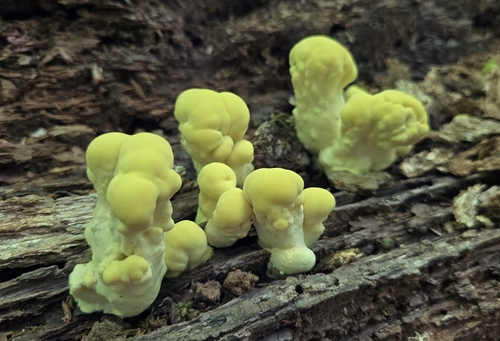




Chicken of the Woods
Laetiporus
The Chicken of the Woods is a bright orange fungus that grows on trees. It looks like a fluffy chicken and is often found in the woods!
Habitat: Forests and wooded areas
The Chicken of the Woods is a vibrant, shelf-like fungus with brilliant orange, yellow, or peach-colored surfaces and bright sulfur-yellow undersides. It grows in overlapping layers, lacking traditional gills, which makes it visually distinct from most other shelf fungi.
Category
FungiRarity
Rare
Danger
1/5 · Very low
Snaps
20
Indigenous peoples traditionally used it for food, showing its long history as a wild delicacy.
Its bright colors act like a beacon, signaling its presence from far away in the forest.
This fungus can grow huge, with some clusters weighing more than 50 pounds!
Unlike many mushrooms, it doesn't have gills; it releases millions of spores from tiny pores!
Chicken of the Woods can break down dead wood because of powerful enzymes that helps them recycle nutrients in the forest.
Chicken of the Woods can reappear year after year on the same tree because its mycelial network lives inside the wood.
Chicken of the Woods has bright colors that might warn some animals it’s not for them, helping protect its fruiting body.
Quercus rubra
Causes brown rot in red oak trees.
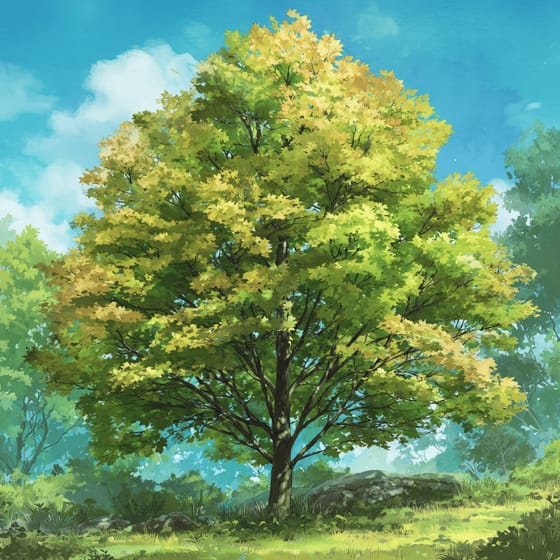
Acer saccharum
Decays the heartwood of sugar maples.

Arion ater
Feeds on the fungal fruiting body.
Spore-producing organisms reproduce by releasing small, often single-celled, reproductive units called spores.
Edible plants are those parts of a plant that are considered safe for human consumption.
Rapid growing plants exhibit accelerated growth rates, quickly increasing in size and biomass within a short period.
Forest habitats are terrestrial environments dominated by dense tree cover, supporting a high diversity of plant and animal life.
Danger
1/5 · Very low
Do not pick or eat anything you find. Some plants and mushrooms can be harmful.
The easiest way to identify Chicken of the Woods is to use the Snappit nature identifier app.
10-100 cm
edible
5-60 cm
Forests and wooded areas
wood
Late spring to fall
White or pale yellow
Zoom in to split clusters and explore where this object has been snapped.
Jun 12, 2026
ConcordPhoto attribution
(c) Ben Gruhot, some rights reserved (CC BY)
License: CC BY 4.0 ↗
Image may be shown cropped inside the card frame.

Rhode Island, US
You might spot Rugosa Rose and American Herring Gull.
View guide →

Tennessee, US
You might spot American Robin, Northern Cardinal, and Eastern Chipmunk.
View guide →

New Jersey, US
You might spot Mountain Laurel, Pink Lady's Slipper, and Fowler's Toad.
View guide →

Massachusetts, US
You might spot Common Eastern Bumble Bee, Bee, and Eastern Calligrapher.
View guide →
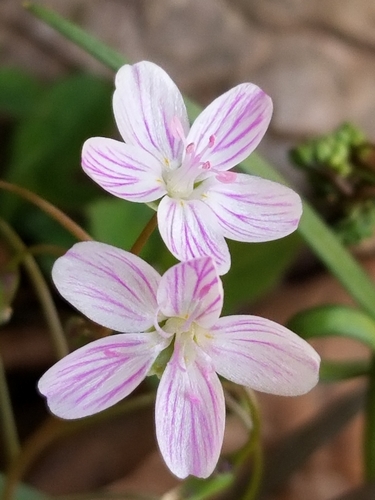
New Jersey, US
You might spot Virginia Springbeauty, Wineberry, and Multiflora Rose.
View guide →

Illinois, US
You might spot Common Milkweed and Common Eastern Bumble Bee.
View guide →
Take the discovery with you
Snap it with Snappit to identify it, learn what makes it special, and add the discovery to your collection.