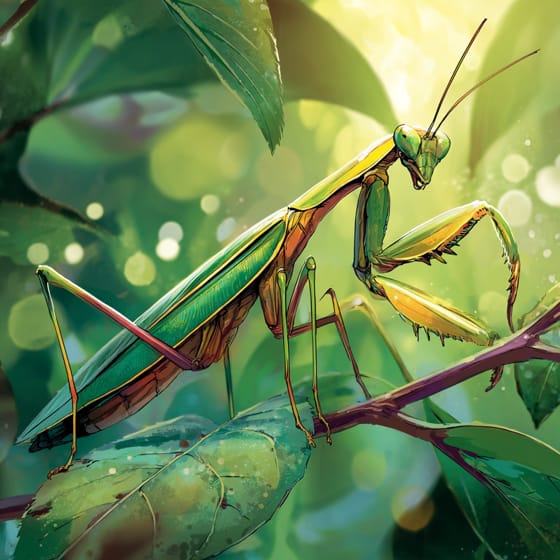





Chinese Mantis
Tenodera sinensis
The Chinese Mantis is a cool bug that can be green or brown. They are great at catching other insects with their long arms and can even turn their heads to look around!
Habitat: Gardens
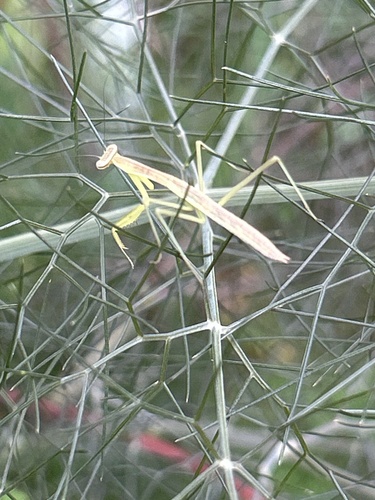
The Chinese Mantis is a large, elongated insect that can be bright green, brown, or tan, allowing it to blend into foliage. It has a distinctive triangular head with large eyes and powerful, spiny forelegs held in a prayer-like position.
Category
InsectsRarity
Common
Danger
1/5 · Very low
Snaps
40
A female mantis can lay hundreds of eggs in a foamy, protective case called an ootheca!
Sometimes, the female mantis eats the male after mating for a nutrient boost!
They only have one ear, located on their belly, which helps them detect bats!
This mantis is not native to North America but was brought there accidentally in the late 1800s!
Chinese Mantises can perfectly match the color of plants, helping them become invisible ambush predators.
The Chinese Mantis has super-fast, spiky forelegs that snap shut in a blink to catch unsuspecting prey.
Chinese Mantises can turn their heads almost all the way around to spot prey without moving their body.
These hungry insect hunters eat many different small animals, especially other insects!
Apis mellifera
a common food source
Schistocerca americana
a large insect prey
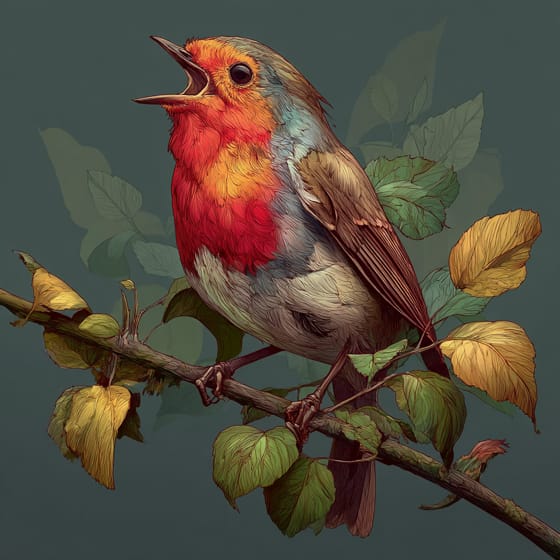
Turdus migratorius
a common bird predator
Didelphis virginiana
a nocturnal mammal predator
Solitary animals live alone for most of their lives, only interacting with others for mating or parental care.
Camouflaged describes organisms that possess coloring or patterns that allow them to blend into their environment.
Colorful describes organisms or objects displaying a wide range of bright and distinct colors.
This trait identifies organisms whose diet primarily consists of insects and other small invertebrates.

An ambush predator hunts by patiently waiting and concealing itself, then launching a sudden attack when unsuspecting prey comes within range.

This trait identifies organisms whose diet consists entirely or primarily of animal tissue.

This trait identifies organisms that exhibit exceptional swiftness in movement for hunting, escape, or travel.

This habitat trait indicates species that can coexist with humans in urban and suburban environments, utilizing man-made structures and green spaces.
Danger
1/5 · Very low
Be gentle and don't touch them unless an adult says it's okay.
The easiest way to identify Chinese Mantis is to use the Snappit nature identifier app.
90-240 mm
60-120 mm
150-240 days
These hungry insect hunters eat many different small animals, especially other insects!
Gardens
Ambush
6
Zoom in to split clusters and explore where this object has been snapped.
Jun 11, 2026
Brookside ReservationPhoto attribution
(c) Lisa Wiencek Gerbec, some rights reserved (CC BY)
License: CC BY 4.0 ↗
Image may be shown cropped inside the card frame.

Rhode Island, US
You might spot Common Eastern Bumble Bee and Osprey.
View guide →

Ohio, US
You might spot Spotted Lanternfly and White-Tailed Deer.
View guide →

Iowa, US
You might spot Common Eastern Bumble Bee and Eastern Cottontail.
View guide →

Ohio, US
You might spot Duck, Canada Goose, and Muscovy Duck.
View guide →

New Jersey, US
You might spot Duck, Canada Goose, and Red-Winged Blackbird.
View guide →

Kentucky, US
You might spot Bird's-Eye Speedwell and Barn Swallow.
View guide →
Take the discovery with you
Snap it with Snappit to identify it, learn what makes it special, and add the discovery to your collection.










.jpg&width=800)



