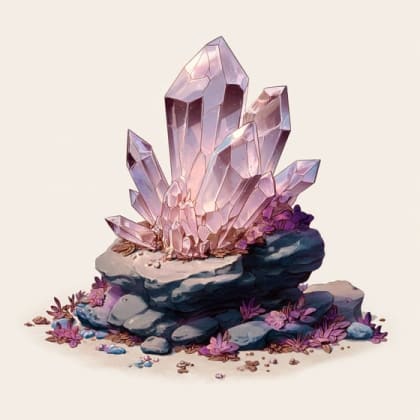




Clear Quartz
Clear quartz is a shiny, see-through crystal that looks like a tiny ice cube! It's known for its clarity and brightness.
The Clear Quartz is a transparent, colorless mineral that often looks like frozen water or pure ice. It commonly forms beautiful six-sided prisms with pointed ends, making it distinct from many other clear crystals.
Category
MineralRarity
Common
Danger
1/5 · Very low
Snaps
Be the first to snap!
Clear quartz can be found in giant crystals weighing more than a car!
It's tough enough to scratch most metals, like iron and steel!
Many beautiful gemstones, like amethyst, are just different colored quartz!
The sand on many beaches is mostly tiny grains of quartz!
Clear Quartz has a unique atomic structure that allows it to refract light, splitting it into dazzling rainbows.
Clear Quartz has a piezoelectric property, meaning it vibrates precisely when squeezed, making it perfect for clocks.
Clear Quartz has high transparency and resistance to heat, making it perfect for fiber optics that carry internet signals.
Vitreous luster describes a mineral's appearance when reflecting light, resembling glass, often translucent or transparent.
Fluorescent minerals emit visible light when exposed to ultraviolet light or other non-visible radiation, a phenomenon called fluorescence.
A gemstone is a piece of mineral crystal which, when cut and polished, is used to make jewelry or other adornments.
Crystalline describes a mineral or rock composed of crystals, often exhibiting a regular atomic structure and geometric external form.

Natural refers to organisms, materials, or phenomena existing or produced by nature, not artificially created.
Danger
1/5 · Very low
Handle gently and avoid sharp edges. Ask an adult before picking anything up.
The easiest way to identify Clear Quartz is to use the Snappit nature identifier app.
clear, transparent, colorless, milky white
7
vitreous
2.65
hexagonal
Zoom in to split clusters and explore where this object has been snapped.
Recent snaps will appear here as new observations are added.
Take the discovery with you
Snap it with Snappit to identify it, learn what makes it special, and add the discovery to your collection.