


Snappit logo
Snappit
Get App

Coral

Corals are sea animals related to jellyfish and sea anemones; reef-building stony corals (order Scleractinia) live as colonies of tiny polyps that build limestone skeletons and keep microscopic algae in their tissues, which make most of their food. Over thousands of years these skeletons pile up into coral reefs, the largest structures built by living things on Earth. Soft corals are related animals that do not build reefs.

Also known as Stony coral, Hard coral, Reef-building coral

Loading the 3D coral…
Coral
colorful trait badgesymbiotic trait badgekeystone species trait badgeminiature trait badge
Coral

Rarity: Common

Healthy

Coral abilities

  • up to 20 cm of branch a year (staghorn coral)

  • up to 90% of the algae’s food goes to the coral

  • 15–35% of daily needs from catching food

  • 2 kinds of tentacle: hunting and fighting

  • 105 species spawning on the same nights

  • +1 °C above the usual summer high can start it

  • 2–3 weeks after mild heat, some turn neonStill debated

Real corals

Photos from Wikimedia Commons. Four of them can repaint the 3D model.

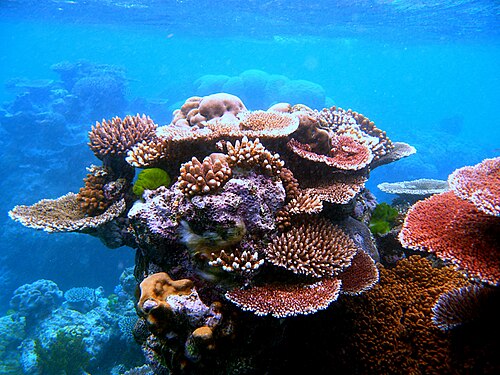
  • A colourful outcrop of table, branching and boulder corals in clear blue water
    HealthyGolden-brown tissue over the skeleton. At night the polyps open their tentacles.Algae inside make most of its foodHealthy corals on Flynn Reef, Great Barrier Reef. Photo: Toby Hudson, CC BY-SA 3.0
  • Wide, flat table corals stacked in layers with fish swimming over them
    Table corals (Acropora hyacinthus) in American SamoaPhoto: Wendy Cover / NOAA, Public domain
  • A round brain coral covered in winding ridges and grooves
    Boulder brain coral (Colpophyllia natans)Photo: Nick Hobgood, CC BY-SA 3.0
  • Close-up of a coral colony covered in small polyps with their tentacles out
    Galaxy coral polyps, Red SeaPhoto: Diego Delso, CC BY-SA 4.0
  • Coral polyps releasing small round bundles of eggs and sperm into dark water
    Polyps releasing egg and sperm bundles, Flower Garden Banks, Gulf of MexicoPhoto: G.P. Schmahl / NOAA, Public domain
  • A thicket of white, bleached branching coral
    BleachedWhite or very pale: the algae have left, so the white skeleton shows through the tissue.Alive but starving; it can recover if the water coolsBleached staghorn coral on the Great Barrier Reef. Photo: Matt Kieffer, CC BY-SA 2.0
  • A dome-shaped coral glowing bright green in dark water
    GlowingNeon green, yellow or red: the coral’s own fluorescent proteins shining under blue light. Some heat-stressed corals turn extra bright.Fluorescence, not bioluminescenceA coral’s fluorescent proteins glowing green, photographed in a public aquarium. Photo: Vincent Niochet, CC BY-SA 4.0
  • A large dead brain coral covered in fuzzy algae on a sandy reef
    DeadBare skeleton covered in a fuzzy turf of algae. No living polyps are left.Algae take over the space where corals livedDead brain coral overgrown by algae, Florida Keys. Photo: Jstuby, CC0
  • View from orbit of a coastline with pale reef patches in blue-green water
    Part of the Great Barrier Reef seen from the International Space Station in 2022Photo: NASA Johnson Space Center, Public domain
  • A large, folded leather soft coral on a reef with fish behind it
    A soft coral (probably Sarcophyton), Maldives: soft corals don’t build reefsPhoto: Tchami, CC BY-SA 2.0

Coral by the numbers

Measured by scientists and agencies, with comparisons you can picture.

Polyp size
1–3 mm
across, for most stony coral polyps⁠[2, 3]
Species
≈1,300
described stony coral species (a 2007 count), plus about 3,000 soft corals⁠[5]
Growth
up to 20 cm
Up to ≈10× faster⁠[4, 14]
Algae food
up to 90%
of what the algae make is passed to the coral⁠[6]
Reef area
348,361 km²
≈0.1% of the ocean’s surface⁠[37, 38]
Reef life
≈25%
of all marine life depends on reefs at some point⁠[18, 39]
Great Barrier Reef
3,863 reefs
stretching more than 2,000 km along Queensland⁠[12, 40]
Bleaching 2023–25
84%
of the world’s reef area hit by bleaching-level heat⁠[30]
Threatened
44%
of 892 reef-building coral species (IUCN, 2024)⁠[41]
Old age
400+ yrs
estimated for a 5.3 m tall Porites colony on the Great Barrier Reef⁠[15]

Coral myths and facts

Tap Myth or Fact for each claim, then check the answer.

0 of 8 answered

  1. “Coral is a plant.”

  2. “Coral is just a rock.”

  3. “You can see the Great Barrier Reef from space.”

  4. “Coral reefs cover less than 1% of the ocean but support about a quarter of sea life.”

  5. “A bleached coral is dead.”

  6. “All corals live in warm, shallow water.”

  7. “Fire coral is a kind of coral.”

  8. “Sunscreen is the main reason coral reefs are dying.”

Coral records

Superlatives and record holders, each checked against its source.

  • Biggest structure built by living things

    2,000+ km

    Great Barrier Reef, Australia

    3,863 reefs along the coast of Queensland⁠[40, 12]

  • Largest known coral colony (reported)

    111 m long

    A shoulder-blade coral (Pavona clavus), Great Barrier Reef

    about 3,970 m², found by citizen scientists in 2026 · preliminary measurements⁠[47, 48, 49]

  • Mega coral of the Solomon Islands

    34 × 32 m

    Pavona clavus colony found by National Geographic Pristine Seas

    about 5 m tall and roughly 300 years old · announced as the world’s largest in 2024⁠[49, 48]

  • Widest Porites coral measured

    10.4 m

    Muga dhambi (“big coral”), Goolboodi (Orpheus Island)

    wide and 5.3 m tall · estimated 421–438 years old⁠[15]

  • Oldest coral dated (2009 study)

    4,265 yrs

    A deep-sea black coral (Leiopathes)

    a black coral, not a stony coral · deep-sea corals like it grow only 4–35 µm a year⁠[50]

  • First forecast mass spawning

    1983

    105 coral species, Great Barrier Reef

    after mass spawning was first seen in 1981–82, scientists forecast the nights and watched 105 species spawn at reefs up to 500 km apart⁠[26]

  • Longest coral larval life recorded (2008 study)

    244 days

    Five reef-building species (lab study)

    maximum larval lifespans of 195–244 days, long enough to drift between distant reefs⁠[51]

Life of a coral

From a drifting egg to a colony that can live for centuries.

  1. Spawning night

    Eggs and sperm set free

    A few nights after a full moon, a colony releases its eggs and sperm into the water, at the same time as its neighbours. Most stony corals that make eggs and sperm spawn like this.⁠[26, 27]

  2. ≈2 hours

    First divisions

    Fertilised eggs start dividing about 2 hours after spawning.⁠[52]

  3. 1.5–2 days

    A swimming larva

    The embryo becomes a swimming larva called a planula. In one study, all the larvae checked were moving by 36 hours and fully mobile by 48 hours.⁠[52]

  4. 4–7 days

    Ready to settle

    In the lab, larvae of spawning corals settled 4–7 days after fertilisation. Some swim for weeks, and in the lab larvae have survived up to 244 days.⁠[52, 27, 51]

  5. Settling

    Choosing a home

    The larva sinks to the reef and picks a spot. Chemicals from crusty coralline algae can trigger it to turn into its first polyp, which starts building a limestone cup.⁠[53, 27]

  6. Early life

    Picking up algae

    Most corals take in their algae from the water around them rather than getting them from their parents.⁠[9]

  7. ≈3 years

    A small colony

    Polyps bud off clones and the colony spreads. In a restoration trial in the Philippines, young colonies averaged about 8 cm across after 35 months.⁠[27, 54]

  8. Grown up

    Ready to spawn

    Staghorn coral can breed once it is about 17 cm (7 inches) tall. Broken branches can also grow into new colonies.⁠[4]

  9. Centuries

    A long life

    Because polyps keep budding, colonies can live for hundreds of years. One Porites on the Great Barrier Reef is estimated at 421–438 years old.⁠[42, 4, 15]

Why coral reefs matter

Coral reefs take up a tiny share of the ocean but do a huge amount of work.

  • ≈0.1%

    of the ocean’s surface

    Shallow coral reefs cover about 348,000 km², according to satellite maps published in 2024.⁠[37, 38]

  • ≈25%

    of marine life depends on reefs

    At some point in their lives, including more than 4,000 fish species.⁠[18]

  • 830,000

    species estimated on reefs

    An expert estimate of all many-celled species living on coral reefs, known and not yet discovered (fungi not counted).⁠[19]

  • 97%

    of wave energy stopped

    Reefs cut wave energy by 97% on average, protecting coasts where 100 million or more people may benefit.⁠[55]

These are estimates: reef area depends on how a reef is defined, and many reef species are still undiscovered.

Are corals endangered?

Many are. Marine heatwaves are now the biggest danger, on top of pollution, disease and physical damage.

IUCN Red List

Varies by species

Corals don’t have one single Red List status: each species is assessed on its own. In 2024 the IUCN reassessed 892 reef-building coral species and found 44% threatened with extinction, up from about one third in 2008. Endangered is the most common threatened category among stony corals on the Red List (244 of 891 species).⁠[41, 16]

IUCN Red List: reef-building corals, Nov 2024

Threats

  • Marine heatwaves84%

    Climate change is the main threat. During the fourth global bleaching event (2023–2025), bleaching-level heat reached about 84% of the world’s reef area. Severe bleaching now returns about every 6 years.⁠[41, 30, 31]

  • Ocean acidification+30%

    The ocean absorbs carbon dioxide, which makes seawater more acidic: about 30% more since the Industrial Revolution. That makes it harder for corals to build their skeletons.⁠[56]

  • Crown-of-thorns starfish42%

    Outbreaks of this coral-eating starfish caused 42% of the coral loss on the Great Barrier Reef from 1985 to 2012. Storms caused 48% and bleaching 10%.⁠[57]

  • Pollution and runoff

    Sediment smothers corals, and fertiliser runoff feeds algae that can take over. Oil near the surface can damage eggs and sperm during spawning.⁠[35]

  • Disease

    About 40 coral diseases affect more than 200 hard coral species. Stony coral tissue loss disease, first reported off Florida in 2014, has almost wiped out pillar coral there.⁠[36, 20]

  • Physical damage

    Anchors, boat groundings, tangled litter and fishing gear, and people standing on reefs all break corals.⁠[58]

What’s helping

  • Cutting emissions1.5 °C

    Scientists project a further 70–90% loss of coral reefs at 1.5 °C of global warming and more than 99% at 2 °C. Cutting greenhouse gases is the main way to save corals.⁠[59, 41]

  • Protected areas

    No-take zones on the Great Barrier Reef, expanded in 2004, seem to have fewer crown-of-thorns outbreaks and more coral. Protection alone can’t stop extreme heat, though.⁠[60, 61]

  • Cleaner water

    Better water quality could help reduce starfish outbreaks. Without them, coral cover on the Great Barrier Reef could grow about 0.89% a year even with storms and bleaching.⁠[57]

  • Restoration60–70%

    Coral nurseries grow fragments and replant them, and some teams sow coral larvae. Projects report 60–70% survival but usually cover only about 100 m², and scientists stress it is no replacement for climate action.⁠[62, 11, 54]

  • Reef-safe visits

    Float above the reef, never stand on, touch or break coral, use mooring buoys instead of anchors, and choose mineral sunscreen or a sun shirt.⁠[58, 46]

Some corals and their Red List status

  • Staghorn coral (Acropora cervicornis)Critically Endangered

    A fast-growing Caribbean branching coral that helped build reefs there for 5,000 years. Hit by heat, disease, pollution and hurricanes.⁠[41, 4]

  • Elkhorn coral (Acropora palmata)Critically Endangered

    Staghorn’s partner reef-builder in the Caribbean, facing the same threats.⁠[41]

  • Grooved brain coral (Diploria labyrinthiformis)Critically Endangered

    An Atlantic brain coral. Atlantic corals are especially threatened by yearly severe bleaching, pollution and disease.⁠[16, 41]

  • Pillar coral (Dendrogyra cylindrus)Critically Endangered

    Naturally rare. Stony coral tissue loss disease has almost removed it from Florida.⁠[16, 20]

  • Table coral (Acropora hyacinthus)Endangered

    An Indo-Pacific table coral like the one in the model.⁠[16]

  • Lobe coral (Porites lobata)Least Concern

    A slow-growing boulder coral of the Indo-Pacific.⁠[16, 13]

  • White coral (Desmophyllum pertusum)Vulnerable

    A cold-water reef-builder of the deep sea, threatened by bottom trawling and other deep-sea activities.⁠[41]

Stony coral vs soft coral vs sea anemone

All three are anthozoans: animals that live their whole lives as polyps. Only stony corals build reefs.

Stony coral vs soft coral vs sea anemone
Stony coralSoft coralSea anemone
Group⁠[5]Order Scleractinia (hexacorals)Subclass OctocoralliaOrder Actiniaria (hexacorals)
Species⁠[5]≈1,300≈3,000≈1,200
Skeleton⁠[5, 3]Hard limestone cup under every polypTiny limestone spikes (sclerites) in soft tissueNone: soft-bodied
Body plan⁠[5]Usually in sixesAlways 8 tentacles, usually featheryUsually in sixes; tentacles not feathery
Lives as⁠[1, 45, 5]Mostly colonies; some live aloneColonies (one known solitary species)Single polyps
Builds reefs⁠[1, 3]Yes: the main reef buildersNoNo

Fire coral looks like a stony coral and helps build reefs, but it is a hydrozoan, more closely related to jellyfish.

Coral quiz

12 questions. Every answer is somewhere on this page.

Question 1 of 12Score 0

Is coral an animal, a plant or a rock?

Coral field notes

Diet, food web, safety and badges from the Snappit field guide.

Safety

Danger 1/5 · Very low

Don't touch, stand on, break or collect coral: it is alive, and fire coral, a jellyfish relative that looks like coral, stings. Float above the reef and tell an adult if you get stung.

Traits

Classification

Kingdom
Animalia
Phylum
Cnidaria
Class
Anthozoa

Also known as

Stony coral · Hard coral · Reef-building coral · Scleractinian coral · Reef Coral · Sea Coral

Sources for these coral facts

62 studies and references · checked
  1. NOAA National Ocean Service. Corals Tutorial: What are corals? (anatomy).
  2. NOAA National Ocean Service. Corals Tutorial: Polyps up close (anatomy diagram).
  3. NOAA National Ocean Service. Corals Tutorial: How do coral reefs grow? (hard and soft corals).
  4. NOAA Fisheries. Staghorn coral (Acropora cervicornis). Species directory.
  5. Daly M, Brugler MR, Cartwright P, et al. (2007). The phylum Cnidaria: a review of phylogenetic patterns and diversity 300 years after Linnaeus. Zootaxa 1668:127–182.
  6. NOAA National Ocean Service. Corals Tutorial: Zooxanthellae… what?
  7. LaJeunesse TC, Parkinson JE, Gabrielson PW, Jeong HJ, Reimer JD, Voolstra CR, Santos SR (2018). Systematic revision of Symbiodiniaceae highlights the antiquity and diversity of coral endosymbionts. Current Biology 28(16):2570–2580.e6.
  8. Bollati E, D’Angelo C, Alderdice R, Pratchett M, Ziegler M, Wiedenmann J (2020). Optical feedback loop involving dinoflagellate symbiont and scleractinian host drives colorful coral bleaching. Current Biology 30(13):2433–2445.e3.
  9. Aihara Y, Maruyama S, Baird AH, Iguchi A, Takahashi S, Minagawa J (2019). Green fluorescence from cnidarian hosts attracts symbiotic algae. PNAS 116(6):2118–2123.
  10. Von Euw S, Zhang Q, Manichev V, et al. (2017). Biological control of aragonite formation in stony corals. Science 356(6341):933–938.
  11. NOAA National Ocean Service. Corals Tutorial: Restoring corals.
  12. Hughes TP, Kerry JT, Baird AH, et al. (2018). Global warming transforms coral reef assemblages. Nature 556:492–496.
  13. NOAA National Ocean Service. Corals Tutorial: Massive corals.
  14. NOAA National Ocean Service. Corals Tutorial: Types of coral reefs.
  15. Smith A, Cook N, Cook K, et al. (2021). Field measurements of a massive Porites coral at Goolboodi (Orpheus Island), Great Barrier Reef. Scientific Reports 11:15334.
  16. IUCN (2026). The IUCN Red List of Threatened Species, version 2026-1, accessed via the GBIF checklist (dataset 19491596-35ae-4a91-9a98-85cf505f1bd3).
  17. NOAA National Ocean Service. Corals Tutorial: Table corals.
  18. US Environmental Protection Agency. Basic information about coral reefs.
  19. Fisher R, O’Leary RA, Low-Choy S, et al. (2015). Species richness on coral reefs and the pursuit of convergent global estimates. Current Biology 25(4):500–505.
  20. NOAA Fisheries. Pillar coral (Dendrogyra cylindrus). Species directory.
  21. Houlbrèque F, Ferrier-Pagès C (2009). Heterotrophy in tropical scleractinian corals. Biological Reviews 84(1):1–17.
  22. NOAA National Ocean Service. Corals Tutorial: Where are reef-building corals found?
  23. Vuleta S, Nakagawa S, Ainsworth TD (2024). The global significance of Scleractinian corals without photoendosymbiosis. Scientific Reports 14:10161.
  24. Yosef O, Popovits Y, Malik A, Ofek-Lalzer M, Mass T, Sher D (2020). A tentacle for every occasion: comparing the hunting tentacles and sweeper tentacles, used for territorial competition, in the coral Galaxea fascicularis. BMC Genomics 21:548.
  25. Kropp LM, Parsley CB, Burnett OL (2018). Millepora species (fire coral) sting: a case report and review of recommended management. Wilderness & Environmental Medicine 29(4):521–526.
  26. Babcock RC, Bull GD, Harrison PL, Heyward AJ, Oliver JK, Wallace CC, Willis BL (1986). Synchronous spawnings of 105 scleractinian coral species on the Great Barrier Reef. Marine Biology 90(3):379–394.
  27. NOAA National Ocean Service. Corals Tutorial: How do corals reproduce?
  28. NOAA National Ocean Service. What is coral bleaching? Ocean Facts.
  29. NOAA Coral Reef Watch. 5km methodology: Degree Heating Weeks.
  30. NOAA Coral Reef Watch. Current global bleaching: status update (updated 2 Jun 2026).
  31. Hughes TP, Anderson KD, Connolly SR, et al. (2018). Spatial and temporal patterns of mass bleaching of corals in the Anthropocene. Science 359(6371):80–83.
  32. Matz MV, Fradkov AF, Labas YA, et al. (1999). Fluorescent proteins from nonbioluminescent Anthozoa species. Nature Biotechnology 17(10):969–973.
  33. Ben-Zvi O, Lindemann Y, Eyal G, Loya Y (2022). Coral fluorescence: a prey-lure in deep habitats. Communications Biology 5:537.
  34. DeLeo DM, Bessho-Uehara M, Haddock SHD, McFadden CS, Quattrini AM (2024). Evolution of bioluminescence in Anthozoa with emphasis on Octocorallia. Proceedings of the Royal Society B 291:20232626.
  35. NOAA National Ocean Service. Corals Tutorial: Pollution.
  36. NOAA National Ocean Service. Corals Tutorial: Diseases.
  37. Lyons MB, Murray NJ, Kennedy EV, et al. (2024). New global area estimates for coral reefs from high-resolution mapping. Cell Reports Sustainability 1(2):100015.
  38. Charette MA, Smith WHF (2010). The volume of Earth’s ocean. Oceanography 23(2):112–114.
  39. Plaisance L, Caley MJ, Brainard RE, Knowlton N (2011). The diversity of coral reefs: what are we missing? PLOS ONE 6(10):e25026.
  40. NASA Goddard Space Flight Center / USGS Landsat 7 (1999, posted 2017). Great Barrier Reef. NASA Image and Video Library.
  41. IUCN (2024, 13 Nov). Over 40% of coral species face extinction – IUCN Red List. Press release, Baku (COP29).
  42. NOAA National Ocean Service. Are corals animals or plants? Ocean Facts.
  43. NASA Johnson Space Center (2022). iss068e004262: Earth observation of the Great Barrier Reef from the International Space Station. NASA Image and Video Library.
  44. NASA Johnson Space Center (1990). STS032-520-014: Earth observation of the western Coral Sea and the Great Barrier Reef. NASA Image and Video Library.
  45. NOAA Ocean Exploration. Do all corals live in warm water?
  46. NOAA National Ocean Service. Skincare chemicals and marine life.
  47. Hutchins R (2026, 26 Feb). Citizen scientists find largest known coral on Great Barrier Reef. Oceanographic.
  48. Crisp S, van Hulten D, Southworth L, et al. (2026). Size and ecology of a giant Pavona clavus coral colony in the Kingdom of Tonga. Ecology and Evolution 16(7):e73940.
  49. National Geographic (2024, 14 Nov). Scientists discover world’s largest coral—so big it can be seen from space.
  50. Roark EB, Guilderson TP, Dunbar RB, Fallon SJ, Mucciarone DA (2009). Extreme longevity in proteinaceous deep-sea corals. PNAS 106(13):5204–5208.
  51. Graham EM, Baird AH, Connolly SR (2008). Survival dynamics of scleractinian coral larvae and implications for dispersal. Coral Reefs 27(3):529–539.
  52. Babcock RC, Heyward AJ (1986). Larval development of certain gamete-spawning scleractinian corals. Coral Reefs 5(3):111–116.
  53. Heyward AJ, Negri AP (1999). Natural inducers for coral larval metamorphosis. Coral Reefs 18(3):273–279.
  54. dela Cruz DW, Harrison PL (2020). Enhancing coral recruitment through assisted mass settlement of cultured coral larvae. PLOS ONE 15(11):e0242847.
  55. Ferrario F, Beck MW, Storlazzi CD, Micheli F, Shepard CC, Airoldi L (2014). The effectiveness of coral reefs for coastal hazard risk reduction and adaptation. Nature Communications 5:3794.
  56. US Environmental Protection Agency. Threats to coral reefs.
  57. De’ath G, Fabricius KE, Sweatman H, Puotinen M (2012). The 27-year decline of coral cover on the Great Barrier Reef and its causes. PNAS 109(44):17995–17999.
  58. NOAA National Ocean Service. Corals Tutorial: What are the other threats to corals?
  59. IPCC (2018). Summary for Policymakers. In: Global Warming of 1.5 °C. Special Report.
  60. McCook LJ, Ayling T, Cappo M, et al. (2010). Adaptive management of the Great Barrier Reef: a globally significant demonstration of the benefits of networks of marine reserves. PNAS 107(43):18278–18285.
  61. Hughes TP, Kerry JT, Álvarez-Noriega M, et al. (2017). Global warming and recurrent mass bleaching of corals. Nature 543:373–377.
  62. Boström-Einarsson L, Babcock RC, Bayraktarov E, et al. (2020). Coral restoration – a systematic review of current methods, successes, failures and future directions. PLOS ONE 15(1):e0226631.

Frequently Asked Questions

How to identify Coral?

Compare body symmetry, shells, segments, legs, tentacles and how the animal moves. Invertebrates span many unrelated groups, so start with body structure. Invertebrate Identifier: upload a photo and compare the visible details.

What colors can Coral be?

white, pink, red, orange, blue, purple, yellow

Is coral an animal or a plant?

Coral is an animal. Each coral is a colony of tiny polyps, related to jellyfish and sea anemones. Most reef-building corals have plant-like algae living in their tissues, which make most of their food.

Is coral alive or a rock?

Both, in a way. The hard part is a limestone skeleton, but a thin layer of living polyps covers it and keeps building it. When the polyps die, algae grow over the bare skeleton.

What is coral bleaching?

When water stays too warm, corals lose the algae that feed and colour them and turn white. About 4 weeks at 1 °C above the usual summer high is enough for significant bleaching. Bleached corals are alive and can recover if the heat eases, but many die.

How fast does coral grow?

It depends on the shape. Healthy staghorn coral can grow up to about 20 cm a year, while boulder-shaped massive corals grow about 0.3–2 cm a year. Building a whole reef can take up to 10,000 years.

Can you see the Great Barrier Reef from space?

Yes. Astronauts on the International Space Station, about 420 km up, photograph it. But it isn’t the only living thing visible from orbit: huge plankton blooms have been photographed too.

Can you touch coral?

No. Touching, standing on or breaking coral damages the living polyps, and fire coral, a jellyfish relative that looks like coral, stings. Float above the reef and use mooring buoys instead of anchors.

Are coral reefs dying?

Many reefs are in trouble. In 2024 the IUCN found 44% of reef-building coral species threatened, mainly by climate change, and from 2023 to 2025 bleaching-level heat reached about 84% of the world’s reef area. Cutting emissions, protecting reefs and keeping water clean all help.

What do corals eat?

Most of their food comes from the algae living inside them. At night the polyps also catch plankton with stinging tentacles, which meets 15–35% of a healthy coral’s daily needs.

Where to spot

Take the discovery with you

Found Coral?

Snap it with Snappit to identify it, learn what makes it special, and add the discovery to your collection.
  1. 1Spot it
  2. 2Snap it
  3. 3Keep the discovery

More Invertebrate