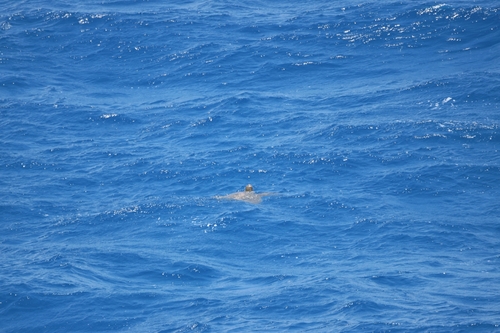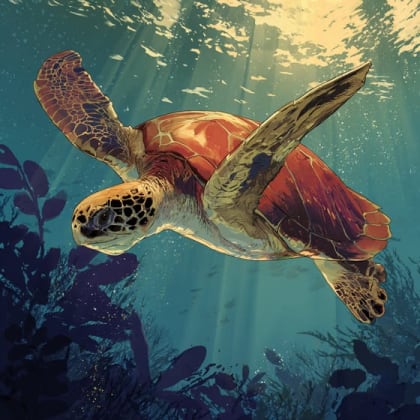



Sea Turtle
Chelonia mydas
Sea turtles are ancient reptiles that live in the ocean. They have flippers to help them swim and can hold their breath for a long time underwater. Sea turtles travel long distances and are important for keeping marine ecosystems healthy.
Habitat: Coastal areas
The Sea Turtle has a smooth, heart-shaped carapace (shell) that ranges from olive-brown to black, often with lighter streaks. Its underside is typically yellowish-white. Unlike land turtles, it possesses powerful, paddle-like front flippers for efficient propulsion through water.
Category
ReptilesRarity
Common
Danger
1/5 · Very low
Snaps
18
A mother sea turtle often travels thousands of miles to lay her eggs on her birth beach!
Baby turtles know how to swim the instant they hatch and reach the ocean, it's amazing!
Some sea turtles can slow their heart rate to just one beat every nine minutes when diving deep!
The sand temperature where eggs incubate decides if baby turtles are boys or girls!
Sea turtles can use the Earth's magnetic field as a built-in GPS, which helps them find their way across vast oceans.
Sea turtles have special glands near their eyes that help them cry out excess salt from the ocean water they drink.
Sea turtles can hold their breath for hours, allowing them to dive deep for food or rest on the seafloor.
Green sea turtles are mostly plant-eaters, munching on tasty seagrass and algae!
Age differences: Young sea turtles eat more invertebrates like jellyfish, but adults become mostly vegetarian.
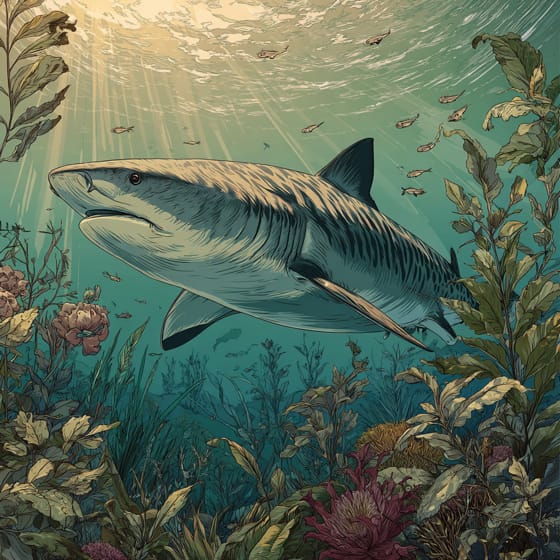
Galeocerdo cuvier
Large adult sea turtles are hunted by this powerful apex predator.
Ocypode quadrata
Hatchling sea turtles are vulnerable prey for these crabs on nesting beaches.
Thalassia testudinum
This seagrass is a primary food source for adult green sea turtles.
This trait characterizes organisms whose diet consists entirely or primarily of plant material.
Thermoregulating organisms maintain a stable internal body temperature despite fluctuations in the external environment.
This trait signifies organisms belonging to a very old evolutionary group with ancestors dating back millions of years.
This trait characterizes organisms with an exceptionally long lifespan compared to others of their kind.

Coastal habitats are dynamic environments located along the interface between land and sea, influenced by tides, waves, and saltwater.

Describes a species whose presence and role have a disproportionately large effect on its environment.
Regenerative organisms possess the ability to regrow lost or damaged body parts, tissues, or organs.

Marine habitats encompass all saltwater environments of the Earth's oceans, supporting an immense diversity of aquatic life.

Migratory animals undertake seasonal movements from one region to another, typically in response to changes in climate or food availability.
Danger
1/5 · Very low
Always admire sea turtles from a safe distance and never disturb their nests on the beach.
The easiest way to identify Sea Turtle is to use the Snappit nature identifier app.
78-112 cm
110-318 kg
80-100 years
35 km/h
Green sea turtles are mostly plant-eaters, munching on tasty seagrass and algae!
3.5 km/h
Coastal areas
Zoom in to split clusters and explore where this object has been snapped.
Jun 5, 2026
Kawai Nui MarshPhoto attribution
(c) Damien Wallace, some rights reserved (CC BY)
License: CC BY 4.0 ↗
Image may be shown cropped inside the card frame.

Hawaii, US
You might spot Brown Anole, Gold Dust Day Gecko, and Red-Crested Cardinal.
View guide →

Hawaii, US
You might spot Gold Dust Day Gecko, Yellow Tang, and Black Triggerfish.
View guide →

Hawaii, US
You might spot Gold Dust Day Gecko, Star Of Bethlehem, and Spanish Shawl.
View guide →

Hawaii, US
You might spot Gold Dust Day Gecko, Yellow Tang, and Saffron Finch.
View guide →

US
You might spot Brown Anole, Zebra Dove, and Red-Crested Cardinal.
View guide →

Hawaii, US
You might spot Koster's Curse and White-Rumped Shama.
View guide →
Take the discovery with you
Snap it with Snappit to identify it, learn what makes it special, and add the discovery to your collection.