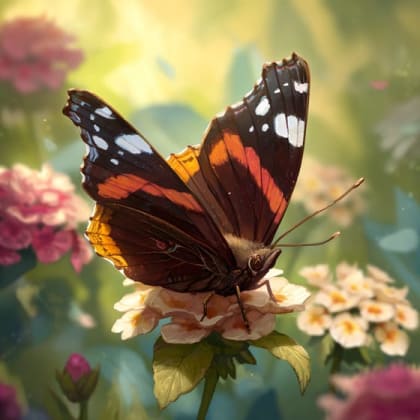
Owl Butterfly
Caligo memnon
The Owl Butterfly has large, owl-like eyespots on its wings to scare away predators. It's a master of camouflage in the rainforests it calls home.
Habitat: Rainforests
The Owl Butterfly is a large insect, predominantly dull brown to purplish-blue. Its most striking feature is the enormous, realistic 'owl eye' pattern on the underside of each hindwing, complete with a yellow iris and black pupil, designed to mimic a predator's gaze. The upper side often shows iridescent blue or purple.
Category
InsectsRarity
Common
Danger
1/5 · Very low
Snaps
Be the first to snap!
The brilliant blue on some wings comes from light bouncing off tiny scales!
The huge 'owl eyes' on its wings are just patterns, not real eyes!
Their caterpillars wear spiky 'crowns' on their heads to look fierce!
These butterflies have tiny feet that can taste sweet fruit!
Owl Butterfly has huge, realistic 'owl eye' patterns on its hindwings that scare away predators by mimicking a larger animal's gaze.
Owl Butterfly can effectively fly and find food during the dim light of dawn and dusk, avoiding many daytime predators.
Owl Butterfly can locate fermenting fruit from a distance using its strong sense of smell to find sugary meals.
Adult Owl Butterflies sip nectar and feast on the juice from fermenting fruits!
Age differences: Caterpillars munch on leaves from various host plants, while adults prefer liquids.
Musa acuminata
Caterpillars munch its leaves for growth.
Phyllostomus discolor
Bats hunt these crepuscular butterflies using echolocation.
Calathea lutea
Caterpillars feed on its large, broad leaves.
Wildlife encompasses all undomesticated animal and plant life existing in their natural habitats.
Camouflaged describes organisms that possess coloring or patterns that allow them to blend into their environment.
This trait characterizes organisms whose diet consists entirely or primarily of plant material.
This trait signifies organisms belonging to a very old evolutionary group with ancestors dating back millions of years.

This habitat trait refers to species found in tropical rainforests, characterized by high annual rainfall, high biodiversity, and dense tree cover.

Nocturnal animals are primarily active during the nighttime hours, typically resting or sleeping during the day.
Danger
1/5 · Very low
Observe from a distance to avoid disturbing their natural behavior.
130-160 mm
50-70 mm
14-28 days
15-25 km/h
Adult Owl Butterflies sip nectar and feast on the juice from fermenting fruits!
Rainforests
Foraging
6
Zoom in to split clusters and explore where this object has been snapped.
Recent snaps will appear here as new observations are added.