Japanese Maple
Acer palmatum
The Japanese Maple is a small tree with beautiful, colorful leaves. It looks stunning in gardens, especially in autumn.
Habitat: Gardens and parks
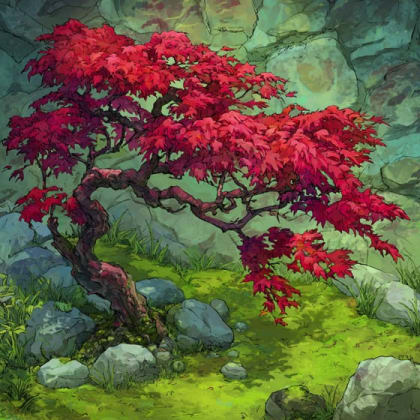
The Japanese Maple has delicate, deeply lobed leaves that come in a stunning array of colors, from vibrant greens to fiery reds, oranges, and deep purples. Its graceful, often multi-trunked form creates a beautiful, spreading canopy, making it visually distinct with its intricate branch structure.
Category
TreesRarity
Common
Danger
1/5 · Very low
Snaps
4
In Japan, some of their leaves are lightly fried in tempura as a crispy, sweet snack!
Japanese Maples are a favorite for bonsai, creating tiny, perfect tree versions for display!
Some Japanese Maples can live for over 100 years, becoming ancient, majestic trees!
There are more than a thousand different kinds, each with unique leaf shapes and colors!
Japanese Maples have winged seeds that spin like helicopters, letting the wind carry them far away to find new places to grow.
Japanese Maples can thrive in dappled shade, which helps them survive under taller trees in their native forests.
Its leaves perform a spectacular color transformation each fall, protecting the tree and preparing for winter.
Cervus nippon
Deer browse on its tender leaves and twigs.
Parus major
Small birds nest among its dense branches.
Callambulyx tatarinovii
Its caterpillars munch on maple leaves.
Deciduous plants periodically shed all their leaves, typically during autumn or dry seasons.
Ornamental plants are cultivated primarily for their aesthetic appeal, enhancing landscapes and gardens with their attractive foliage, flowers, or form.
Broadleaf trees are angiosperms characterized by flat, wide leaves that are typically shed annually in temperate climates.
Fall color refers to the seasonal change in foliage pigmentation, primarily in deciduous plants, displaying vibrant hues.

This habitat trait indicates species that can coexist with humans in urban and suburban environments, utilizing man-made structures and green spaces.
Danger
1/5 · Very low
Do not pick or eat anything you find. Some plants and mushrooms can be harmful.
3-9 m
3-8 m
No
10-50 cm
50-100 years
Gardens and parks
Samara
Medium
Zoom in to split clusters and explore where this object has been snapped.

Washington, US
You might spot Garden Spider, Duck, and Fringed Willowherb.
View guide →

British Columbia, CA
You might spot Western Sword Fern, Douglas Fir, and Red Huckleberry.
View guide →
.jpg)
Washington, US
You might spot Duck, Great Blue Heron, and Western Redcedar.
View guide →

Washington, US
You might spot Garden Spider, Western Redcedar, and Fringed Willowherb.
View guide →

Washington, US
You might spot Western Sword Fern and Bigleaf Maple.
View guide →

California, US
You might spot Conifers, Buttercups, and Gourd Family.
View guide →