
Coelacanth
Latimeria chalumnae
The Coelacanth is a prehistoric fish that was thought to be extinct until it was rediscovered in 1938. It has unique lobed fins and can grow up to 6 feet long.
Habitat: Deep Sea
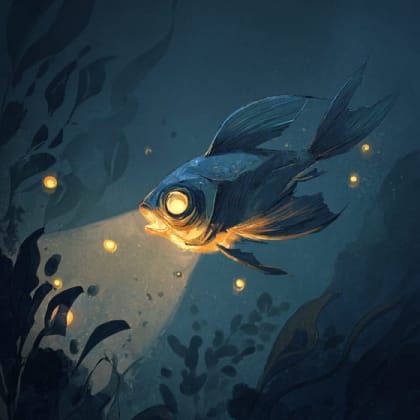
The Coelacanth has distinctive, muscular lobe-fins that resemble limbs, and a unique three-lobed tail fin. Its body is covered in large, plate-like blue-grey scales, giving it a prehistoric, armored appearance.
Category
FishRarity
Rare
Danger
1/5 · Very low
Snaps
Be the first to snap!
Coelacanths can live for over 100 years, making them super old fish!
Their special fins move like walking, similar to early land animals.
They have armored scales that protect them like a knight's suit.
They were thought extinct for 65 million years before being found again!
Coelacanth has sturdy, paired lobe-fins that help them 'walk' along the seafloor, moving like an early land animal.
Coelacanth can detect electric fields using a special rostral organ, which helps them find hidden prey in the dark.
Coelacanth has a unique skull joint that allows its jaw to open very wide, helping them swallow large prey whole.
Coelacanth has an oil-filled notochord and fatty organs that help them remain perfectly buoyant without much effort.
Coelacanths are stealthy deep-sea hunters that ambush fish and squid in the dark ocean depths.
Epigonus telescopus
Coelacanths prey on these deep-sea fish in their habitat.
Heteroteuthis dispar
Squid are a common part of the Coelacanth's deep-sea diet.
Hexanchus griseus
Larger sharks may opportunistically prey on Coelacanths.
Wildlife encompasses all undomesticated animal and plant life existing in their natural habitats.
Piscivorous organisms are animals that primarily subsist on a diet of fish.
This trait signifies organisms belonging to a very old evolutionary group with ancestors dating back millions of years.
Deep sea habitats are characterized by extreme pressure, darkness, and cold temperatures, supporting unique life forms below the sunlit zone.

Regenerative organisms possess the ability to regrow lost or damaged body parts, tissues, or organs.

Aquatic habitats encompass environments where organisms live predominantly in water, including oceans, rivers, lakes, and wetlands.

Nocturnal animals are primarily active during the nighttime hours, typically resting or sleeping during the day.

Venomous organisms produce toxins that are injected into another animal, typically through a bite or sting.
Danger
1/5 · Very low
Coelacanths live in the deep ocean and are not encountered by people, so there's no need to worry about them.
150-180 cm
65-98 kg
60-100 years
Coelacanths are stealthy deep-sea hunters that ambush fish and squid in the dark ocean depths.
1.5 km/h
Deep Sea
Ambush
700 m
Zoom in to split clusters and explore where this object has been snapped.
Recent snaps will appear here as new observations are added.