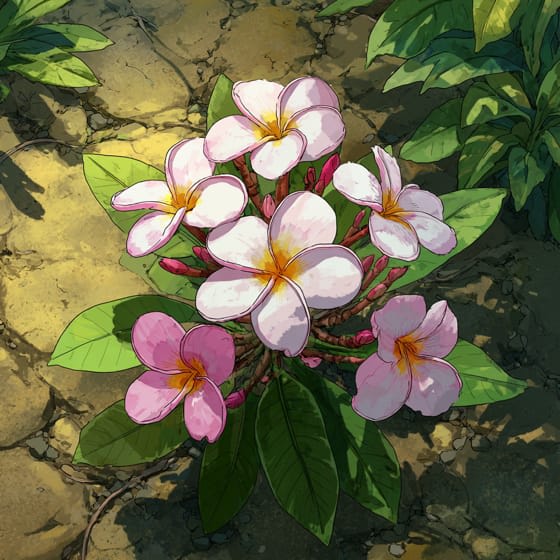





Frangipani
Plumeria rubra
Frangipani, also known as Plumeria, has sweet-smelling flowers that are often used in leis. They come in many colors and are perfect for warm places!
Habitat: Tropical regions
The Frangipani has five-petaled, waxy flowers that come in white, yellow, pink, red, or vibrant multi-color combinations. Its strong, sweet fragrance is distinctive. It often forms a small, spreading tree or shrub with thick, succulent branches and leathery dark green leaves.
Category
PlantsRarity
Rare
Danger
1/5 · Very low
Snaps
Be the first to snap!
Frangipani flowers produce no nectar, tricking pollinators with their sweet scent alone!
In many cultures, Frangipani flowers are woven into beautiful traditional leis and garlands.
The genus name 'Plumeria' honors Charles Plumier, a 17th-century French botanist.
You can easily grow a new Frangipani plant just from a broken stem cutting!
Frangipani flowers release a powerful, sweet fragrance at night to attract nocturnal hawk moths for pollination.
Frangipani has milky white sap that oozes out when cut, containing toxic compounds to deter hungry herbivores.
Frangipani has thick, succulent stems and roots that store water, helping it survive dry periods.
Erinnyis ello
Moths visit flowers for their scent
Pseudosphinx tetrio
Larvae feed on Frangipani leaves
Coleosporium plumeriae
Fungus causes rust spots on leaves
Shade tolerant plants are adapted to grow and thrive in areas with low light levels, requiring less direct sunlight.
Everblooming plants produce flowers continuously or in repeated flushes over a long period.
Fragrant flowers emit a pleasant aroma, often to attract pollinators or for defense.
Medicinal plants possess chemical compounds that can be used for therapeutic purposes to treat illnesses or maintain health.
Danger
1/5 · Very low
Explore with care and ask an adult if you’re unsure what to do.
200-800 cm
200-800 cm
5-10 cm
Summer to Fall, year-round in tropics
No
Mild
Perennial
Insect
Zoom in to split clusters and explore where this object has been snapped.
Recent snaps will appear here as new observations are added.