




Guppy
Poecilia reticulata
Guppies are tiny, colorful fish that come in many different colors! They are friendly and love to swim around in groups.
Habitat: Freshwater streams and ponds
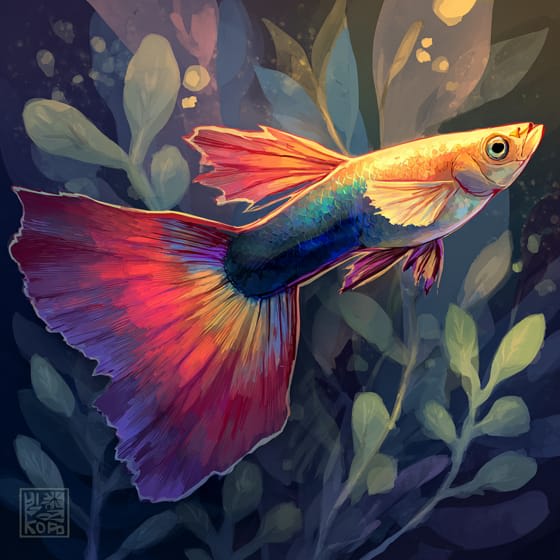
The Guppy has a small, torpedo-shaped body. Males are famously vibrant with iridescent scales and large, fan-like or sword-shaped caudal fins in red, blue, green, and yellow patterns. Females are larger, silvery-grey, and typically have duller, more transparent fins, making them less colorful than males.
Category
FishRarity
Common
Danger
2/5 · Low
Snaps
Be the first to snap!
Guppies are livebearers, meaning babies hatch inside the mother and are born swimming freely!
Male guppies have a special fin called a gonopodium used for internal fertilization!
Scientists study guppy mating dances to learn about animal behavior and evolution!
Some guppies have been found living in brackish water, adapting to salty conditions!
Guppies can have many babies frequently because they are live-bearers, helping them quickly populate new areas.
Male guppies use their bright colors and fin displays to attract females, helping them find a mate and show health.
Guppies can tolerate slightly varying water conditions because they are hardy, allowing them to live in diverse habitats.
These small fish eat tiny bugs, algae, and plant bits, helping keep their watery homes clean.
Eleotris pisonis
A native predator in guppy habitats.
Aedes aegypti
Guppies consume the larvae of this mosquito, helping control populations.
Daphnia pulex
Guppies graze on these tiny crustaceans as part of their varied diet.
Wildlife encompasses all undomesticated animal and plant life existing in their natural habitats.
Social animals live in organized groups, cooperating for survival benefits such as foraging, defense, and raising offspring.
This trait identifies organisms whose diet includes both plant and animal matter.
Colorful describes organisms or objects displaying a wide range of bright and distinct colors.

Freshwater habitats include non-saline aquatic environments such as rivers, lakes, ponds, and wetlands, vital for numerous species.

Describes a species whose presence and role have a disproportionately large effect on its environment.

Aquatic habitats encompass environments where organisms live predominantly in water, including oceans, rivers, lakes, and wetlands.
Danger
2/5 · Low
Watch quietly from a distance and never try to feed or chase wild animals.
2-6 cm
0.001-0.005 kg
2-3 years
These small fish eat tiny bugs, algae, and plant bits, helping keep their watery homes clean.
5 km/h
Freshwater streams and ponds
Foraging
2 m
Zoom in to split clusters and explore where this object has been snapped.
Recent snaps will appear here as new observations are added.