




White Rhinoceros
Ceratotherium simum
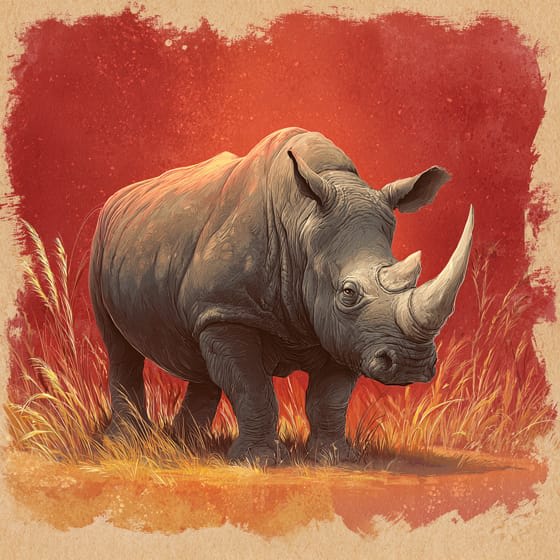
The white rhinoceros is a large, gentle giant with a big horn on its nose. They love to eat grass and can be found in open areas like savannas.
Habitat: Grasslands and savannas
The White Rhinoceros has a massive, grey body with a distinctive broad, flat mouth perfect for grazing. Its two prominent horns, the front one longer than the rear, curve slightly backwards, and it has a noticeable hump on its neck.
Category
MammalsRarity
Common
Danger
3/5 · Moderate
Snaps
Be the first to snap!
A group of rhinos is called a 'crash' – imagine a crash of giant beasts running towards you!
Despite their massive size, white rhinos are surprisingly quiet, often moving silently.
They love wallowing in mud, which helps cool them down and protect their skin from bugs!
White rhinos aren't actually white, they're grey! Their name might come from a mistranslation.
White Rhinoceros can navigate and find food because of their excellent sense of smell, making up for poor eyesight.
White Rhinoceros can hear danger from far away because their tubular ears can rotate independently to pick up sounds.
White Rhinoceros has a wide, flat mouth that helps them efficiently graze large quantities of grass close to the ground.
White Rhinoceros has incredibly thick skin that protects them from scratches, thorns, and sun exposure.
These gentle giants are herbivores, munching mainly on grass all day long.
Buphagus erythrorynchus
Removes ticks from their skin.
Panthera leo
Can prey on vulnerable calves.
Cenchrus ciliaris
A major part of their diet.
Homo sapiens
Hunted by poachers for horns.
Wildlife encompasses all undomesticated animal and plant life existing in their natural habitats.
Furry describes animals possessing a dense covering of soft hair or fur.
Social animals live in organized groups, cooperating for survival benefits such as foraging, defense, and raising offspring.
Characterized by having one or more hard, permanent, pointed projections on the head.

This trait characterizes organisms whose diet consists entirely or primarily of plant material.

This habitat trait denotes species native to savannas, which are grasslands with scattered trees, typically found in tropical or subtropical regions with distinct wet and dry seasons.

This trait signifies organisms belonging to a very old evolutionary group with ancestors dating back millions of years.
Danger
3/5 · Moderate
Always admire rhinos from a safe distance. They are big and strong, so it's best to watch them from behind a fence or in a vehicle.
340-420 cm
1800-3600 kg
40-50 years
50 km/h
These gentle giants are herbivores, munching mainly on grass all day long.
Grasslands and savannas
Grazing
1
Zoom in to split clusters and explore where this object has been snapped.
Recent snaps will appear here as new observations are added.