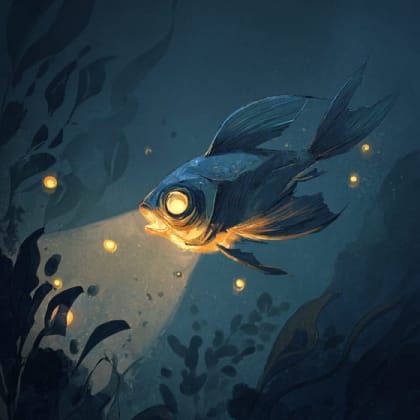


Stoplight Loosejaw
Malacosteus niger
The Stoplight Loosejaw is a deep-sea fish with a unique feature - its transparent head with green bioluminescent eyes! It uses its glowing eyes to attract prey in the dark depths of the ocean.
Habitat: Deep Sea
The Stoplight Loosejaw is a slender, black-bodied deep-sea fish. It has an enormous, unhinged mouth with many sharp teeth and peculiar light-emitting organs below its eyes and on its chin, giving it a unique appearance.
Category
FishRarity
Rare
Danger
2/5 · Low
Snaps
Be the first to snap!
Even though it's small, its needle-sharp teeth are perfect for gripping slippery prey in the dark!
Its mouth is so big, it has no floor and looks like it's missing part of its head!
The red light it makes is invisible to most other deep-sea creatures, giving it a secret hunting beam!
This fish lives in absolute darkness, where sunlight never reaches, making it a true deep-sea explorer!
Stoplight Loosejaw can see red light because it has special eye pigments, helping it find prey that cannot see the red glow.
Stoplight Loosejaw can create its own red light from organs near its eyes, allowing it to search for prey invisibly in deep darkness.
Stoplight Loosejaw has a jaw that can drop far open and a throat that expands, letting it swallow prey bigger than its head.
A fierce deep-sea hunter, it eats other fish and crustaceans it finds in the dark depths.
Myctophum punctatum
A common bioluminescent prey in the deep sea.
Argyropelecus aculeatus
Another deep-sea fish commonly eaten by loosejaws.
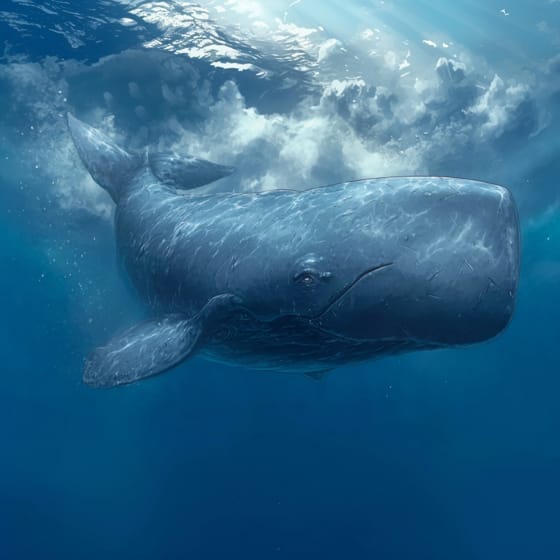
Physeter macrocephalus
Large deep-diving predator that hunts deep-sea fish.
Piscivorous organisms are animals that primarily subsist on a diet of fish.
An ambush predator hunts by patiently waiting and concealing itself, then launching a sudden attack when unsuspecting prey comes within range.
Deep sea habitats are characterized by extreme pressure, darkness, and cold temperatures, supporting unique life forms below the sunlit zone.
Echolocation is a biological sonar used by animals to navigate, hunt, and communicate by emitting sound waves and interpreting the echoes.

Regenerative organisms possess the ability to regrow lost or damaged body parts, tissues, or organs.

Aquatic habitats encompass environments where organisms live predominantly in water, including oceans, rivers, lakes, and wetlands.

Pertaining to organisms that emit light through bioluminescence or fluorescence.

Nocturnal animals are primarily active during the nighttime hours, typically resting or sleeping during the day.

Venomous organisms produce toxins that are injected into another animal, typically through a bite or sting.
No aliases listed yet.
Danger
2/5 · Low
This fish lives in the deep ocean where it's not safe for humans to explore. It's best admired from pictures or videos.
15-26 cm
0.05-0.2 kg
5-15 years
A fierce deep-sea hunter, it eats other fish and crustaceans it finds in the dark depths.
3 km/h
Deep Sea
Ambush
2500 m
Zoom in to split clusters and explore where this object has been snapped.
Recent snaps will appear here as new observations are added.