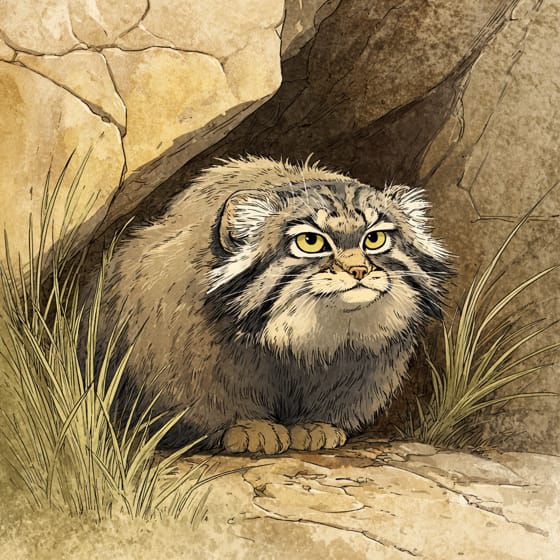





Pallas's Cat
Otocolobus manul
Pallas's Cats, also known as manuls, are small wild cats with fluffy fur and expressive faces. They live in the cold mountains of Central Asia and are excellent hunters.
Habitat: Mountain regions
The Pallas's Cat is a small, stout feline with a distinctive flattened face, very short, rounded ears set low and wide, and remarkably thick, long, pale gray fur with white tips. Its stocky body, short legs, and bushy, ringed tail make it appear larger than it is, unlike many slender wild cats.
Category
MammalsRarity
Rare
Danger
2/5 · Low
Snaps
Be the first to snap!
Despite grumpy looks, they often appear surprised or annoyed!
Low-set ears help them peek over rocks without being seen.
They have the longest, densest fur of any cat, perfect for icy winds.
This cat is named after Peter Pallas, a naturalist who first described it.
Pallas's Cat has an incredibly dense, long coat that helps them blend perfectly with rocky, snowy environments.
Pallas's Cat can flatten its head and body close to the ground, allowing them to hide undetected in sparse terrain.
Pallas's Cat has round pupils, unlike most small cats, which helps them see clearly in bright daylight.
Pallas's Cat uses its long, bushy tail for balance on rugged terrain and wraps it for extra warmth.
Small mammals and birds are its main meal.
Ochotona pallasi
Primary prey species in much of its range.
Microtus brandtii
Important prey for this cat.
Alectoris chukar
Hunted for food in certain regions.

Aquila chrysaetos
Will hunt young Pallas's Cat kittens.
Canis lupus
Known to prey opportunistically on kittens.
Furry describes animals possessing a dense covering of soft hair or fur.
Solitary animals live alone for most of their lives, only interacting with others for mating or parental care.
Camouflaged describes organisms that possess coloring or patterns that allow them to blend into their environment.
This habitat trait identifies species found in mountainous regions, characterized by high elevation, steep slopes, and varying climate zones.

This habitat trait describes species found in steppes, which are dry, treeless grasslands characterized by extreme seasonal temperature variations and low precipitation.

An ambush predator hunts by patiently waiting and concealing itself, then launching a sudden attack when unsuspecting prey comes within range.

This trait identifies organisms whose diet consists entirely or primarily of animal tissue.

Nocturnal animals are primarily active during the nighttime hours, typically resting or sleeping during the day.
Danger
2/5 · Low
Admire Pallas's Cats from a distance in the wild and never try to touch or approach them.
46-60 cm
2.5-5 kg
10-12 years
40 km/h
Small mammals and birds are its main meal.
Mountain regions
Ambush
2-6
Zoom in to split clusters and explore where this object has been snapped.
Recent snaps will appear here as new observations are added.