

Tolpis Webbii
tolpis webbii
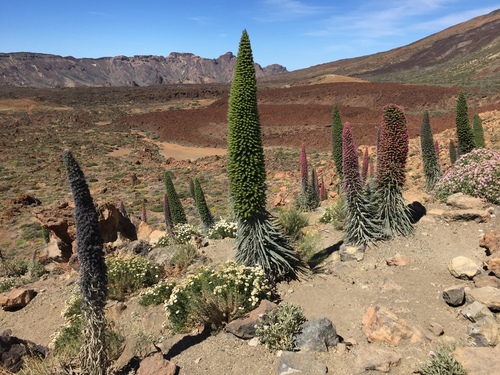
Tolpis webbii ist ein charmanter, ausdauernder Halbstrauch, der in den Hochgebirgszonen der Kanarischen Inseln, insbesondere auf Teneriffa und La Palma, endemisch ist. Diese widerstandsfähige Pflanze gehört zur Familie der Asteraceae und ist ein klassisches Merkmal des subalpinen Gestrüpps und des Unterholzes der Kanarischen Kiefernwälder. Sie gedeiht in vulkanischen, nährstoffarmen Böden und malt die dramatischen Vulkanlandschaften mit Ausbrüchen leuchtend gelber Blüten. Ihre Fähigkeit, intensiver Sonneneinstrahlung und saisonaler Trockenheit standzuhalten, macht sie zu einer wichtigen Pionierart in diesen rauen Umgebungen, die lokale Insektengemeinschaften unterstützt.
Lebensraum: In hochgelegenen vulkanischen Strauchlandschaften und Kanarischen Kiefernwäldern zu finden, typischerweise an felsigen, trockenen Hängen.
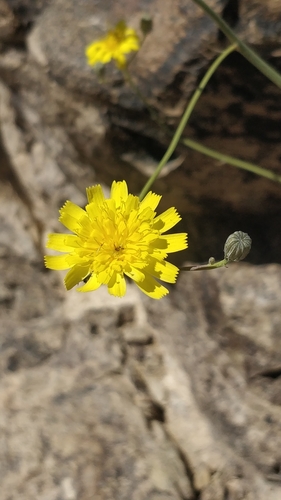
Diese Pflanze wächst als holzig basierte Staude oder kleiner Halbstrauch und erreicht eine Höhe von 20 bis 60 Zentimetern. Sie weist lanzettliche, graugrüne Blätter auf, die oft an der Basis oder entlang der unteren Stängel gebündelt sind. Ihr auffälligstes Merkmal sind die zusammengesetzten Blütenköpfe, die aus zahlreichen leuchtend gelben Zungenblüten bestehen, die eine etwas dunklere zentrale Scheibe umgeben und einen robusten, mehrfach verzweigten Löwenzahn imitieren.
Kategorie
PflanzenSeltenheit
Gewöhnlich
Gefahr
1/5 · Sehr gering
Snaps
Mach den ersten Snap!
Trotz ihres zarten, löwenzahnähnlichen Aussehens besitzt diese Pflanze eine holzige Basis, die es ihr ermöglicht, jahrelang als ausdauernder Halbstrauch zu überleben.
Sie ist eine der ikonischen Pflanzenarten, die den Kraterrand des Teide, Spaniens höchsten Gipfel, schmücken.
Der Artname 'webbii' ehrt Philip Barker Webb, einen englischen Botaniker, der die maßgebliche Studie zur Flora der Kanarischen Inseln im 19. Jahrhundert mitverfasste.
Extrahiert erfolgreich Nährstoffe und bildet Wurzeln in stark porösen, jungen vulkanischen Substraten.
Nutzt spezialisierte Blattkutikula und tiefe Wurzelsysteme, um lange Trockenperioden in Hochgebirgsumgebungen zu überleben.
Produziert schützende Flavonoide in seinem Laub, um Schäden durch intensive Sonneneinstrahlung in großer Höhe zu mindern.
Als photoautotrophe Pflanze produziert sie Energie durch Photosynthese, indem sie Sonnenlicht, Wasser und Kohlendioxid in Zucker umwandelt.
Pinus canariensis
Dient als Konkurrent im Unterholz um Licht und Raum mit jungen Setzlingen.
Bombus canariensis
Ist auf einheimische Bienen zur Bestäubung ihrer leuchtend gelben Blütenköpfe angewiesen.

Oryctolagus cuniculus
Eingeführte Pflanzenfresser fressen ihre Blätter und Blütenknospen, was das Überleben der Sämlinge beeinträchtigt.
Für dieses Objekt sind noch keine Merkmal-Badges vergeben.
Noch keine Alternativnamen vorhanden.
Sammlungen für dieses Objekt erscheinen hier, wenn weitere Themen hinzugefügt werden.
Gefahr
1/5 · Sehr gering
Noch keine besonderen Sicherheitshinweise.
Beginne mit der ganzen Pflanze und vergleiche dann Blattstellung, Blattränder, Stängel und eventuelle Blüten oder Früchte. Gegenständige Blätter wachsen paarweise, wechselständige einzeln am Stängel. Zusammen verraten diese Details weit mehr als ein einzelnes grünes Blatt. Pflanzen bestimmen: Lade ein Foto hoch und vergleiche die sichtbaren Merkmale.
20-60 cm
2-7 Jahre
Als photoautotrophe Pflanze produziert sie Energie durch Photosynthese, indem sie Sonnenlicht, Wasser und Kohlendioxid in Zucker umwandelt.
In hochgelegenen vulkanischen Strauchlandschaften und Kanarischen Kiefernwäldern zu finden, typischerweise an felsigen, trockenen Hängen.
Zoome hinein, um Cluster aufzulösen und zu sehen, wo dieses Objekt fotografiert wurde.
Neueste Snaps erscheinen hier, wenn neue Beobachtungen hinzukommen.
Nimm die Entdeckung mit
Fotografiere deinen Fund mit Snappit, bestimme die Art und füge die Entdeckung deiner Sammlung hinzu.