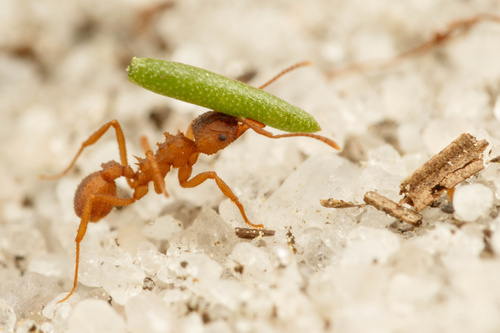
Davis' Big-headed Ant
Pheidole davisi
Davis' Big-headed Ant is a small ant known for its big head! These ants work together in groups and are often found in gardens and forests. They are very busy and love to explore!
Hábitat: Forests
The Davis' Big-headed Ant has two distinct worker forms: smaller minor workers and larger major workers with disproportionately massive, shiny, reddish-brown heads. Its body is also reddish-brown to dark brown, appearing smooth and somewhat glossy. The major's powerful head is its most distinguishing feature.
Categoría
InsectosRareza
Common
Peligro
2/5 · Bajo
Snaps
¡Sé la primera persona en hacer un snap!
A single queen can live for several years, laying thousands of eggs in her lifetime!
Major workers can block nest entrances with their huge heads, acting as living doors!
These ants are super fast diggers, creating complex tunnels underground for their homes.
They clean up their environment by scavenging dead insects and plant material.
Davis' Big-headed Ant has powerful jaws on its large-headed soldiers that help them crush tough seeds and defend the colony from threats.
Davis' Big-headed Ant can lay invisible scent trails because of special glands that helps them guide fellow workers to newly found food sources.
Davis' Big-headed Ant can lift objects many times its own body weight because of its strong exoskeleton and muscles that help them carry food back to the nest.
These ants are omnivores, eating almost anything from tiny insects to sweet plant juices.

Phrynosoma cornutum
A favorite prey for this unique reptile in their shared habitats.
Rhopalosiphum maidis
They collect sugary honeydew produced by these tiny plant sap-suckers.
Musca domestica
Scavenges dead flies and other small insects for protein.
Solenopsis invicta
Often preyed upon by aggressive invasive fire ants in battle.
Los animales sociales viven en grupos organizados, cooperando para obtener beneficios de supervivencia como la búsqueda de alimento, la defensa y la cría de descendencia.
Este rasgo identifica organismos cuya dieta incluye tanto materia vegetal como animal.
Los hábitats boscosos son entornos terrestres dominados por una densa cubierta arbórea, que sustentan una gran diversidad de vida animal y vegetal.
Describe a los organismos que descomponen la materia orgánica muerta, reciclando los nutrientes de vuelta al ecosistema.

Los animales diurnos están activos principalmente durante el día y suelen descansar o dormir por la noche.

Relativo a especies que son significativamente más pequeñas que lo típico o promedio de su tipo.

Describe organismos que transfieren polen, permitiendo la fertilización y reproducción de las plantas.
Todavía no hay alias listados.
Peligro
2/5 · Bajo
Be careful not to disturb ant nests, as they can bite if they feel threatened.
1.8-5 mm
60-90 días
These ants are omnivores, eating almost anything from tiny insects to sweet plant juices.
Forests
Foraging
6
20000
Acércate para separar los grupos y explorar dónde se ha fotografiado este objeto.
Los snaps recientes aparecerán aquí a medida que se añadan nuevas observaciones.