

Dorr'S Sage Complex
salvia dorrii
Dorr's Sage (Salvia dorrii), commonly known as purple sage or desert sage, is a highly aromatic woody perennial shrub native to the arid interior of western North America. Renowned for its striking, vibrant inflorescences and silver-gray foliage, this hardy plant thrives in some of the continent's most challenging environments, including the Great Basin and Mojave Deserts. It plays a critical ecological role, providing essential nectar for native pollinators and shelter for desert wildlife. Its distinctive aromatic leaves are rich in essential oils, which help deter herbivores and reduce water loss. For centuries, various Indigenous peoples of the Great Basin have valued Dorr's Sage for its traditional medicinal properties and ceremonial uses. Today, it is increasingly appreciated in water-wise landscaping and xeriscaping, celebrated for both its rugged resilience and stunning, long-lasting summer blooms. If you want to identify Dorr'S Sage Complex in the wild, use the Snappit app.
Habitat: Found in dry, sandy, or gravelly soils of desert shrublands, sagebrush steppes, and pinyon-juniper woodlands across western North America.
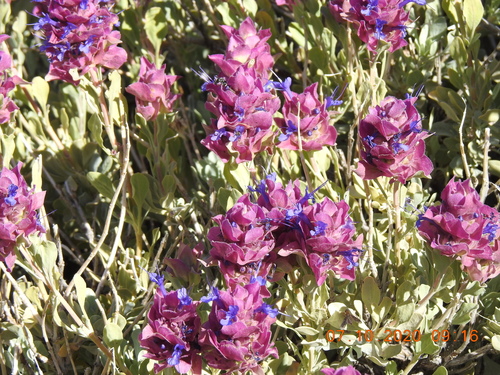
Dorr's Sage is a low-growing, mounding shrub typically reaching heights and widths of 30 to 90 centimeters. It is easily identified by its narrow, spoon-shaped leaves, which are covered in tiny, silver-white hairs that give the foliage a dusty, grey-green appearance. The most striking feature of the plant is its dense, spike-like inflorescences. These flower clusters consist of small, tubular, bright blue-to-purple flowers surrounded by large, persistent, papery bracts of deep purple, rose, or green, which remain colorful long after the actual flowers have withered.
Category
PlantsRarity
Common
Danger
1/5 · Very low
Snaps
Be the first to snap!
Members of the Great Basin tribes traditionally used the smoke from burning Dorr's Sage leaves to treat colds and clear chest congestion.
The striking purple petals that catch your eye from afar are actually papery leaves called bracts; the true flowers are the much smaller blue tubes nestled within them.
The strong, minty-sage scent of Dorr's Sage is so potent that it can often be smelled from yards away, especially after a rare desert rainstorm.
Its leaves are densely blanketed in tiny silver hairs that reflect solar radiation, reduce wind speeds at the leaf surface, and conserve precious moisture.
The plant synthesizes rich terpene-laden essential oils that emit a pungent herbal aroma, effectively deterring herbivorous insects and mammals.
Colorful, papery bracts protect developing seeds and maintain their structures after flowering to shelter delicate reproductive organs from harsh desert winds.
As a photosynthetic plant, Dorr's Sage produces its own energy using sunlight, water, and carbon dioxide, aided by nutrients absorbed from the soil.
Bombus crotchii
Collects nectar and pollen from the flowers, acting as an important pollinator.
Centrocercus urophasianus
Feeds on the leaves and seeds of various sage species, utilizing them for food and nesting cover.

Sylvilagus audubonii
May occasionally browse the foliage during periods of extreme drought when other food is scarce.
No trait badges are assigned for this object yet.
No aliases listed yet.
Collections for this object will appear here as more themes are added.
Danger
1/5 · Very low
No special safety notes yet.
The easiest way to identify Dorr'S Sage Complex is to use the Snappit nature identifier app.
30-90 cm
10-50 years
As a photosynthetic plant, Dorr's Sage produces its own energy using sunlight, water, and carbon dioxide, aided by nutrients absorbed from the soil.
Found in dry, sandy, or gravelly soils of desert shrublands, sagebrush steppes, and pinyon-juniper woodlands across western North America.
Zoom in to split clusters and explore where this object has been snapped.
Recent snaps will appear here as new observations are added.


















