





Desert Cottontail
Sylvilagus audubonii
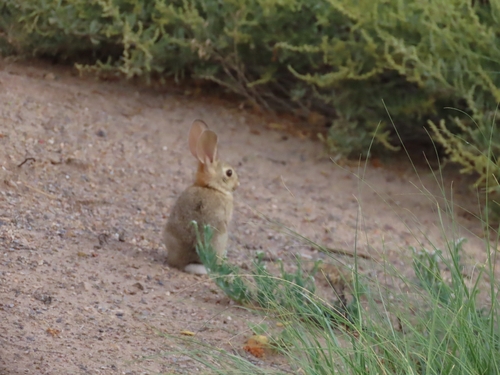
The Desert Cottontail is a fluffy rabbit that loves to hop around in the desert! With its big ears and soft fur, it is great at staying cool in the hot sun.
Habitat: Desert
The Desert Cottontail has soft, sandy brown to grayish fur that blends perfectly with its desert home. Its most distinct feature is a fluffy white tail, shaped like a cotton ball, which is visible when it runs.
Category
MammalsRarity
Common
Danger
1/5 · Very low
Snaps
37
A female cottontail can have many litters of babies in a single year!
Baby cottontails are born blind and helpless, needing their mother's full care.
Cottontails don't dig burrows, they often use abandoned ones or hide in dense plants!
They communicate danger by thumping their powerful hind feet on the ground.
Desert Cottontail can run in an unpredictable zig-zag pattern that helps them escape speedy predators by confusing them.
Desert Cottontail has large, rotating ears that help them pinpoint faint sounds from far away to detect danger quickly.
Desert Cottontail has fur coloring that perfectly matches desert rocks and plants, helping them hide from hungry eyes.
Desert Cottontail can eat its own special droppings to get extra nutrients, making sure no good food goes to waste!
This little herbivore munches on grasses, leaves, and twigs, staying hydrated from its food!
Furry describes animals possessing a dense covering of soft hair or fur.
Social animals live in organized groups, cooperating for survival benefits such as foraging, defense, and raising offspring.
This trait characterizes organisms whose diet consists entirely or primarily of plant material.
Desert habitats are arid regions characterized by extremely low precipitation and often extreme temperatures, supporting specialized flora and fauna.

Diurnal animals are primarily active during daylight hours, typically resting or sleeping at night.

This trait identifies organisms that exhibit exceptional swiftness in movement for hunting, escape, or travel.
No aliases listed yet.
Danger
1/5 · Very low
If you see a rabbit, watch it from a distance and don't try to touch it.
The easiest way to identify Desert Cottontail is to use the Snappit nature identifier app.
30-38 cm
0.7-1.4 kg
1-2 years
30 km/h
This little herbivore munches on grasses, leaves, and twigs, staying hydrated from its food!
Desert
Foraging
Zoom in to split clusters and explore where this object has been snapped.
Jun 12, 2026
Mesilla PlazaPhoto attribution
(c) Suanne Pyle, some rights reserved (CC BY)
License: CC BY 4.0 ↗
Image may be shown cropped inside the card frame.

New Mexico, US
You might spot Tree Cholla, Colorado Pinyon, and House Finch.
View guide →

California, US
You might spot Western Fence Lizard, Duck, and California Brittlebush.
View guide →

California, US
You might spot Western Fence Lizard, Eastern Fox Squirrel, and Duck.
View guide →

New Mexico, US
You might spot White-Winged Dove and Silverleaf Nightshade.
View guide →

New Mexico, US
You might spot Duck, Greater Roadrunner, and American Robin.
View guide →

Nevada, US
You might spot Engelmann's Hedgehog Cactus.
View guide →
Take the discovery with you
Snap it with Snappit to identify it, learn what makes it special, and add the discovery to your collection.





.jpg&width=800)


.JPG&width=800)


.jpg&width=800)
