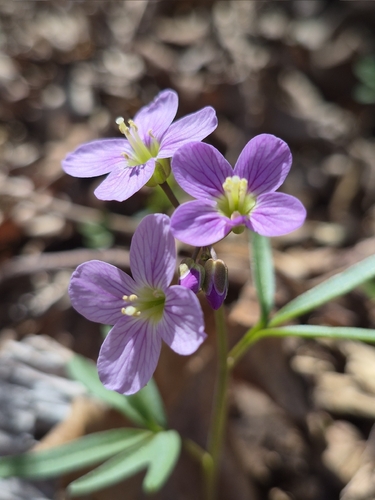


Nuttall'S Toothwort
cardamine nuttallii
Nuttall's Toothwort (Cardamine nuttallii) is a delightful, low-growing perennial wildflower native to the damp, shaded woodlands of western North America. Emerging in early spring, this vernal ephemeral blankets the forest floor with a delicate display of pale pink to vibrant purple blossoms, signaling the end of winter. It plays an important role in its ecosystem by providing early-season nectar to newly emerged pollinators and food for specialized insect larvae. Resilient and adapted to forest shade, it survives most of the year dormant underground as a small tuberous rhizome, waiting for the perfect spring conditions to briefly burst into life. For quick identification of Nuttall'S Toothwort during outdoor trips, download the Snappit app.
Habitat: Found in moist, shaded coniferous and deciduous forests, riparian zones, and damp meadows at low to middle elevations.
This small wildflower typically reaches heights of 10 to 30 centimeters. It features loose clusters of four-petaled, bell-shaped flowers that range in color from nearly white and light pink to deep rose-purple. Its green leaves are deeply divided, often presenting as three distinct leaflets that are roundish or lobed, providing a soft, textured appearance against the damp forest floor. The underground rhizomes have distinctive, tooth-like projections which give the plant its common name.
Category
PlantsRarity
Common
Danger
1/5 · Very low
Snaps
Be the first to snap!
It is one of the very first wildflowers to bloom in the Pacific Northwest, acting as an important indicator of the arrival of spring.
Its scientific genus name Cardamine is derived from the Greek word 'kardamon', referring to its spicy, mustard-like taste.
The common name 'Toothwort' comes from the small, tooth-like scales found on its underground rhizomes.
It sprouts, flowers, and sets seed rapidly in early spring before the forest canopy closes, maximizing its access to sunlight.
It spreads and regenerates using underground tuberous rhizomes, allowing it to survive dry summers and minor disturbances.
It synthesizes mustard oils to deter generalist herbivores and insect pests from feeding on its leaves.
It is a self-sustaining plant that generates its own energy through photosynthesis, absorbing light, water, and essential soil minerals.

Pieris marginalis
Serves as a host plant for the caterpillars of this native butterfly species.
Andrena spp.
Provides an essential early-spring nectar and pollen source for newly emerged mining bees.

Hedera helix
Invasive ground cover that competes aggressively for forest floor space and light.
No trait badges are assigned for this object yet.
No aliases listed yet.
Collections for this object will appear here as more themes are added.
Danger
1/5 · Very low
No special safety notes yet.
The easiest way to identify Nuttall'S Toothwort is to use the Snappit nature identifier app.
10-30 cm
0.01-0.05 kg
2-10 years
It is a self-sustaining plant that generates its own energy through photosynthesis, absorbing light, water, and essential soil minerals.
Found in moist, shaded coniferous and deciduous forests, riparian zones, and damp meadows at low to middle elevations.
Photosynthesis
Zoom in to split clusters and explore where this object has been snapped.
Recent snaps will appear here as new observations are added.