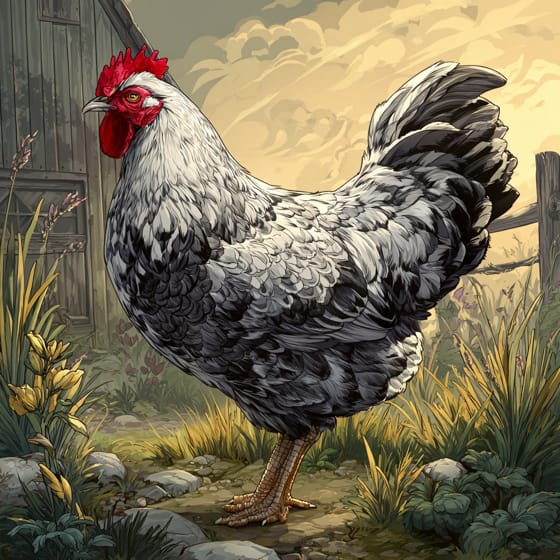





Plymouth Rock Chicken
Gallus gallus domesticus
Plymouth Rock Chickens are friendly birds known for their beautiful striped feathers. They are great for farms and love to peck around in the grass.
The Plymouth Rock Chicken is a large, sturdy bird famous for its distinctive black and white barred plumage, giving it a 'striped' appearance. It has bright red wattles and a single comb, with clean yellow legs and feet.
Category
BirdsRarity
Common
Danger
1/5 · Very low
Snaps
Be the first to snap!
Even their baby chicks hatch with tiny striped downy feathers!
Plymouth Rocks were once America's most popular chicken breed!
Their feathers are so unique, they're often called 'barring'!
They love to scratch around, finding hidden snacks in the dirt!
Plymouth Rock Chicken can lay lots of large brown eggs because it has strong reproductive instincts that help provide food.
Plymouth Rock Chicken has a robust build and dense feathers that help them tolerate various climates, from cold to warm.
Plymouth Rock Chicken has a calm and friendly temperament that makes it a popular and easy-to-manage farm bird.
An omnivore, it pecks and scratches for seeds, grains, insects, and leafy greens.
Wildlife encompasses all undomesticated animal and plant life existing in their natural habitats.
Feathered describes animals, primarily birds, possessing a covering of feathers.
Social animals live in organized groups, cooperating for survival benefits such as foraging, defense, and raising offspring.
This trait identifies organisms whose diet includes both plant and animal matter.

Colorful describes organisms or objects displaying a wide range of bright and distinct colors.

Grassland habitats are terrestrial biomes dominated by grasses and herbaceous plants, supporting a variety of grazing animals.
Danger
1/5 · Very low
Always be gentle and calm around chickens. They are friendly but can be startled easily.
The easiest way to identify Plymouth Rock Chicken is to use the Snappit nature identifier app.
45-55 cm
60-70 cm
2.9-4.3 kg
6-10 years
15 km/h
An omnivore, it pecks and scratches for seeds, grains, insects, and leafy greens.
Foraging
Zoom in to split clusters and explore where this object has been snapped.
Recent snaps will appear here as new observations are added.
Take the discovery with you
Snap it with Snappit to identify it, learn what makes it special, and add the discovery to your collection.




.jpg&width=800)









