





Rose Chafer
Cetonia aurata
Rose Chafers are shiny beetles that love to eat flowers. They are often seen in gardens during the summer!
Habitat: Gardens and meadows
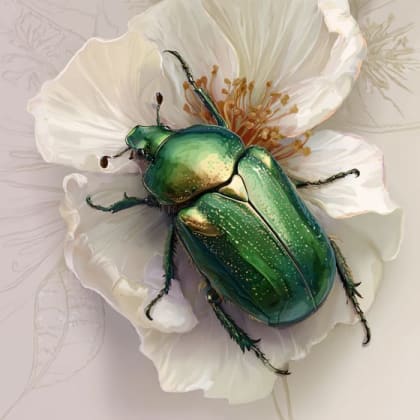
The Rose Chafer is a brilliantly metallic beetle, often appearing iridescent green with a golden or coppery sheen. It has a distinctive flattened body shape and fine white markings on its sides, making it easily distinguishable from other green beetles.
Category
InsectsRarity
Common
Danger
2/5 · Low
Snaps
3
Adult Rose Chafers are known to buzz like tiny helicopters when they fly!
Most of a Rose Chafer's life is spent underground as a hungry grub!
Their shiny green color isn't paint, but light bouncing off tiny structures!
They have special grooves in their legs to help them climb slippery plants.
Rose Chafers can fly with their hardened wing cases (elytra) closed, because of a gap on the sides that helps them launch quickly.
Rose Chafers have a vivid, iridescent green exoskeleton that helps them blend in with foliage or surprise predators.
Rose Chafer larvae can decompose dead wood and plant matter, which helps recycle nutrients back into the soil.
These beetles love to munch on sweet flower parts like pollen and nectar, and sometimes soft fruits!
Age differences: Larvae (grubs) eat decaying wood and plant matter; adults feed on flowers and fruits.
Rosa gallica
Feeds on nectar and pollen, aiding flower reproduction.
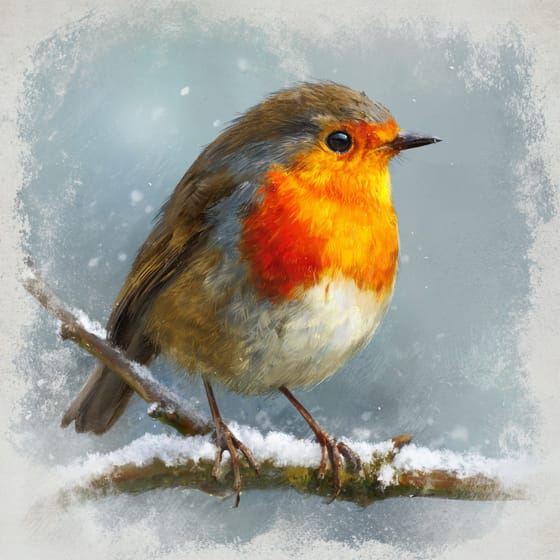
Erithacus rubecula
Birds are common predators of adult Rose Chafers.
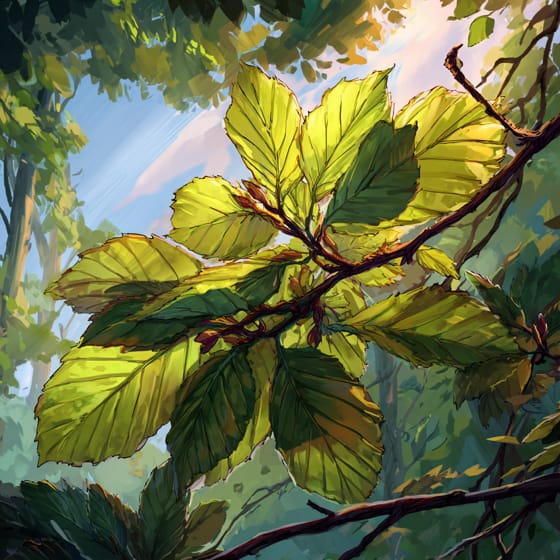
Fagus sylvatica
Larvae often feed on decaying wood of broadleaf trees.
Wildlife encompasses all undomesticated animal and plant life existing in their natural habitats.
Colorful describes organisms or objects displaying a wide range of bright and distinct colors.
This trait characterizes organisms whose diet consists entirely or primarily of plant material.
Diurnal animals are primarily active during daylight hours, typically resting or sleeping at night.

Describes organisms that transfer pollen, enabling the fertilization and reproduction of plants.
Danger
2/5 · Low
Do not touch or pick up. Some insects sting or bite. Ask an adult for help.
The easiest way to identify Rose Chafer is to use the Snappit nature identifier app.
25-35 mm
14-20 mm
30-60 days
5-10 km/h
These beetles love to munch on sweet flower parts like pollen and nectar, and sometimes soft fruits!
Gardens and meadows
Foraging
Zoom in to split clusters and explore where this object has been snapped.

England, UK
You might spot African Elephant, Bornean Orangutan, and Tiger.
View guide →
.jpg)
Ústí nad Labem Region, CZ
You might spot Bears, South American Tapir, and Macaques.
View guide →

Central Denmark Region, DK
You might spot Polar Bear, Brown Bear, and Pea.
View guide →
Take the discovery with you
Snap it with Snappit to identify it, learn what makes it special, and add the discovery to your collection.







.jpg&width=800)



