




Scissortail Rasbora
Rasbora spilocerca Rainboth &
The Scissortail Rasbora is a small, colorful fish that loves to swim in groups. They have beautiful, long tails that look like scissors when they swim!
Habitat: Freshwater rivers and streams
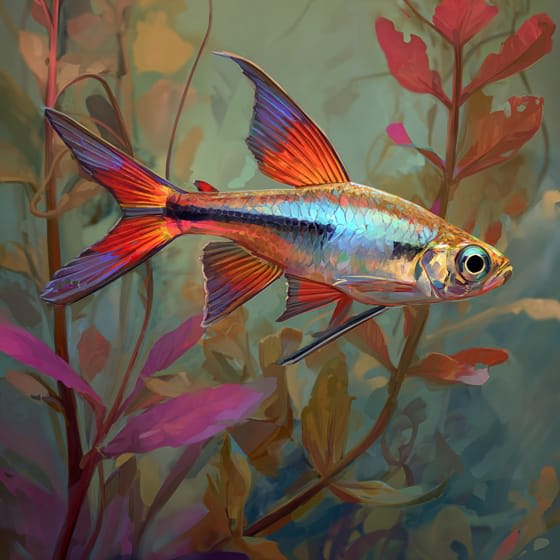
The Scissortail Rasbora has a sleek, torpedo-shaped body with a shimmery silver-gold color. Its most distinctive feature is a deeply forked tail, marked with bold black stripes on each lobe, resembling open scissors.
Category
FishRarity
Common
Danger
2/5 · Low
Snaps
Be the first to snap!
Some people call them "dart fish" because they zip around so quickly!
Their unique tail looks like scissors opening and closing when they swim!
These tiny fish can sense changes in water currents using special lines on their bodies!
They love to swim in huge groups, sometimes hundreds of them!
Scissortail Rasbora can swim in large, synchronized groups that helps them confuse predators and find food more efficiently.
Scissortail Rasbora has a powerful, deeply forked tail that helps them make quick, darting movements to escape danger.
These omnivores munch on tiny bugs, larvae, and algae to stay healthy and energetic!
Channa gachua
Larger predatory fish often hunt Rasboras in their natural habitat.
Daphnia pulex
Scissortail Rasboras feed on these tiny crustaceans.

Hydrilla verticillata
Dense aquatic plants provide hiding places and foraging grounds.
Wildlife encompasses all undomesticated animal and plant life existing in their natural habitats.
Social animals live in organized groups, cooperating for survival benefits such as foraging, defense, and raising offspring.
This trait identifies organisms whose diet includes both plant and animal matter.
Colorful describes organisms or objects displaying a wide range of bright and distinct colors.

Freshwater habitats include non-saline aquatic environments such as rivers, lakes, ponds, and wetlands, vital for numerous species.

Aquatic habitats encompass environments where organisms live predominantly in water, including oceans, rivers, lakes, and wetlands.
Danger
2/5 · Low
Watch quietly from a distance and never try to feed or chase wild animals.
The easiest way to identify Scissortail Rasbora is to use the Snappit nature identifier app.
4-6 cm
0.001-0.003 kg
3-5 years
These omnivores munch on tiny bugs, larvae, and algae to stay healthy and energetic!
7 km/h
Freshwater rivers and streams
Foraging
Zoom in to split clusters and explore where this object has been snapped.
Recent snaps will appear here as new observations are added.
Take the discovery with you
Snap it with Snappit to identify it, learn what makes it special, and add the discovery to your collection.