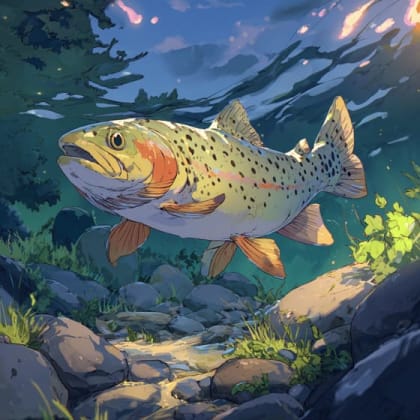
Lake Trout
Salvelinus namaycush
The Lake Trout is a large fish that lives in deep, cold lakes! They have a unique marbled pattern on their skin.
Habitat: Deep, cold freshwater lakes
The Lake Trout has a sleek, torpedo-shaped body, typically dark grey to olive-green with distinct cream or yellowish spots. Its most notable feature is a deeply forked tail, helping it cut through cold waters.
Category
FishRarity
Common
Danger
2/5 · Low
Snaps
3
Lake Trout are important 'indicator species,' showing us if a lake's health is declining.
Lake Trout can live longer than almost any other trout, often reaching 25+ years!
The largest Lake Trout ever caught weighed 102 pounds, heavier than a small human!
They are the deepest-dwelling of all salmonids, living hundreds of feet below the surface!
Lake Trout can live in frigid, deep waters because their bodies are adapted to low oxygen and high pressure.
Lake Trout has excellent vision that helps them hunt prey effectively in the dim light of deep lakes.
Lake Trout has a unique metabolism that helps them thrive and conserve energy in freezing cold lake environments.
Lake Trout are fierce hunters, eating mostly smaller fish, insects, and crustaceans!
Age differences: Younger trout eat small invertebrates, while adults primarily hunt other fish.
Coregonus clupeaformis
A primary prey fish.
Mysis diluviana
An important food source.

Ursus arctos
During spawning migrations.
Petromyzon marinus
An invasive parasite.
Colorful describes organisms or objects displaying a wide range of bright and distinct colors.
Piscivorous organisms are animals that primarily subsist on a diet of fish.
This trait signifies organisms belonging to a very old evolutionary group with ancestors dating back millions of years.
This trait characterizes organisms with an exceptionally long lifespan compared to others of their kind.

This trait identifies organisms whose diet consists entirely or primarily of animal tissue.

Freshwater habitats include non-saline aquatic environments such as rivers, lakes, ponds, and wetlands, vital for numerous species.

Regenerative organisms possess the ability to regrow lost or damaged body parts, tissues, or organs.

Aquatic habitats encompass environments where organisms live predominantly in water, including oceans, rivers, lakes, and wetlands.
Danger
2/5 · Low
Watch quietly from a distance and never try to feed or chase wild animals.
The easiest way to identify Lake Trout is to use the Snappit nature identifier app.
40-100 cm
1-10 kg
10-25 years
Lake Trout are fierce hunters, eating mostly smaller fish, insects, and crustaceans!
10 km/h
Deep, cold freshwater lakes
Pursuit
Zoom in to split clusters and explore where this object has been snapped.

Wyoming, US
You might spot Elk, American White Pelican, and Arrowleaf Balsamroot.
View guide →

Michigan, US
You might spot Common Merganser, Tansy, and American Herring Gull.
View guide →
Wyoming, US
You might spot Moose, Black Bear, and Sticky Geranium.
View guide →
Take the discovery with you
Snap it with Snappit to identify it, learn what makes it special, and add the discovery to your collection.